
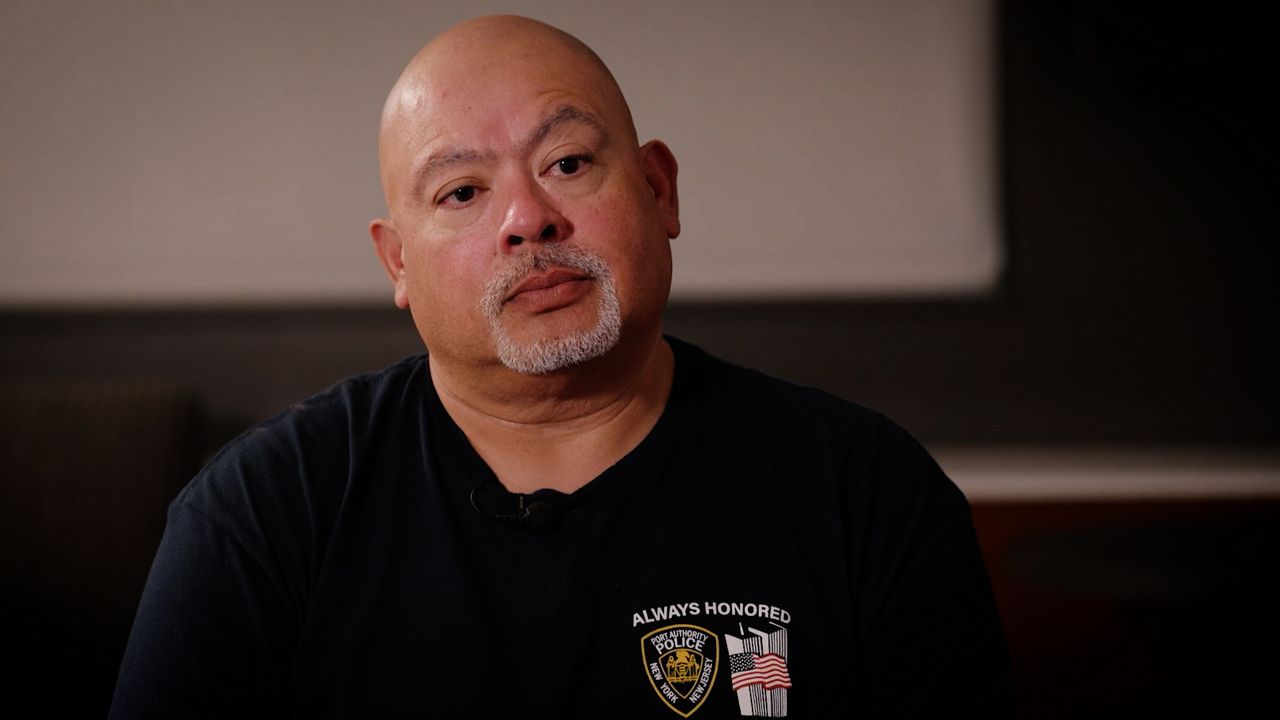
The call came in for all Port Authority police officers to go back to the police desk. Will Jimeno, who had just graduated from the academy eight months earlier, knew something seriously wrong must be happening.
In the reserve room, he saw NY1 reporting on the breaking news that American Airlines Flight 11 had slammed into the north tower of the World Trade Center.
At that time, many people thought it was an accident. But one of Jimeno’s fellow officers did not.
“Sergeant Ross, who had actually seen the plane out on 42nd Street and Eighth Avenue fly over us, he said, those are terrorists,” Jimeno told NY1.
The Port Authority had a command center at the World Trade Center, Jimeno said, since it owned the buildings.
“We were going down there to help evacuate and help our brothers and sisters get more people out,” he said.
A bus took about 20 officers from the bus terminal on 42nd Street down to lower Manhattan.
“I stepped off the bus. And when I looked up and saw the big black hole, and all the papers and the destruction, I never thought that I would see war on U.S. soil,” said Jimeno, who had served in the Navy. “And that’s what I thought. We’re at war.”
At this point, the south tower had also been struck by United Airlines Flight 175. But Jimeno had no idea at the time.
“When we got there, we only thought that Tower One was in distress, not Tower Two,” Jimeno said. “I had seen the big, black gaping hole in Tower One, and I saw the corner of Two on fire. So I thought in my head, OK, the plane hit, blew up, deflected some debris.”
And he knew the situation in the buildings was dire when he saw people jumping.
“They were jumping by themselves. They were holding hands, and they would disappear behind buildings,” he said.
But he also noticed something else: civilians helping one another out. He specifically remembers two men carrying a woman out of one of the towers who had a severe cut on her leg.
“And I thought to myself, if these civilians can be this brave, us in uniform, we really need to step it up,” he said.
That’s when Sgt. John McLoughlin came to the bus looking for volunteers: Who knew how to use Scott Air-Paks?
Those help first responders breathe fresh air in dangerous environments with smoke or toxic chemicals.
His team would be going into the World Trade Center.
Jimeno said in the academy, they learned how to use the Scott Air-Paks, since they cross-train on firefighting.
That’s why he, Dominick Pezzulo and Antonio Rodrigues volunteered. They were all in the same academy class.
“We started running toward the buildings, which was very dangerous,” Jimeno recalled in an interview with NY1 this summer. “It was scary. There were pieces of the plane, concrete, unfortunately, human remains.”
McLoughlin’s team headed into the concourse underneath the north and south towers. That’s where they saw Officer Christopher Amoroso, who joined them in their mission.
“We were making our way back from Tower Two to Tower One, and we were down this hallway when the explosion happened,” Jimeno said.
At the time, he had no idea what was happening.
In fact, he said McLoughlin saw the wall of debris heading right for them and thought it was a car bomb.
“It was a miracle there was a doorway to our right. So he said, run, run to the freight elevator, because he thought, if we can get to that elevator, the elevator beams might deflect the explosion around us,” Jimeno explained.
He said it sounded like a million freight trains heading for them.
“The roar of the devil,” he said. “That’s how powerful it was, how violent it was. And it’s something I’ll never forget.”
And then: silence.
The five Port Authority police officers were among the many in and around the south tower, buried underneath more than 110 stories of rubble.
“There was a hole about 30 feet above me. It was letting light in, and I could see how bad I’m buried,” Jimeno said.
McLoughlin immediately shouted for the four officers. Jimeno responded. So did Pezzulo.
That was it.
“I started calling Antonio Rodrigues by his nickname, A-Rod. And Chris Amoroso, just called him Chris. And I yelled their name for, like, two minutes, and Dominick said, ‘Willie, they’re in a better place,’” Jimeno said.
Jimeno admitted he was afraid when he got to the World Trade Center site initially. But being buried? He wasn’t afraid anymore.
“It really switched over to survival. It switched over to, what can I do to try to get out of here?” he said.
Jimeno had a giant piece of concrete pinning him down. He couldn’t move. He said he couldn’t see McLoughlin, but later learned he was trapped in a fetal position, his helmet stuck in debris.
Pezzulo was in a pushup position, debris surrounding him, according to Jimeno, but he was able to free himself, basically crawling over Jimeno’s face. That’s how little room they had between them.
“[Pezzulo] looked up and he could see the hole, the one hole that was letting light come in,” Jimeno said. “And he had told [McLoughlin], ‘I can go up for help.’ And Sergeant McLoughlin said, ‘No, you got to get Jimeno out.’”
While it is known not to leave someone behind in law enforcement, Jimeno said he and Pezzulo had an honest conversation.
“He’s like, ‘Well, I got a family home.’ I said, ‘Bro, I got a family, a home and a baby on the way,’” Jimeno remembered. “And we talked about it. It’s just natural. We’re human beings.”
Instead of going out of the hole, Pezzulo worked to get Jimeno out. Jimeno was stuck.
That’s when Jimeno said that same roar happened.
He had no idea the north tower was collapsing on them, too.
“I thought I was going to die,” Jimeno said.
As more concrete buried him further, Jimeno said he thought he had moments left to live. He said he thought about his wife, Allison, who was seven months pregnant, and his 3-year-old daughter, Bianca.
He said at home, he would often use sign language to tell them “I love you.”
“I took both my hands, crossbow in my chest because I figured if they find me, they’ll let Allison know that this is the way I found her,” he told NY1, showing the sign for “love you.” “They found me. And, she would know. In my last moments, I was thinking of her and my family.”
But when the roar turned to silence, Jimeno was still alive.
McLoughlin’s screams of pain had gotten louder.
And then there was Pezzulo. He got hit by debris and was badly injured.
“He said, ‘I love you, Willie. Don’t let anybody forget that I died trying to save you guys,’” Jimeno recalled. “I said, ‘Dominick, I would never let anybody forget that.’”
Pezzulo took his gun and fired it once at where the hole was in the debris, hoping someone above would hear that and save them, Jimeno shared.
It was a final act to save his brothers in blue. And then, Pezzulo passed away.
McLoughlin told Jimeno they could soon die, too.
“If they don’t get to us by the morning, our bodies are going to shut down,” he said his sergeant told him.
He said he tried to think positive thoughts and think about his family. But it felt like an eternity.
“It’s like having 80 Chevy Suburbans placed on one side of your body,” he said. “That’s how much pressure was on me.”
And at one point, he was ready to give up.
“We had been crushed. We had been burnt. Dominick’s gun later fired in the hole. We had bullets flying around,” he said. “I was ready to give up that evening, and I made my peace with God.”
He said he had a vision that changed everything.
“I see a person with a white, glowing robe coming toward me. I couldn’t see his face. Just brown hair,” Jimeno said. “Over one shoulder was a tranquil lake and trees. Over the other was tall, endless grass. And he’s coming toward me, and I know it is. To me, it’s Jesus.”
He snapped out of the vision and said he had the resolve to keep fighting.
“Every second. We really had to push. So when you say, what does it take to survive? It takes a lot of willpower and it’s something that everybody has,” he said. “You just have to dig down deep and find it.”
He and McLoughlin would talk to each other to stay awake and positive.
After 10 hours, Jimeno said he heard something above him: United States Marine Corps. “Can anybody hear us?”
Rescuers were able to find Jimeno. He said they told him afterward it looked like he had been dumped in concrete.
That began the three-hour process of getting him extracted from a hole so small Jimeno could only see two heads staring back at him.
But Jimeno was still in danger.
“They put an oxygen mask on me to get me some air, because I started to hyperventilate,” he said.
With so many fires still burning on the site, Jimeno said the three rescue workers trying to get him out were ordered to leave him, because there was a fire nearby.
“They thought we weren’t going to make it. And these guys said, ‘No, we’re not leaving them,’” Jimeno said, noting they risked their own lives to get him out.
Jimeno said the three were NYPD Detective Scott Strauss, NYPD Detective Patrick McGee and paramedic Chuck Sereika.
When he was finally extracted, Jimeno saw what happened for the first time.
“I saw the moon. I couldn’t see the buildings. I said, ‘Where is everything?’ And that’s when the firefighters said, ‘It’s all gone, kid.’ And that’s the first time I cried,” Jimeno remembered.
He was transported to Bellevue Hospital. On the way, he asked the paramedics: Where are the other people rescued?
The response: He was it.
Jimeno said he started crying again.
In all, 18 people were rescued from the rubble, including Jimeno and McLoughlin.
He almost didn’t survive the night, telling NY1 he flatlined twice in the emergency room. When he woke up, his wife, Allison, was next to him.
“I kind of made the ‘I love you’ sign with my hand, but my hands were so swollen,” he said.
He had been crushed and diagnosed with compartment syndrome, which could have been fatal.
Jimeno has a brace on his left leg to this day.
Going home, he said, was a challenge. One that Allison quickly noticed.
Jimeno said he was diagnosed with post-traumatic stress disorder.
“Why am I alive? Why isn’t Dominick [Pezzulo], Antonio [Rodrigues], Chris [Amoroso], Bruce Reynolds, Dave [Lemagne], I can keep going on the list of people,” he said. “Why aren’t they here?”
Jimeno said he thought about taking his own life multiple times.
But he said he didn’t get help until one day, when he said he was ready to throw a shoe at Allison for not moving fast enough to find the remote control he wanted.
He said he stopped himself, jumped into his truck and drove off.
“I told myself, there’s something wrong with you,” he said. “But I don’t know what it is.”
He said work with a therapist helped him.
“The day I’m done with 9/11 is the day they burn me,” Jimeno said. “But up to that point, I have to be able to live with it.”
He said he never planned on sharing his story. That is, until about two years after 9/11, when one of his neighbors in New Jersey asked if he would consider speaking to his child’s school.
“The kids are afraid to get on planes,” the parent told him.
Jimeno told his story to the students.
Other schools then started requesting Jimeno speak. It has since snowballed to universities and military groups, Jimeno said.
“On September 11th, we weren’t able to get people out ourselves. Our team, we went in there and then we needed to get taken out,” he said. “But years later, because of our story or the film ‘World Trade Center,’ it’s helped people.”
Several times, people have told him that his story saved their life. He even decided to write two books to try to help people as they navigate their trauma.
Jimeno is still in touch with McLoughlin.
“He’s not only a friend, he’s family,” Jimeno said.
He has stayed in touch with some of the families of the Port Authority officers who died in the collapse. But for all of them, Jimeno said he keeps the promise he made Pezzulo nearly 25 years ago.
He will always share their stories and say their names.
“I want people to never forget. And it’s a promise we made,” he said. “And it’s a promise that I will always keep personally, ‘til the day I die.”