
In the aftermath of the Triangle Shirtwaist Fire, labor leader Rose Schneiderman somberly observed that “the life of men and women is so cheap and property is so sacred.”
More than a century later, she could have been addressing the familiar argument that New York’s construction workers are hearing today: Keeping them safe costs too much.
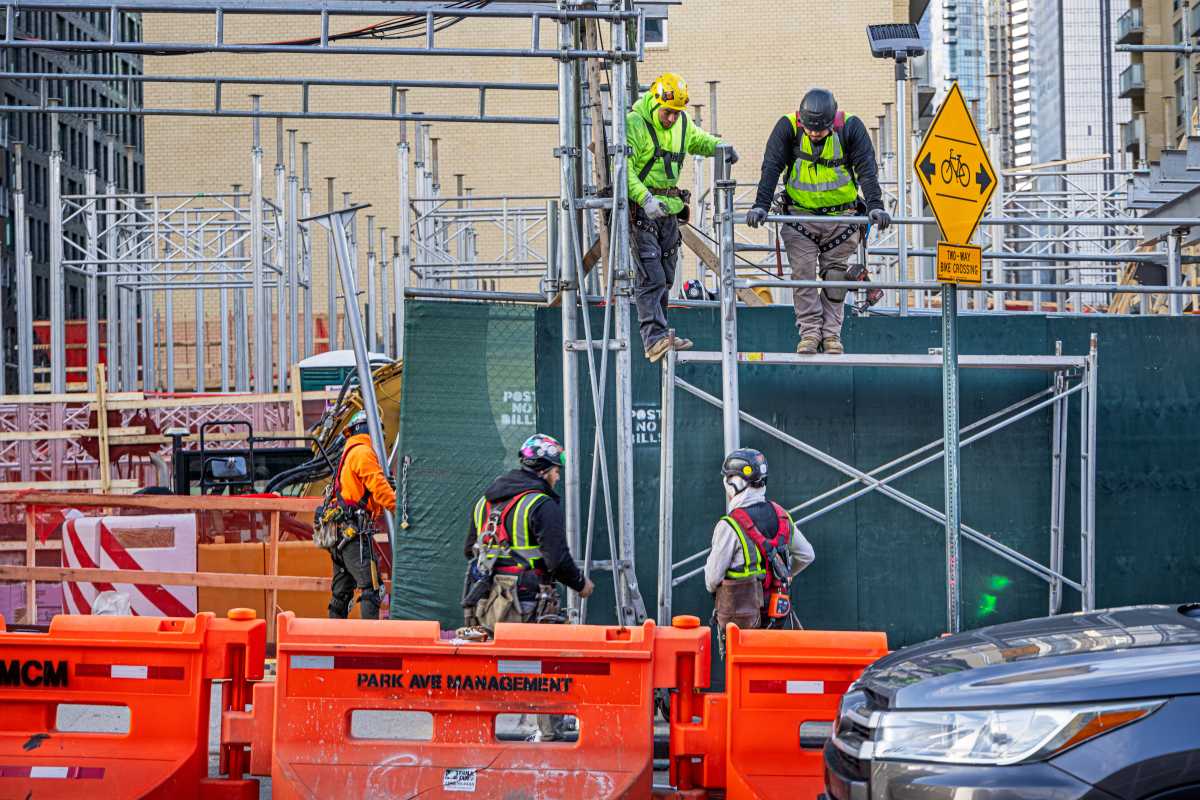
New York’s Scaffold Safety Law requires owners and contractors to provide proper safety protections for construction workers who face some of the most dangerous conditions that would terrify many of us: working at heights. The law reflects a basic principle of workplace safety: Those who control the job site, set the conditions and have the power to prevent a fall should and must be held responsible if they fail to protect workers. It ensures that the consequences of an unsafe job site are not simply pushed onto an injured worker and their family.
Now, insurance and real estate interests are blaming worker protections for high construction costs. But data reported to insurance regulators and compiled by the National Association of Insurance Commissioners (NAIC) undermine that claim and prove that the Scaffold Safety Law is not driving up liability costs. In 2025, New York insurers paid roughly 50.6 cents in claims for every dollar of liability premium collected, compared with 60.9 cents in Illinois and 58.5 cents in Texas. Illinois repealed its comparable worker safety law in 1995. Three decades later, Illinois insurers still pay out a greater share of liability premiums in claims than those in New York.
The human cost of weakening worker protections is real. The supposed financial case for doing so is invented.
 Charlene Obernauer is Executive Director of the New York Committee for Occupational Safety and Health, or NYCOSH.
Behind this debate are workers like a 56-year-old roofer who fell 18 feet to his death through an unguarded skylight while working on a Town of Oyster Bay construction site in August 2021. The Occupational Safety and Health Administration (OSHA) found the company had provided no fall protection to any of the eight employees on that roof, and had already been cited seven times since 2011 for the same hazard, a pattern OSHA called a “serial” violation. The private company finally agreed to pay $600,000 in January 2026. But this money went to the federal government, not to his family.
In this case, the Scaffold Safety Law guarantees that the workers’ family can hold the employer accountable in court. For a family that lost the income of their main breadwinner the day he fell from that roof and died, the Scaffold Safety Law is the only path to avoid financial catastrophe.
Our Deadly Skyline report shows that 55 construction workers died in New York State in 2024. Falls remain one of the greatest dangers, accounting for half of New York City construction-related incidents in 2024. Year after year, our data show that more than 80% of the time, these deaths occur on nonunion job sites – proof that the workers most likely to be killed on the job are the ones with the least power to demand protection on their own. The workers with the least power on a job site should not have the fewest protections. The Scaffold Safety Law follows every worker onto every site, union or not, and unions have long supported it.
Responsible contractors and workers are not adversaries. Both have an interest in safe job sites and an insurance system that pays claims.
Across New York, workers and families live with the consequences of injuries and accidents long after a construction project is finished. But the answer to an affordability crisis is not making dangerous work more dangerous.
When a worker is catastrophically injured, the cost does not disappear. The question is whether responsibility rests with those who profit from the work, or is shifted onto injured workers, their families and the public. If a worker is injured or dies on the job, that worker deserves justice. And the Scaffold Safety Law makes this possible.
Labor Day is a reminder of what workers like Rose Schneiderman fought for: that a worker’s life should never be treated as simply another cost of doing business.
Charlene Obernauer is Executive Director of the New York Committee for Occupational Safety and Health, or NYCOSH.