
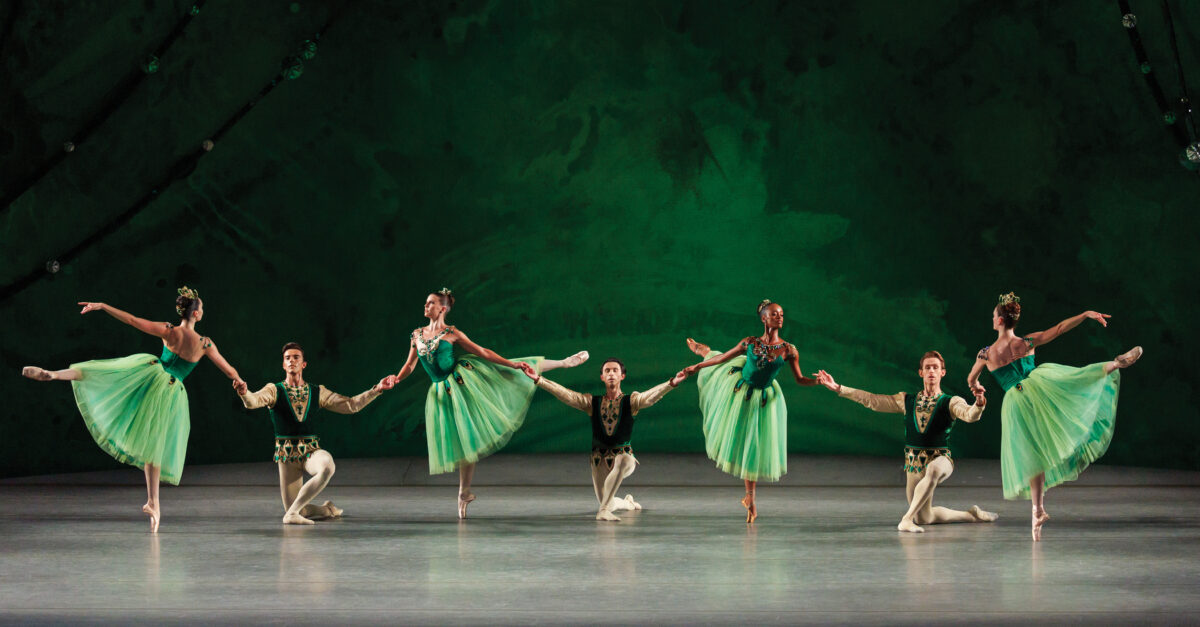
Debuting in 1967, George Balanchine’s Jewels was a smash hit. Writing for The New York Times, amidst an abundance of effusive praise, dance critic Clive Barnes went so far as to claim, “It is open to doubt whether even George Balanchine has ever created a work in which the inspiration was so sustained, the invention so imaginative or the concept so magnificent.” New York City Ballet Co-founder Lincoln Kirstein said, “The very title sounded expensive before any step was taken,” and the glitter and glam paid out in gold.
The story of the ballet’s inception is well-known, and characteristic of Balanchine’s instincts, which were often as artistically innovative as they were commercially sound. In 1955, world-renowned violinist and Russian émigré Nathan Milstein hosted his close friend Balanchine and the businessman Claude Arpels, Jr.; over dinner, they discussed gemstone mining as the potential creative impetus for a new ballet. More than a decade later, Balanchine visited the Fifth Avenue salons of Van Cleef & Arpels and, as Kirstein noted in the 1967 program notes, “So impressed was Mr. Balanchine by the beauty of the jewels he saw there that he decided to try to capture it forever.” NYCB had moved to the New York State Theater, with its vast stage, just three years prior. The idea of coupling a large cast with the sparkle of jewels, and expansive footwork to bring them to radiant life, was quite attractive.

George Balanchine’s Jewels, “Diamonds,” performed by the New York City Ballet
(Erin Baiano)
Amidst the landscape of popular ballets—productions like The Nutcracker or The Sleeping Beauty, for example—Jewels is uniquely abstract, and is generally considered the first evening-length, plotless ballet. At its debut, Jewels was presented with-out an overarching title; the program included only the simple, one-word names for each of the three sections: “Emeralds,”“Rubies,” and “Diamonds.” (In keeping with his general approach to such matters, Balanchine declined to provide further explanation for the “meaning” of the ballet, insisting that “The ballet had nothing to do with jewels. The dancers are just dressed like jewels.”)
The ballet begins, with “Emeralds,” in France, where Balanchine danced and choreographed for the Ballets Russes under the impresario Serge Diaghilev, and where Kirstein first witnessed Balanchine’s work. This section is scored to excerpts from Gabriel Fauré’s incidental music for the 1898 Maurice Maeterlinck play Pelléas et Mélisande and for Edmond Haraucourt’s 1889 play Shylock, adapted from Shakespeare’s The Merchant of Venice. Though Fauré never achieved the popularity of Claude Debussy, who, along with Impressionism as a classical genre, succeeded Fauré, the earlier composer’s noble and crystalline approach to these pieces evokes “the France of elegance, comfort, dress, perfume,” per Balanchine. This sense of reminiscence and romance permeates the choreography as well, with languid footwork and expressive arm movements that recall the French ballets of the 19th century, and Karinska similarly turned to the Romantic era for the costumes.

George Balanchine’s Jewels, “Rubies,” performed by the New York City Ballet
(Erin Baiano)
Following “Emeralds,” “Rubies” bounds onto the stage with the vibrancy and immediacy of jazz-age America. For this section of the ballet, Balanchine selected Stravinsky’s 1929 Capriccio for Piano and Orchestra, which Kirstein called “One of the liveliest of [the composer’s] neo-classic works.” Stravinsky had originally composed the piece as a solo for himself when he was touring as a pianist; he relied on the 16th-century German theorist Michael Praetorius’s definition of a capriccio as “a fantasy with a freely organized form allowing flights of imagination.” Thus the piece is playfully alive with the influences of American jazz, showtunes, and other popular stylings, and reflects Balanchine and Stravinsky’s shared embrace of their new home’s unique artistic contributions. By the time he’d begun work on “Rubies,” Balanchine had already collaborated directly with Stravinsky, in America, on Orpheus (1948) and Agon (1957), and used a healthy number of Stravinsky’s pieces for ballets, including for the similarly watershed Firebird in 1949. Their relationship was well established, and their shared history of relocations to France and then the United States only served to further strengthen the bond. Karinska carried this expat enthusiasm into the flapper-esque costumes, which feature headdresses for the women that are notably similar to the Statue of Liberty’s crown.
With “Diamonds,” the sensational finale of Jewels, the ballet shifts to the earliest phase of Balanchine’s creative life—the city of St. Petersburg, the Mariinsky Theater, and the Imperial Ballet of his youth. For such regality and nostalgia, the choreographer turned to the quintessential Russian ballet composer: Peter lyitch Tschaikovsky. Composed in 1875, around the same time as Swan Lake, “Tschaikovsky’s third symphony is not as familiar as his later ones,” wrote Kirstein, “but its full-blown majesty and dominating melodies recommend it as music for the great panoply of the opera-house stage.” For “Diamonds,” Karinska invented the “powder puff” tutu; the combination of a shorter tulle skirt with a wired hoop lends the dancers a dreamy, floating quality. The look befits the way in which “Diamonds” is both looking backward, and facing beyond; it is a work that symbolizes timelessness, as much as Balanchine’s personal past.
Jewels are by their very nature fixed, hard-edged objects of unchanging beauty. And yet, what the dancers and audiences of Balanchine’s Jewels have remarked upon so frequently is the freedom the ballet exemplifies: as a representation ofBalanchine’s history of relocations and avant garde artistic innovations—and often surprising musical choices—and as a canvas for our collective imaginings throughout its distinctive three movements. In 1983, Arlene Croce wrote in The New Yorker that Jewels is “unsurpassed as a Balanchine primer, incorporating in a single evening every important article of faith to which this choreographer subscribed and a burst of heresy, too.” That push and pull of window-display sparkle and unbridled, dazzling expression ensures that the ballet’s allure will continue far beyond its 60th anniversary this season.
Visit NYCBallet.com.