
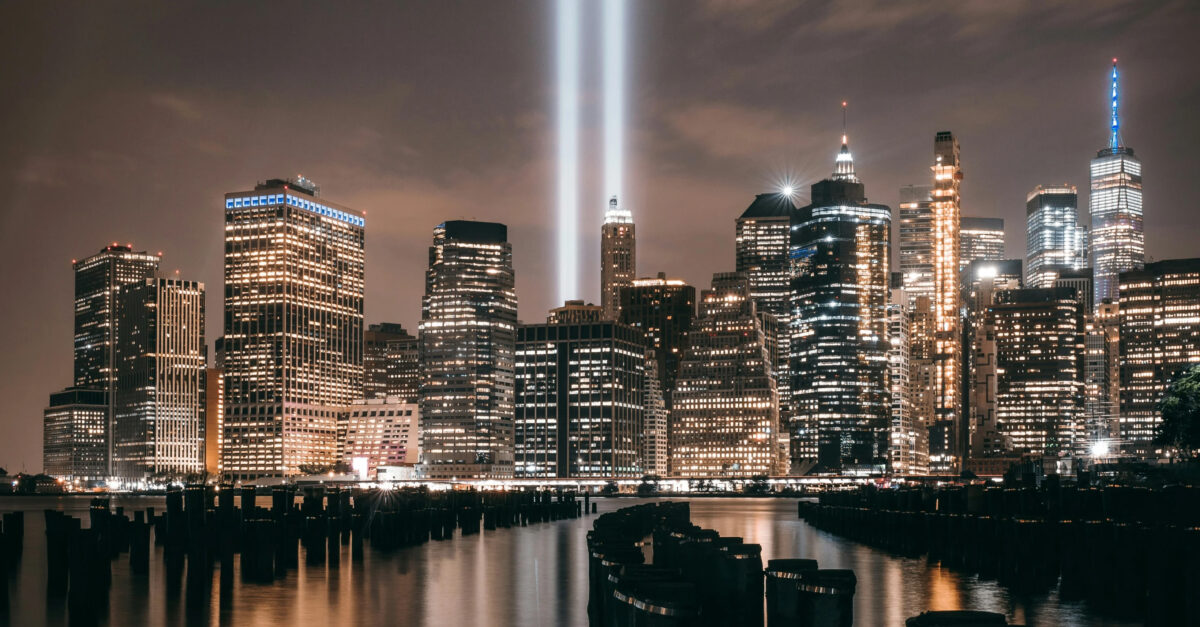
Twenty-five years after the tragedy of 9/11, the New York Philharmonic and Tang Music & Artistic Director Gustavo Dudamel offer commemoration and consolation through music on September 11 at Ground Zero, at the Perelman Performing Arts Center, and on September 16–18 and 19 with John Adams’s On the Transmigration of Souls in David Geffen Hall. This is far from the first time that the Orchestra has played a vital part in marking a pivotal moment in history.
On September 20, 2001, then Music Director Kurt Masur conducted Brahms’s A German Requiem in a concert that did more than raise money for disaster relief. Screened free of charge on Lincoln Center’s Josie Robertson Plaza and broadcast nationwide, it served a larger, farther-reaching purpose, acting as a ceremony of grief and resilience for a public facing unimaginable loss.
A year later, the Orchestra premiered On the Transmigration of Souls, co-commissioned by the Philharmonic and Lincoln Center. Through a litany of names as well as snippets from posters reflecting the desperation of those seeking loved ones, it’s a piece that remembers both those who were lost and the time itself. Adams described the work as “a ‘memory space,’ where you can go and be alone with your thoughts and emotions.” In returning to the piece a quarter-century later, both in New York and on a Euro-pean tour in October, the Orchestra is bringing this “memory space” to listeners who may have their own memories, and also to those too young to have witnessed the events firsthand.
“It’s one of those events in life where every-body remembers exactly where they were and what they were doing,” Philharmonic Principal Associate Concertmaster Sheryl Staples says of 9/11. She remembers the Brahms concert as being “just so powerful. Masur asked that there be no applause, and that brought the feeling of doing something so meaningful. A sa musician, when some huge tragedy occurs, it’s easy to wonder, ‘What am I doing here? I’m just playing my violin,’ but then I think about Bernstein’s response to President Kennedy’s assassination: ‘We will make music more intensely and more beautifully and more devotedly than ever before.’”
The Brahms was meaningful in the moment; the Adams represented a step toward rebuilding, cementing how the Philharmonic can act on Bernstein’s idea. “A year later we had enough space that we could handle listening to that,” Staples believes. “It becomes very important to remember, especially for those who don’t have that immediate personal memory.”
Music can be a time machine: composers’ notes on the page document a set of instructions, which might be hundreds of years old; performers bring them to life in the present. Philharmonic trumpet player Thomas Smith, who also was in the Orchestra at the time, considers the players who have joined the Orchestra since these two powerful performances, without memories of that time. “Hopefully,” Smith says, “we can shed some light on it, take a little bit more out of it than just the notes on the page.”
Smith explains that musicians are curious about the history behind the music: “They’ll read up on the events, or ask of their older colleagues, ‘What was going on?’” Music is not just a way to commemorate a piece of history, but, through sound, he feels it can evoke that time for newer New Yorkers who didn’t directly experience this tragedy. He recalls something acute from the Philharmonic’s collective memory: the sequence of funeral cortèges, one for each of the dozen fallen firefighters from Engine 40 / Ladder 35 firehouse, located around the corner from David Geffen Hall. Almost 100 years earlier, Philharmonic Music Director Gustav Mahler witnessed a fireman’s funeral—the steady drum stroke stuck in his mind and reappeared in his unfinished Symphony No. 10.
Music brings people together, not only in the present but also across time. Music remembers.
Visit NYPhil.org.