
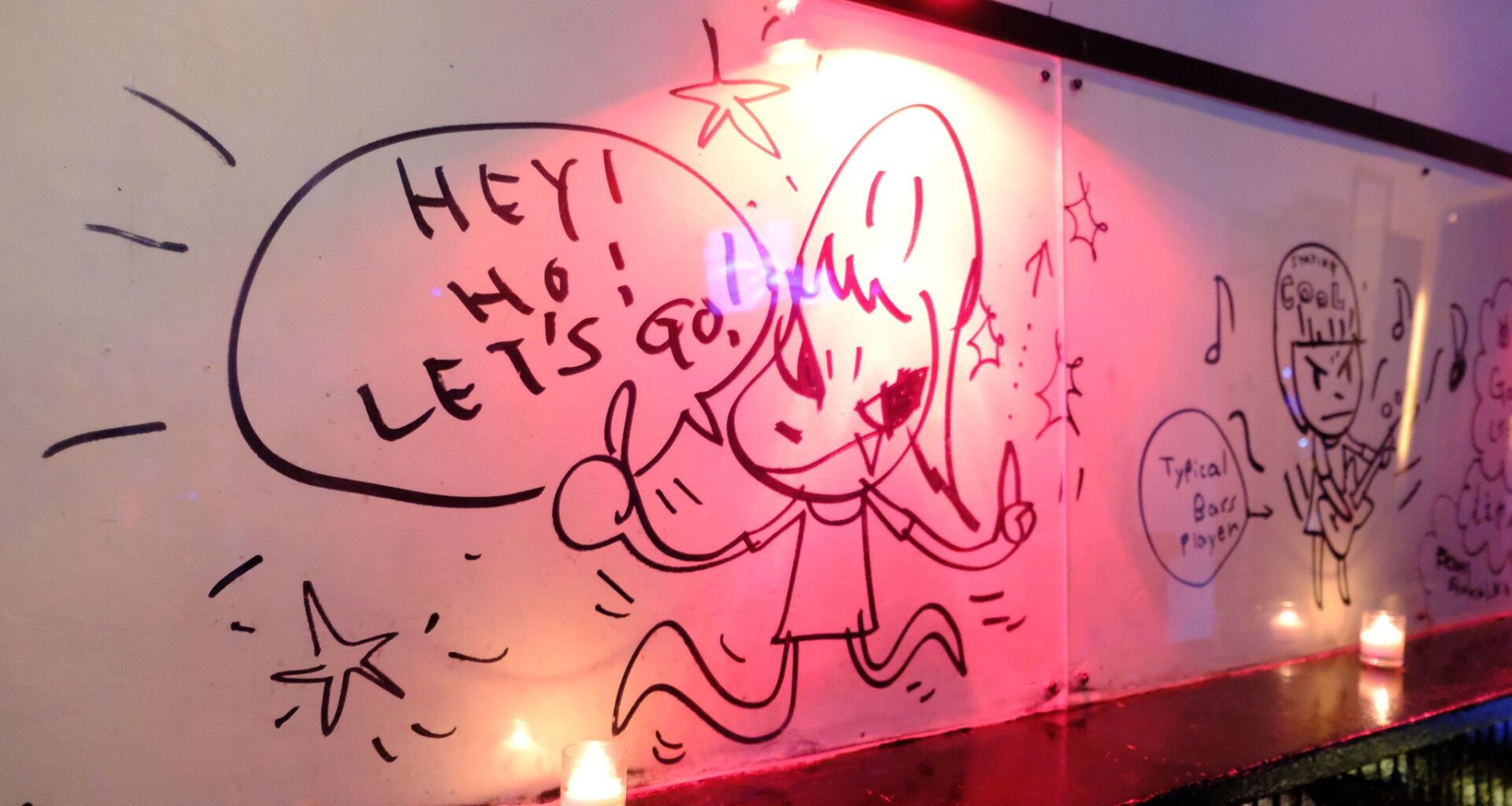
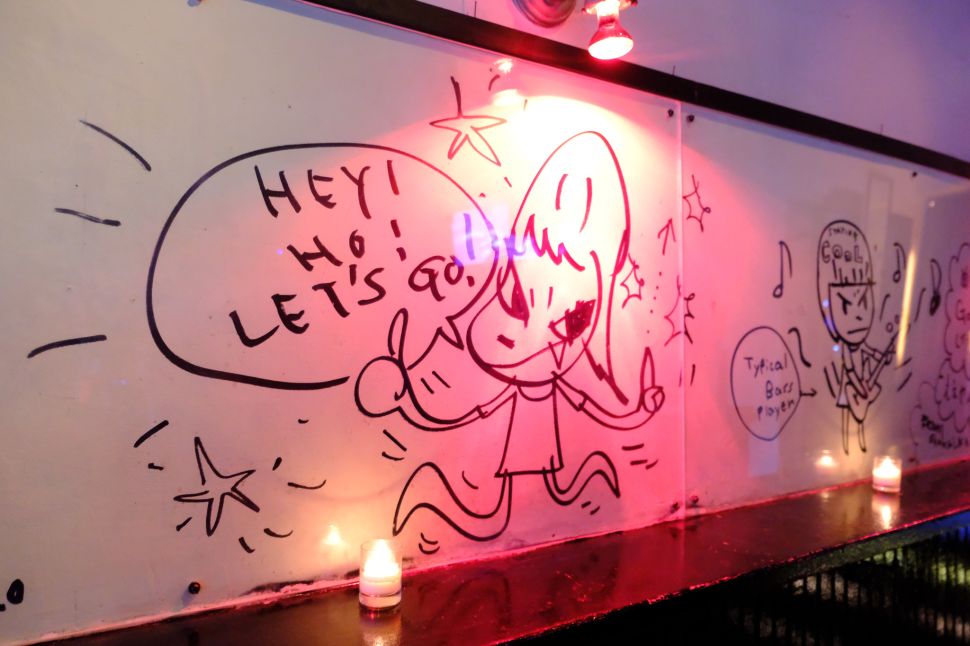
 An angry punk rock singer is among the drawings created by Yoshitomo Nara on the walls of Niagara in New York’s East Village. Photo by Jamie Lubetkin
It’s a warm summer afternoon in New York’s East Village, happy hour, in fact, inside Niagara, a divey joint with a punk rock pedigree that is announced by the mural of Clash frontman Joe Strummer on one of its exterior walls. Inside, a few patrons are taking advantage of the bar’s specials: $5 draft, $5 wine, $5 well shots. The scenery inside is typical of such establishments. The bar runs along one wall of the long, narrow main room; there are a half dozen beer taps offering up Guinness, Brooklyn Lager, Miller; an ample array of booze is stacked on glass shelves behind the bar; and a convivial server stands at the ready. This is very common stuff along Avenue A. But if a patron were to look over their shoulder, they’d be in for a wholly uncommon encounter with unfiltered contemporary art in the form of drawings by Yoshitomo Nara.
One of the world’s most successful living artists, Nara’s paintings routinely sell for tens of millions of dollars. But in 2009 on the eve of a New York gallery show, he committed marker drawings on the walls of Niagara—an enduring gift from the artist to the neighborhood’s punk rock underground. A sort of thank you for the inspirational music and cultural disruptions that came out of the East Village when Nara was a teen coming of age in Hirosaki, Japan. Since that night at Niagara, Nara has had repeated New York successes: major gallery shows, 130 pieces in MoMA’s collection and multimillion-dollar sales at New York auction houses.
Now, 17 years after he made the Niagara drawings, Nara returns to New York a superstar, one of only a handful of living artists to have cracked the $25 million mark for a single painting. A year after he signed on with David Zwirner, the gallery is clearing out both of its spaces in Chelsea for a massive solo show opening in late October that will highlight Nara’s newest paintings and drawings, along with sculptures and earlier works selected for the show by the artist himself. The opening comes just days before the Smithsonian’s Hirshhorn Museum and Sculpture Garden opens “Yoshitomo Nara: Sentinels of Stillness,” an exhibition of three new monumental Nara sculptures.
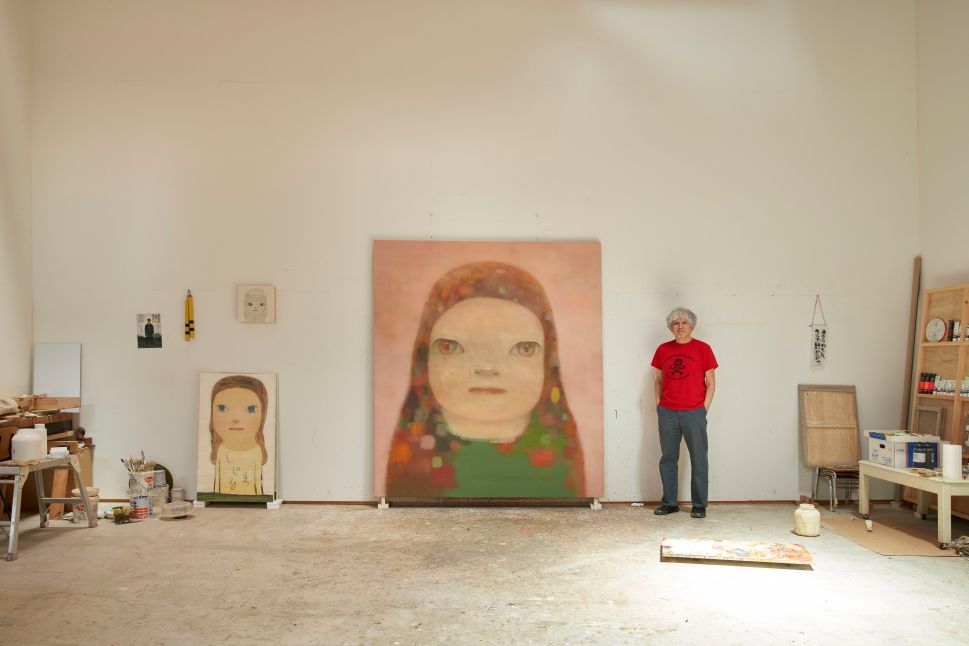 Yoshitomo Nara in his studio, 2026. Photograph: Keita Saiki, Artwork: Yoshitomo Nara
Zwirner’s Chelsea real estate is some of the finest gallery space in New York: big, beautiful white cubes, but white cubes nonetheless. Sometimes sweeping gallery retrospectives, museum acquisitions and auction sales are not enough to take the full measure of an artist, especially one like Nara who identifies with the rebellious outsiders of lower Manhattan. Works in the wild, like those in Niagara, help complete the picture.
“He’s an avid consumer of popular culture… he’s someone who’s been very influenced by film, music, the myth of America, if you will, and New York played a huge role in that,” Pedro Alonzo, an independent curator who specializes in art that exists beyond museum walls, told Observer. Alonzo curated Nara’s 2021 career survey at Dallas Contemporary and added that Nara was inspired from an early age by the city’s downtown culture, “particularly the burgeoning punk scene with the Ramones, CBGBs, all of that, those were mythical to a young Japanese kid who was drawing in his notebook.” CBGBs, by the way, was just a few blocks from Niagara.
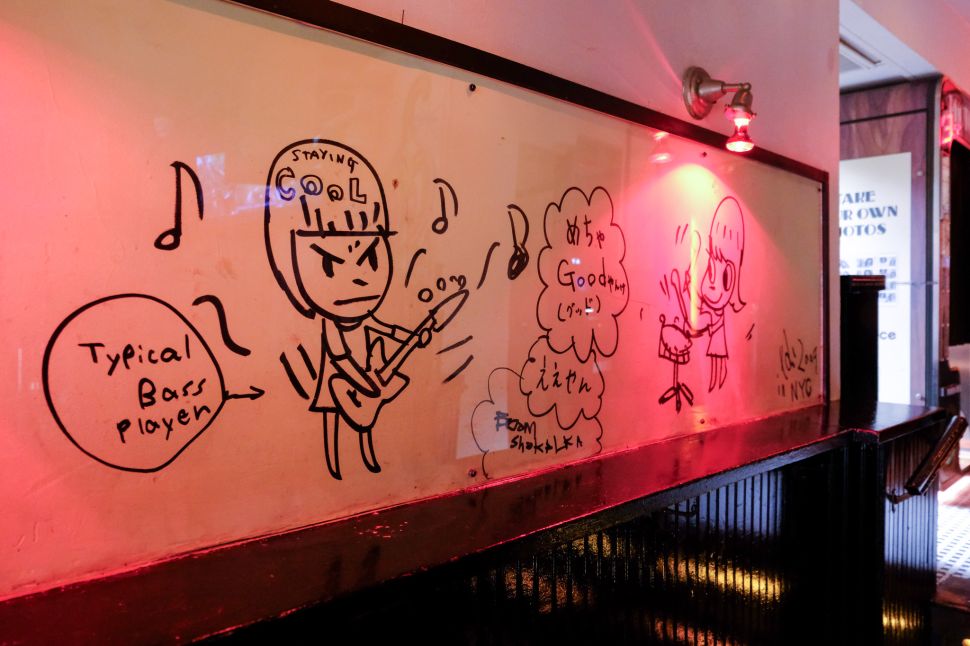 A “typical bass player” and a happy drummer at Niagara. Photo by Jamie Lubetkin
The walls of Niagara were Nara’s impromptu notebook as a celebration on the eve of his fourth solo exhibition at Marianne Boesky Gallery in Chelsea was heating up. Using a black marker, Nara drew a mural along a 10-foot section of wall opposite the bar that includes three of his signature precious darlings, a drummer—a bass player and a singer, who offers up her middle finger along with the Ramones signature refrain from Blitzkrieg Bop, “Hey! Ho! Let’s Go!” At the end of the room, another singer asks “Hey, NYC. Are you happy?” And above the bathrooms, two helpful Nara girls make clear which door is “for girls” and which is “for the boys.”
Yeewan Koon, an art historian and curator who authored the 2020 Phaidon monograph Yoshitomo Nara and has worked with the artist for more than two decades, told Observer that Nara has long been driven by an impulse to engage directly with audiences, but fame has made that more and more difficult over time. “This side of Nara has never really gone away, even if it surfaces less often now—the market has made such gestures harder to give away freely. But the impulse persists in smaller, quieter forms: markers left on the walls of friends’ homes, drawings made and given rather than sold,” said Koon, now a professor of art history at the University of Hong Kong.
She pointed to a favorite photograph that features a ring of bare forearms on which the artist has drawn his famous Nara girls. “These gestures were never meant to last or to be exploited, and that’s precisely the point—they’re not artworks so much as ways of being present with people, the same instinct that once sent him drawing on bar walls for no reason other than that the night called for it.”
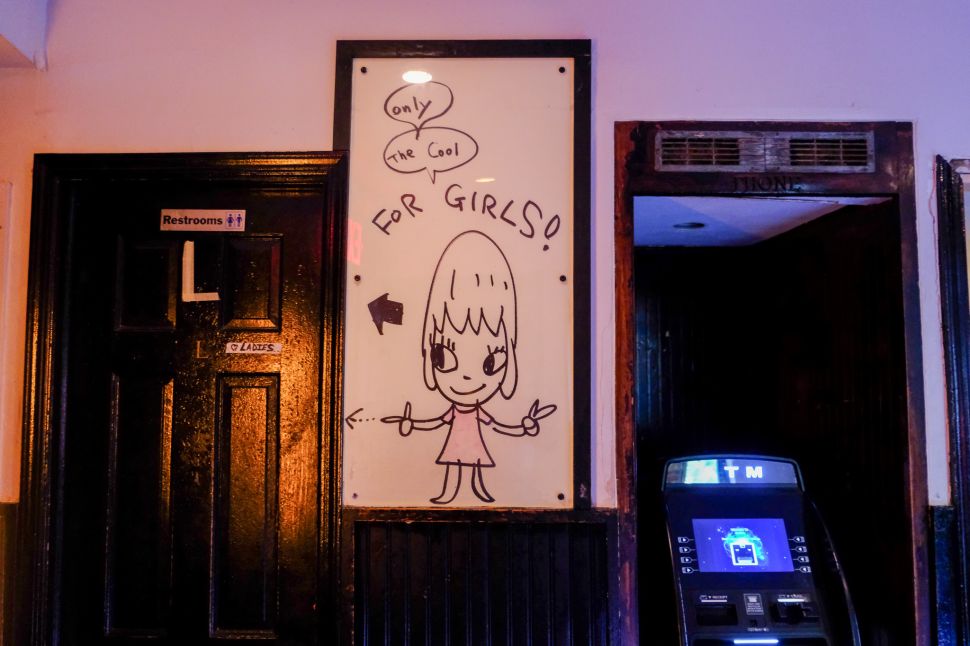 A Nara girl points the way to the ladies’ restroom. Photo by Jamie Lubetkin
“That same impulse carries directly into the drawings,” Koon continued. “The same willingness to let a marker move fast and loose, without the caution that a canvas or a bronze cast might invite… Whether it’s a wall in a bar, a friend’s forearm, or a sheet of paper, the drawing carries the same energy: quick, direct, unafraid of looking unfinished. If the paintings and sculptures are where Nara works and reworks, undoing and rebuilding, the drawings are closer to where that original impulse survives almost unmediated—the bar-wall spontaneity, just given a more permanent surface to land on.”
A lot of what defines Nara’s painting is right there on the wall in Niagara: the oversized head, the child/adult ambiguity, the emotional directness, the punk sensibility, the fearless confrontational gaze. The Niagara works came amid a string of New York moments that informed Nara’s personal and artistic evolution.
After he completed the Niagara drawings, Nara left the bar just after 3 a.m. only to continue his freelance drawing on a wall in the First Avenue L-train subway stop. A pair of New York cops took note and he was arrested like a common graffiti writer, which is, in fact, what he was at the time.
Nara was sprung the next morning in time to attend his opening at Marianne Boesky in Chelsea. His then-lawyer, Guy Oksenhendler, was quoted in the New York Post as saying Nara regretted the incident and “felt that it was an experience he should learn from.” The subsequent show, according to Oksenhendler, was a huge success: “It was a great night. He was there at the opening. The gallery was packed. It was an extremely successful night.”
Another pivotal New York moment came the following year with the opening of a show called “Yoshitomo Nara: Nobody’s Fool,” curated by Miwako Tezuka, at the Asia Society. It was the first time in its history that the society devoted its entire space to an exhibition of work by a single contemporary artist. “At the time, Nara’s work was often received through a certain idea of manga and Japanese subculture—a lens that could flatten his work into something closer to exotic novelty than serious practice. Nobody’s Fool pushed back against that framing directly,” Koon said.
In 2011, Nara joined Pace Gallery, a relationship that lasted until he signed with Zwirner last year. Pace would mount solo shows for Nara in its New York galleries, as well as across its properties in Hong Kong, London, Seoul and Geneva.
In a 2020 press release, one of many issued by Pace during his years with the gallery, Nara describes how drawing is, and always had been, the central element of his work: “Looking back to when I was little… I was able to draw whatever I wanted with a pencil… For me, this turned out to be the point of origin for all my work, and it is a practice that I continue to this day… I have been drawing as though I were breathing. Or taking notes. Or thinking. That’s been my past 30 years.”
Between 2009 and today, Nara’s works have sold for tens of millions of dollars at auction, including the 2000 work Knife Behind Back, which gaveled at $25 million in 2019 at Sotheby’s in Hong Kong. A year later, a bidder paid $12 million at Christie’s Hong Kong for a painting called Can’t Wait ’til the Night Comes that features a Nara girl with one protruding vampire fang, just like the singer drew on the Niagara wall. His biggest New York sale came in 2021 when 1996’s Nice to See You Again went for $15 million at Sotheby’s. In March of this year, Phillips Hong Kong sold what it called an “informal autograph” for HK$2.1 million: one of the Niagara drawings, executed on a grungy bathroom door that was removed and preserved in 2024.
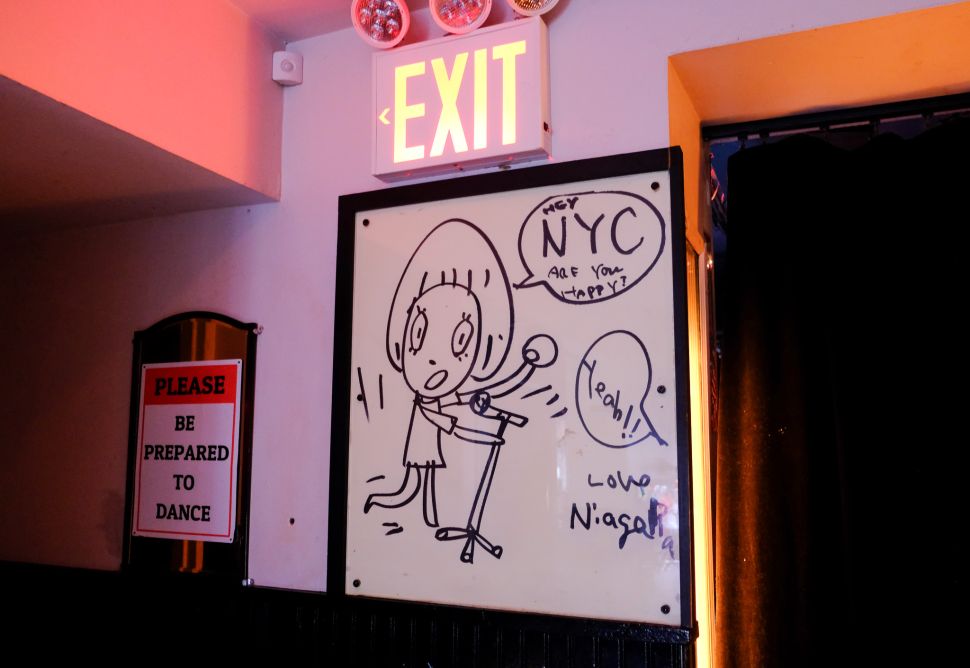 “Happy?” This Nara girl on the wall at Niagara wants to know. Photo by Jamie Lubetkin
In announcing the October show, Zwirner said Nara’s latest work maintains his reliance on “front-facing portraits with direct gazes” and continues to have drawing at its heart. “Drawing is an assured action, the result of an immediate inspiration—it is a state of mind,” the gallery said. At the same time, though, “his intricately layered colors have become more muted and highly nuanced, while his increasingly diffused brushwork, through which his forms materialize, creates richly atmospheric depths across the surface.”
And, Zwirner added, there’s a new Nara method that centers on drawings rendered with color pencils that are washed with translucent acrylic. The show will also include large-format, monochrome drawings made with industrial oil-based paint sticks and 13 of Nara’s 10-times sculptural enlargements from 2024.
Alonzo, who worked closely with Nara in curating his 2021 Dallas Contemporary show, said his newer work may be a bit quieter and more refined, but he doesn’t expect to ever see wholesale compromises in attitude from Nara: “They are more serious. But I would not say that they’re less confrontational. There’s still this child looking you straight in the eye… I still feel that kind of defiant attitude is still there. There are still questions. There’s still provocation.”
It’s the same kind of commitment to confrontation and defiance that Nara rendered on the wall of Niagara and incorporated across his oeuvre as it evolved over the years. Nara, Koon said, is “an artist whose understanding of art was first formed by rock and punk, by alienation and rebellion as global sensibilities rather than exclusively Japanese ones. New York, in other words, is where Nara’s work was first allowed to be heard as much as seen.”
More in Artists