
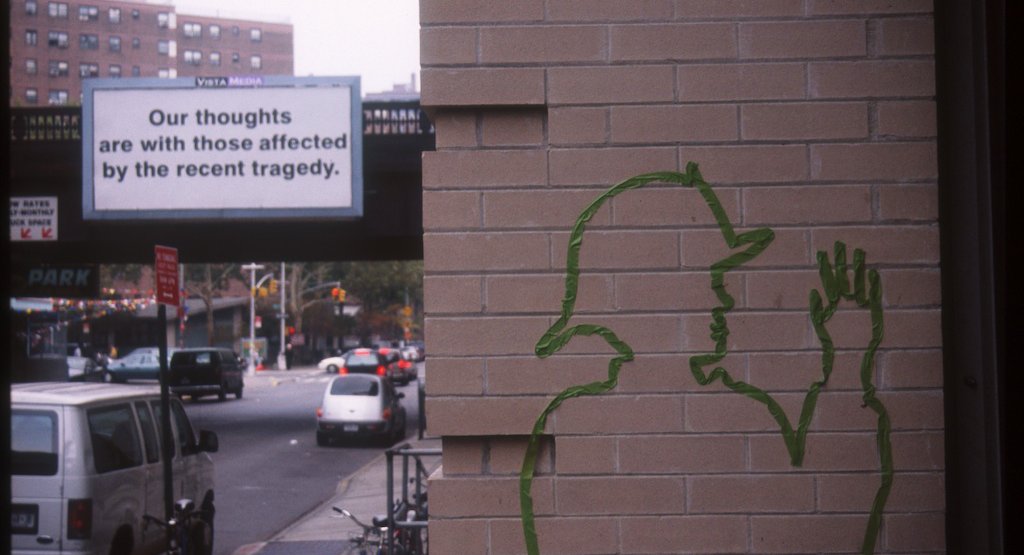
After the Twin Towers fell, life-size human silhouettes made of tape appeared throughout New York City. You’d see them on roll-down gates, construction fences, mailboxes and many building facades. They were made by the artists of collective Tape Art, who spent years memorializing the victims of the attacks through this ephemeral medium.
“The initial impulse was that we were gonna draw everyone who died at the World Trade Center, but that idea quickly got dashed because there was no way to do that,” said Tape Art founder Michael Townsend.
Bodies were still being pulled from the rubble, an ever-changing array of missing posters papered lampposts, and the death count changed daily. Ultimately, the group put up 490 tape profiles representing every lost firefighter and airport passenger – the only numbers then set in stone – with their taped hands holding up fingers to account for the other lost souls.
Alan Feinberg, drawn March 2003 on East 47th Street between Lexington Av. and 3rd Av.
Courtesy of Tape Art
The herculean effort took the group three years to complete. They meticulously documented their process and the lives they were commemorating, recording hours of personal testimonials about their subjects, and setting it to original music composed by a friend. They spent an additional year building a website to permanently commemorate their impermanent memorial.
It launched in 2005. Soon thereafter, the iPhone came out, and with it the beginning of the end for all their lovingly coded QuickTime and Flash embeds, rollermouse-optimized panoramas and flip phone-compatible images. By 2009, the site was completely unusable, and they took it offline.
Thomas Hannafin, drawn June 2003 in Central Park between West 77th St. and West 76th St.
Courtesy of Tape Art
“It ruled our lives for five years,” said Townsend, “and the purpose of it was to build a space where people could come together and share their grief, feel some sense of relief that these loved ones had been remembered in this strange public art piece. And we failed miserably to pull that off.”
The project was briefly touched on in the 2024 documentary “Secret Mall Apartment,” which tells the story of Townsend and his friends building a clandestine hangout spot inside an unused corner of a Providence, Rhode Island shopping mall. Recently, San Francisco-based tech entrepreneur Gordon Wintrob watched the documentary and tried to find the memorial site online.
“He was very disappointed that he could not. So he decided to reach out,” said Townsend, who subsequently shared their trove of impeccably organized but dated archive files.
Raymond Downey, drawn October 2002 on East 20th St. between 5th Av. and Broadway.
Courtesy of Tape Art
“ This is a guy who was deeply moved by the movie, deeply moved by this 9/11 project, and internalized that if we have the data, he has the tools to bring it back to life,” said Townsend. “In less than a week, Gordon resurrected everything” by “feeding it into a machine that can barf out a usable version of the site.”
All the content is original, just brought up to date and made usable with the help of expertly utilized artificial intelligence.
Tape Art-5 John Giordano, drawn at Freedom Place between West 68th St. and West 66th St.
Courtesy of Tape Art
“It’s a beautiful collision of these two worlds,” said Townsend of the unique collaboration of AI and tape art.
“It has haunted me dearly for years, that it’s just been gone from the internet and we couldn’t figure out how to get it back on there. It was so much effort to make,” said Townsend.
Now, just in time for the 25th anniversary, the project is once again back online. When Townsend first saw the updated version, he said he was “gobsmacked.”
“I didn’t burst into tears, but darn close.”