
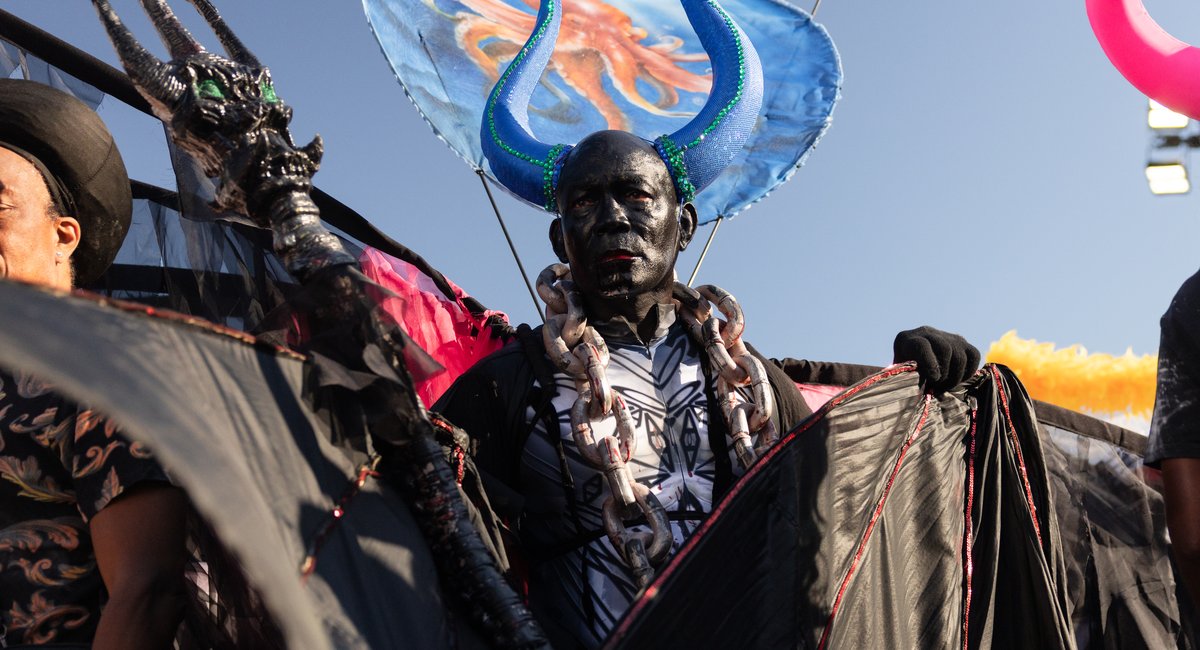
New Yorkers lining Eastern Parkway to watch Brooklyn’s annual West Indian American Day Parade on Monday showed pride by wrapping themselves in their countries’ flags and donning the national colors on bandannas, bikinis, hats and other attire.
Fatima Abney wore a matching skirt and visor with the blue and red colors of Belize’s flag, along with a shirt that read “100% Belizean.”
“From head to toe, we got to represent,” said Abney, 42.
She attended with her aunt, who wore a Belize shirt, armband and bag, and also waved a Belizean flag for good measure.
Abney said she was there for “the costumes, the music and being around everybody.”
Lamont Joseph, the artistic director of the Brooklyn-based Bloodline Dance Theatre, wore one of the parade’s most eye-catching costumes: He marched as an extra tall, pink and floral version of LGBTQ+ activist Marsha P. Johnson.
“I make sure to celebrate both traditions: New York City Pride and New York City Labor Day,” Joseph said, when asked why he chose that costume. “I’m a Caribbean, gay African American who loves both cultures.”
Vendors along Eastern Parkway sold jerk chicken and other Caribbean cuisine, along with fresh juices, ice cream and nutcrackers.
About an hour after the parade stepped off at 11 a.m., some attendees were starting to dance to the soca, dancehall and reggae blasting from the floats going by. One float carried Mayor Zohran Mamdani, who danced and waved, eliciting excited shouts from the crowd.
But Abney said it still seemed calm compared to years past. “I hope it turns up a little bit,” she said.
In recent years, some West Indian Day celebrations have been marred by violence, including last year, when six people were shot near the parade route.
Some attendees said they couldn’t help but notice the increased security at this year’s parade, including a strong police presence and more metal barriers along the route. But attendees said it didn’t take away from the good vibes and sense of community they were seeking.
Others welcomed the increased security. Selma Seaton, who hails from St. Vincent and the Grenadines, attended with her two daughters, aged 8 and 14, and said the police presence made her feel safer bringing her family.
“Security has been getting more and more tight every year, especially this year,” Seaton said. “You walk around and everywhere you can see the police officers.”
Some revelers came to the parade directly from J’Ouvert, the street celebration that precedes Carnival in many Caribbean countries and has now become a tradition ahead of New York City’s West Indian American Day Parade. Although it’s traditionally a pre-dawn celebration, New York’s J’Ouvert has been moved up to 6 a.m. in recent years in an attempt to make it safer.
Eliel Pacheco, 25, who made the two-hour trip to Crown Heights from the Bronx to attend, said the new time doesn’t make the celebration any less special. At J’Ouvert, Pacheco said, he was doused with colored paint as well as oil from the Jab Jab man, a traditional Carnival character from Grenada.
“The Caribbean people years ago started it and I’m really glad that we’re able to continue it,” said Pacheco, who’s Dominican and attended J’Ouvert and the parade with friends from Jamaica and Barbados. “It’s really great to just be in community.”
The NYPD said as of 3 p.m. Monday, there were no violent incidents that had been linked to the parade or J’Ouvert.