
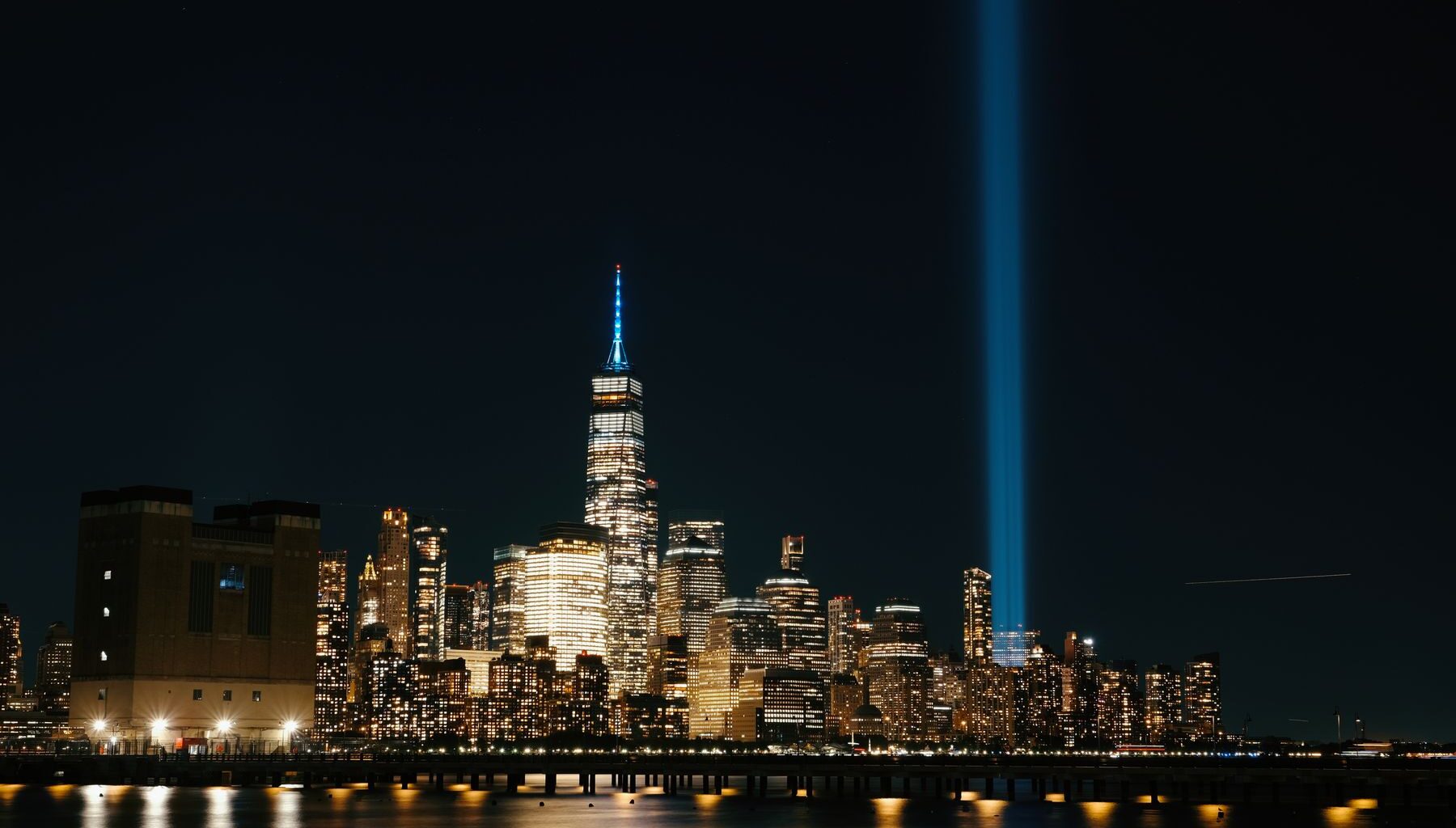
When New York’s Tribute in Light went dark for short intervals, migrating birds that had gathered around its beams dispersed within minutes. Radar, microphones and observers recorded a change that was difficult to miss: an illuminated patch of sky had altered the birds’ movements, and switching off the light allowed them to move away.
The 2017 study in Proceedings of the National Academy of Sciences, led by Benjamin Van Doren and Kyle Horton, estimated that the installation influenced about 1.1 million birds across seven study nights. This was an estimate of birds affected by the light, not a count of birds killed.
Disrupted migration and mortality are different measurements.
A memorial within the path of migration
Tribute in Light commemorates the September 11 attacks through two columns that recall the World Trade Center’s Twin Towers. The 9/11 Memorial & Museum’s description of the installation specifies 88 xenon bulbs, each rated at 7,000 watts, arranged in two 48-foot squares.
Its purpose is remembrance. Its effect on the night sky also makes it an unusual place to investigate how animals respond to artificial illumination. A localized source can be switched off while the surrounding city remains lit, creating a comparison that ordinary observations of a bright skyline cannot easily provide.
The research covered seven nights in different years between 2008 and 2016, rather than seven consecutive nights or every September 11. Weather prevented the inclusion of two years. The headline’s large total belongs to that defined study period; it should not be presented as an annual tally.
How the million-bird estimate was calculated
The researchers compared estimated bird numbers within five kilometers of the installation with the number expected from surrounding baseline densities. Adding those differences across the study produced the 1.1 million estimate, with a 95 percent confidence interval of about 600,000 to 1.6 million.
This method measures an excess concentration of birds near a light source. It is not equivalent to attaching an identification tag to every bird and following its entire migration. The uncertainty range is therefore part of the finding, rather than an optional qualification attached to a precise census.
Nor does a bird’s presence within the affected area establish that it later collided with a building, failed to reach its destination or died. Those would be separate outcomes requiring different observations. The study quantified changes in migration behavior and the scale of the installation’s influence.
Three ways of observing the same airspace
According to the Cornell Lab of Ornithology’s account of the research, volunteers counted birds in the beams while National Weather Service radar data supplied information about density and movement over a larger area. Acoustic equipment recorded the birds’ flight calls.
Each method contributed a different view. Ground observers could see circling close to the lights. Radar extended the observations beyond the small portion of sky visible in the columns. Microphones captured vocal activity that a photograph would leave out. Together, these measurements described changes that a photograph alone could not quantify.
With the installation lit, birds slowed, circled and called more frequently. The response occurred even under clear skies, so poor visibility was not a necessary condition for disruption at this site. When the beams went out, the concentrations dispersed rapidly.
The equipment measured movement; it did not read what the birds perceived.
The observers could request a pause
The shutdown arrangement was also a practical intervention. In Annie Novak’s firsthand reporting for Living Bird, published in 2018, staff and volunteers watched from the parking-garage roof beneath the display and communicated with the production team when birds accumulated.
That account describes a protocol including 1,000 birds remaining in the beams for more than 20 minutes, birds appearing trapped and flying low while calling, or a bird falling dead. A lights-out interval of about 20 minutes gave the birds an opportunity to leave. The numerical threshold was thus one trigger within a broader assessment of what monitors were seeing.
Across the seven study nights, the lights were interrupted 22 times. This was a series of temporary pauses within the memorial display, supported by coordination between its organizers, bird monitors and researchers.
Novak’s account also records birds gathering again after the lights had been restored. A successful pause did not mean that later migrants would encounter an unlit sky for the rest of the night. Monitoring had to continue.
What the result supports beyond the memorial
The U.S. Fish and Wildlife Service’s guidance on nighttime lighting describes the wider problem: artificial lights can draw migrating birds into circling flight, consume energy and increase exposure to buildings and other collision hazards. Where birds become trapped around a necessary light source, the agency describes temporary darkness as one way to let them escape.
The Tribute study offers direct evidence that removing an intense source can reverse the immediate concentration of birds. It does not establish that every lamp, building or species produces the same response, or that a brief shutdown removes all the risks of an illuminated city.
The practical arrangement depended on more than having an off switch. Someone had to watch the birds, recognize the agreed conditions and contact a technician able to interrupt the display. After the lights returned, someone still had to keep looking up.
Follow Science Blog on Google
Add us as a preferred source to see more Science Blog reporting in Google.