
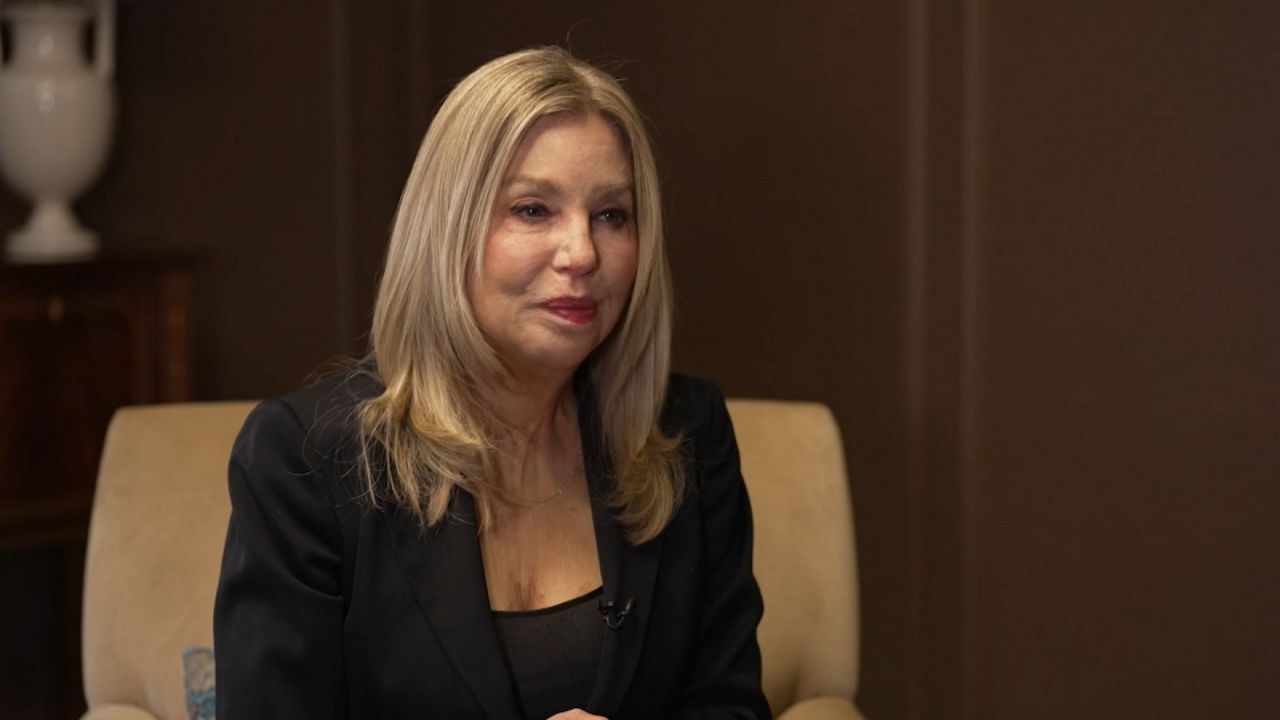
For Lauren Manning, the World Trade Center was part of her life long before Sept. 11.
She began her Wall Street career there and later became a partner at Cantor Fitzgerald.
“I started at the Dean Witter Reynolds training program, which was located down in the North Tower. Upon our graduation, we were up in the Windows on the World, and it was a beautiful moment of just the beginning,” Manning said.
On Sept. 11, Manning was running late. She arrived at the North Tower just as the first plane hit.
“I stood there waiting for the elevator and a second later there was this imperceptible, almost movement as if the whole building had somehow jumped,” Manning said.
“The lobby at the end that I was in filled with an enormous wall of flames that I was immediately engulfed in,” she added.
“I could not breathe. I could not scream. I could not move,” Manning said.
“And, really, right then and there, I had to make a decision on whether or not I would just fall under what was the interminable pain of this thousand-degree heat from the jet fuel explosion or try to break through it,” she said.
Manning broke through and made it outside to a patch of grass where she dropped and rolled.
“And when the flames were barely out, I looked up to see the second plane crashed into the building, the South Tower, with this extraordinary thud,” she said.
Manning suffered burns over 82% of her body. Her odds of survival fell below 10%.
“I had my son at home too — this wonderful little boy. My husband and I didn’t have children as very young parents, so this child meant everything to us. I fought to come back to him. I fought to avenge my lost colleagues,” she said.
After nearly two months in a medically induced coma, Manning woke to learn how many of her colleagues had not survived.
“And slowly, one after another, I was told, ‘No, you know, she didn’t make it. He didn’t make it,'” she said. “And 658 of my colleagues and so many friends were gone.”
“So compounding my own loss of my body was that of just all of those around me that never even had a chance to fight,” Manning said.
“That would be my tribute to them. I would take and try to bring them over the line in some way because I know if they had been able to get down that they would have given it their best shot,” she added.
Manning was not fighting alone. Her husband read her thousands of letters from around the world.
“I was so rich with the prayers and the hopes of so many… it lifted me on some of my darkest days and it gave me that flight beyond the pain,” she said.
“I felt like I was standing with millions of people there for me, and them in support of me, and I would support them. I would not let them down,” Manning added.
The years that followed meant learning to live with the lasting impact of her injuries.
“it’s navigating a body that’s forever changed. A career that was no more. To be a mother to a child when I, for months and months at a time, could not hold my child was extremely difficult,” Manning said.
“I live with a low level of pain every single day,” she added.
Manning chronicled her recovery in her memoir, “Unmeasured Strength.” Her experience also reshaped her work.
She studied narrative medicine at Columbia University, which aims to help health professionals better understand their patients, and now leads Narrative Mindworks, focused on helping people be heard.
“I had a calling to something much more explicit… the field of healthcare,” Manning said.
But for all the ways Sept. 11 changed her, Manning refuses to let that day define her.
“It would hardly ever be the day that would define me. I had a life before, I’ve had a life after it,” she said.
“And yes, I was maimed, but I am living,” Manning added.
She also wants the story of that day to honor the heroism inside the towers.
“To each and every one of those who didn’t make it out. You made it into the rest of us. Thank you for the gift of your love and energy we carry with us,” Manning said.
“We, the people, have the absolute moral and civic responsibility to care for each other,” she said when asked what she wants people to reflect on 25 years after the attacks.
“Maybe you are the one that will make the difference. Maybe you are the one that will help save a life or do something that will be remembered for generations. If not you, then who will it be?” Manning added.
“And remember, the win is in the effort,” she said.