
 Fourteen months after Donald Trump signed the Republicans’ One Big Beautiful Bill to provide billions in tax cuts while seeking to reduce the cost of programs like SNAP food aid and Medicaid, the South Asian Council for Social Services in Queens is trying to help families who are the first to be ensnared in the law’s new work requirements.
“The husband is 66 and retired and his 62-year-old wife has arthritis and can’t work,” said Mary Fernandez, director of family support services. “But she can’t get a note from her doctor and their benefits will drop to $24 a month from $325 if she can’t get an exemption or find some way to volunteer for 20 hours a week to meet the new rules.”
Throughout the city, front-line charities and their funders are trying to blunt the impact of the Trump law. They are working now to help people losing food aid and preparing for the hundreds of thousands of New Yorkers who could lose their healthcare coverage when new work rules are imposed on Medicaid recipients starting Jan. 1.
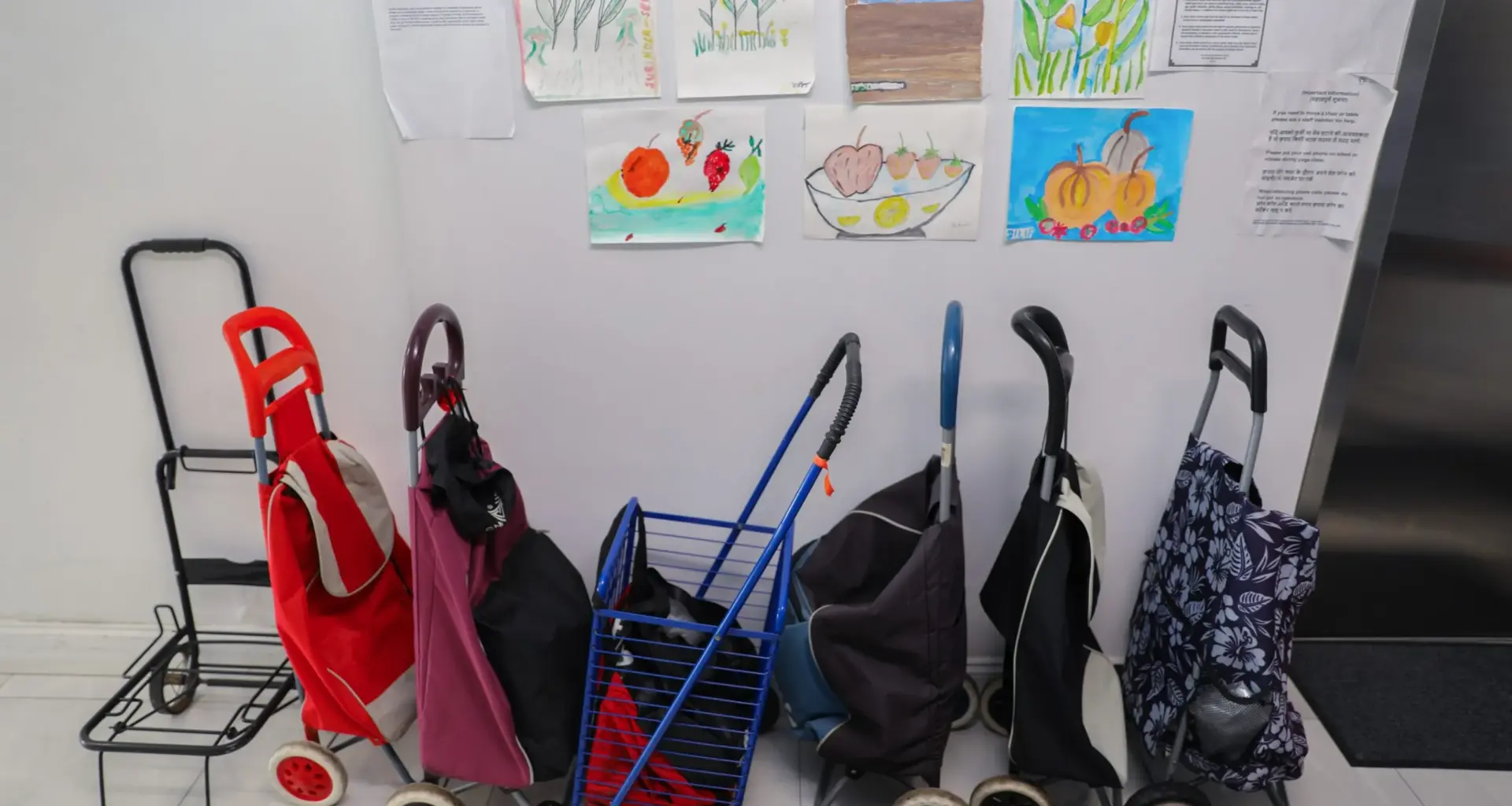
 Maryarchana Fernandez of the South Asian Council for Social Services oversees a food pantry at the Queens nonprofit, Sept. 2, 2026. Photo: Alex Krales/The City Reporter
“There is really a double squeeze,”said Richard Buery, chief executive of the Robin Hood Foundation, which just handed out $39 million to about 100 organizations — with more than $20 million going to groups helping New Yorkers access benefits. “We know that poverty and hardship are being driven by the ongoing increase in the cost of basic needs of food, housing and childcare. That’s happening in a moment where the federal disinvestment in the safety net is coming to bear.”
The city reported that 22,000 people lost SNAP benefits in June amid the law’s requirements that anyone 64 or younger — up from 54 — either work or volunteer 20 hours a week, including parents with children older than 14 years, instead of 18. The number is expected to climb when July numbers are released in the next week.
250 million meals
Robin Hood estimates the SNAP cuts alone will push another 70,000 people into poverty. The group’s research puts the city’s poverty rate is at 26%, about twice the national average of 13%.
As the Trump cuts take hold, food pantries and other services will have to replace 259 million meals a year that are currently paid with SNAP benefits, said Jerome Nathaniel, director of policy and government relations at City Harvest. “The emergency food system is simply not designed to close that kind of gap,” he said.
At the moment, confusion is the order of the day at the 400 food pantries served by United Way of New York City, said Grace Bonilla, the chief executive.
“Put yourself in the place of someone who just aged out of foster care but has never been required to work,” she said. “You get a notice that says you either comply with X number of work hours or your benefits go away. It’s hard to digest, especially if it’s a language above your reading level or in a language you didn’t speak.”
 A sign outside the NYC Human Resources Administration in The Bronx directs visitors to a Medicaid office. The Bronx leads the United States with the highest number of Medicaid enrollees, with 510,000 in Congressional District 15. Photo: Chi Tian/Chalkbeat
Bonilla believes that children aging out of foster care are a key group losing SNAP as well as gig workers and people with irregular work that will find it hard to prove they are meeting the requirements.
United Way has raised $800,000 to create United for Benefits Access, which gives food pantries and other community-based organizations tools to assess how the new rules affect their clients, help them qualify for volunteer hours, track those hours and meet the requirements.
United Way, City Harvest and the Mandani administration have also trained staff at 200 pantries on how to help people keep SNAP aid and how to use recipients as volunteers, but pantry workers are overwhelmed by adding those responsibilities to their primary job of getting food to people, said Bonilla.
Pantries, which have already seen an increase in demand in the last year, are bracing for another surge in recipients.
Fear of ICE
The number of meals handed out monthly by Project Hospitality, which operates food pantries on Staten Island, increased by 11,000 to 145,000 for the 12 months that ended in July compared with the same period the previous year, said Alex Hughes, the group’s director of hunger prevention and advocacy.
Meanwhile, ICE activity in Staten Island is keeping people from accessing food as they worry they will be targeted while they wait in what are often long lines. Hughes’ pantry in Port Richmond, which has seen an increase immigration sweeps, saw the number of people it serves drop from 1,800 in July to 1,100 in August.
“People are staying home out of fear,” he said. He wants the city to sharply increase funding for delivery routes to help residents who are trying to avoid arrest and deportation.
The city will be forced to spend about $120 million more each year in administrative costs to comply with the new paperwork, but that’s certainly manageable in a $126 billion budget — though local governments elsewhere in the state say the amount is straining their budgets.
Already, more than 223,000 city residents have lost their health coverage under the state’s Essential Plan, which provided Medicaid-like coverage to those earning slightly more than the Medicaid limit. State officials have said that about half of them have signed up for coverage through the state’s Affordable Care Act exchanges at a sharply higher cost, although final figures have not been released.
Like the new rules for SNAP, Medicaid recipients between 19 and 64 and those with children over 14 will be required to work or volunteer 20 hours a week beginning Jan. 1 to keep their health care, according to federal rules. They will also have to be recertified twice a year instead once.
But, because the required work and volunteer hours are based on the federal minimum wage of $7.25 an hour, and New York’s minimum wage is more than twice as high, recipients will only have to prove they have averaged 10 hours of work per week.
Nevertheless, the Fiscal Policy Institute believes the new rules will result in about 20% of the more than 1 million city residents on Medicaid losing coverage.
A state plan to recertify New Yorkers could push the number higher, worries United Way’s Bonilla. Currently, city residents can apply for SNAP, cash assistance and Medicaid at one time. But the state is planning to decouple Medicaid, which could force people to make it to enrollment sites in person to keep all their coverage, she said.
 Workers help prepare food at the St. John’s Bread and Life pantry in Bedford-Stuyvesant, Brooklyn, on May 26, 2026. Photo: Alex Krales/The City Reporter
The state Health Department says since local governments will now have to implement the new rules without using the shared platform that currently enrolls people in several programs at once, it isn’t possible to continue the current system. The plan to delink the programs will allow the state to centralize the process, said spokesperson Danielle DeSouza.
Gov. Kathy Hochul’s administration has estimated the administrative cost to the state at $500 million.
In the meantime, fear is the operative word on the front lines at the South Asian food pantry in Flushing.
“I come here every week,” said Manjit Bhalla, 76, who’s been a client since 2019.
“I am very worried because you don’t know what is going on. I see the news and it’s very troublesome,” she said while waiting to pick up her groceries. “They should not be doing what they are doing.”
Alex Krales contributed to this story.