
To Gio Escobar, the 9/11 Memorial & Museum is “the most spiritual place in New York.”
“This beautiful spectacle of a structure is a mass grave,” he said on an August afternoon as we walked around the reflecting pools constructed where the Twin Towers once stood. “Any point of contact with the afterlife and the spirits is something I’m interested in.”
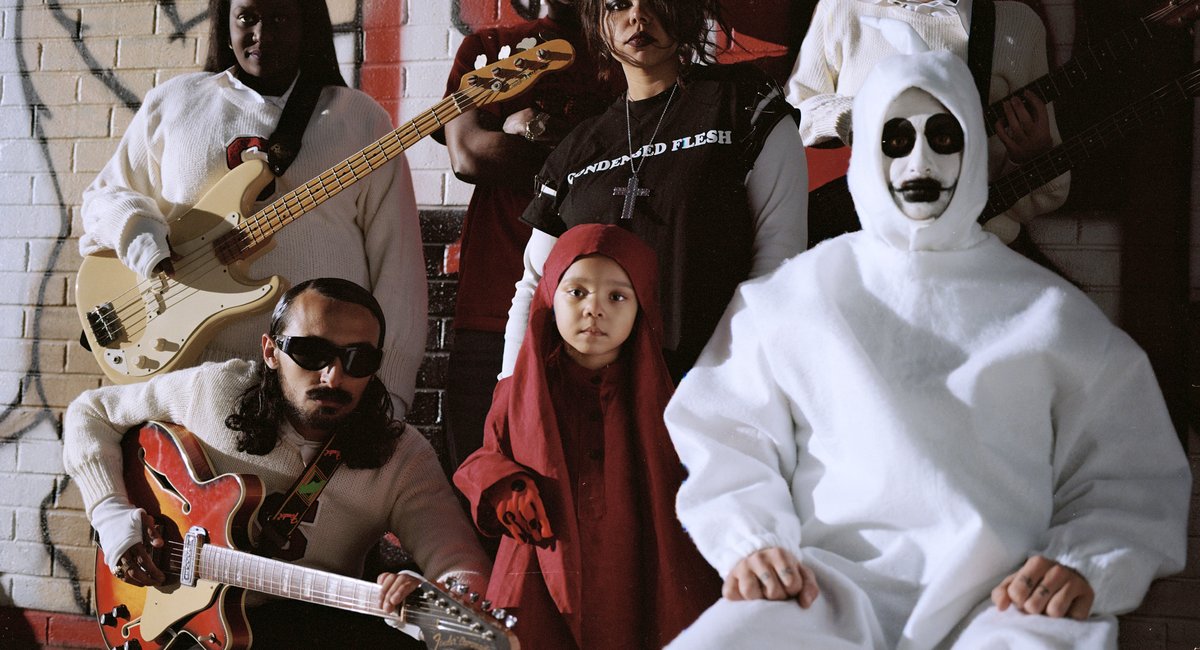
Escobar leads Standing on the Corner, an experimental music collective that defies categorization. For the past decade, he and a rotating group of collaborators have put out a mix of jazz, rap, funk, punk and soul that takes aim at societal ills and corrupt institutions in between declarations of love and care. We met to discuss “Standing on the Corner II,” the group’s latest album and its third to be released on an anniversary of the Sept. 11 attacks — a onetime coincidence that became a pattern when Escobar realized it served as “a way of raising the dead.”
Escobar was raised in the church and said he has since found inspiration in “spiritual contact” and ancestral ties (he is Puerto Rican and, inspired by the communities he grew up around in Brooklyn, has incorporated music of the African diaspora into his work). As he speaks of other planes with an unlit blunt in his hand — which he waves around while speaking but never lights — it’s easy to picture Escobar as a bohemian artist with little regard for commerciality.
But that’s not it, he said. He knows sales and streaming numbers matter. To him, expanding his reach is a step toward success, which he defines as the ability to keep putting out music that tries to make sense of the world. As he constantly considers death, how can he make vibrant, thought-provoking music that feels so full of life?
“I don’t feel that my creativity or my artistry serves me if I’m to pimp it,” he said. “Which is maybe the most straightforward transaction that the music industry promotes and allows. But for me, that’s an empty practice. I want to be someone who is participating on a deeper level.”
Escobar worked on “Standing on the Corner II” with artists Jack Nolan, Buz Donald and Clérida Eltime in a concerted effort to “cut through nothingness,” he said. Lyrics throughout the record’s 15 tracks channel the world-weariness that often accompanies extended periods of instability. But they also urge action: “My heart, it sulks, it bleeds, it loves, it needs some peace, not war,” a distorted voice sings on the mid-album track “Mr. Postman, wait!” Then comes an earnest plea: “I have questions. I need answers and replies, please. Won’t you look and see?”
The voices on “Mr. Postman, wait!” drone on over sporadic synths and electric organ chords, which eventually make way for a full-on organ solo. (Years ago, Escobar was paid to play the instrument during church services around Brooklyn.) The next song, “Roll over Beethoven,” does a 180 by speeding things up and serving up an upbeat blues tune in the style of Chuck Berry.
That stark contrast is a jolt to the system — but not nearly as intense as the gunfire punctuating “Man may not last,” a doomsday track featuring rappers Ladybug Mecca and Styles P. (A variety of artists make guest appearances on the record, including singer-songwriter Solange, to whom Escobar has been linked romantically.) Standing on the Corner has always released political music, Escobar said, but the group delves into subjects on the latest album that they hadn’t previously explored to the same extent. Chief among those topics is the very American matter of gun violence.
As we circled the memorial for a second time, Escobar grappled with the incongruence between his desire to have fewer firearms on the streets and his understanding of what it means for people of color that, “in this country, gun ownership is an inalienable right.”
“There is so much lobbying power in this country around the rights of white men and their guns,” he continued. “It’s embedded in the way our democracy works. And I think it’s time for our people to start exercising those rights the way we see certain communities, specifically white people, arming themselves. … I don’t think it’s intelligent for us to fall behind.”
Escobar looks to history to contextualize injustice. The new album’s song “Sonia” is named for featured artist Sonia Sanchez, the 91-year-old poet who was a leading member of the Black Arts Movement of the 1960s and ’70s. “She’s larger than life and absolutely brilliant,” Escobar said. For “Doesn’t mean a thing,” the group recruited acclaimed guitarist Bubba Dupree (formerly of the band Void), one of the most prominent Black musicians to come out of the D.C. area punk scene.
“There’s something to reaching out to other generations, people who have information that you cannot possibly have,” Escobar said. And when those people are no longer living, the memories and spiritual connections they leave behind can help provide that inspiration instead.
Escobar.
Courtesy of XL Recordings
Escobar also spoke candidly about being part of a music industry whose priorities don’t always align with his own. Standing on the Corner has bucked tradition when it comes to releases. Though it is being released officially this week on stalwart indie label XL, home of acts like Radiohead and Fontaines D.C., “Standing on the Corner II” was first released via DVD in Times Square (on Sept. 11, 2025, of course). Escobar instructed his fans to find a life-sized Mickey Mouse in the middle of Times Square and hand him $50 cash in exchange for a disc.
Despite the passion behind his bold ideas, Escobar is more reticent when it comes to aspects of his personal life. He looks back fondly on the diversity and vibrant sense of community he experienced while growing up in Crown Heights but becomes guarded after clarifying that he no longer lives there. Previous interviews suggest Escobar is around 30 years old, but his publicist later said she couldn’t confirm his age because he was evasive about it when she last asked.
Escobar’s insistence on remaining somewhat mysterious reflects similar qualities in his music. For every pointed remark throughout “Standing on the Corner II,” there is another moment of deep uncertainty. The album opens with a prayer before a voice begins to narrate feelings of displacement. Again and again, over a steady drumbeat and waffling organ sounds, new voices repeat a question that doubles as the track’s title: “Will it ever be the same?”
He laments the destruction of San Juan Hill, the vibrant neighborhood of Black and Puerto Rican residents that was razed in the 1950s so that the notorious urban planner Robert Moses could develop Lincoln Center.
“It’s literally a graveyard,” Escobar said. “It’s built on the destruction of Black and Puerto Rican communities that were displaced and never compensated, never in any way asked to participate in this culture that they were destroying arts to then create. Many things that right now are emblematic of New York … share that history, where they’re built on our dead.”
Perhaps that’s why Escobar keeps returning to the 9/11 Memorial. Death isn’t hidden there. The rushing water drowns out sounds of the city, creating an oddly serene environment. But the 2,983 names inscribed into the bronze panels that surround the pools remind him of how quickly that can all change.
“I feel like I can’t be anywhere else,” he said of living in the city. “I can probably speak for my ensemble when I say that. This is a place we very intentionally thrive in. But it also feels like I’m constantly walking among the dead.”