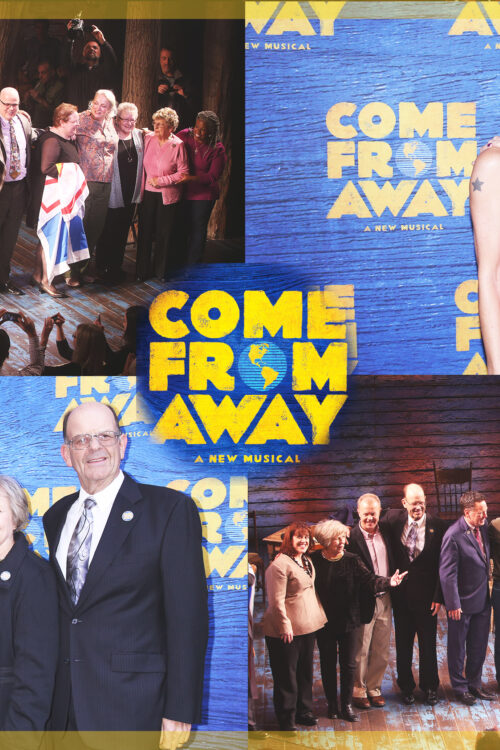
Irene Sankoff and David Hein have always considered their musical Come From Away as a show, not about 9/11, but about what happened on 9/12 and after. Notes Hein, “In times of tragedy, we often focus on the horrible things that happen. And in the days after, it’s the wave of support and the wave of people who are doing good that doesn’t get highlighted enough.”
Hein should know, he and Sankoff, his wife, got a first-hand look when they lived in New York City in 2001, during 9/11.
Acts of immense selflessness form the remarkable story on which Come From Away is based. After the September 11, 2001, terrorists attacks at the World Trade Center and the Pentagon, American airspace was closed and commercial airliners were diverted. Most prominently, 38 planes carrying over 7,000 passengers made an emergency landing in the small town of Gander in Newfoundland, Canada. Surprised but indomitable, the Canadians in that town immediately set to house, feed, and welcome these “come from away”-ers. Lifelong friendships, including some love affairs, were born.
In 2010, Canadian producer Michael Rubinoff commissioned fellow Canadians Sankoff and Hein to write a musical based on that true story. Skeptical—with Sankoff admitting, “I thought that nobody but Canadian high schools would ever do it”—the duo spent a month in Gander interviewing local residents. From their interviews came the musical Come From Away, which ran on Broadway from 2017 to 2022 and was nominated for seven Tony Awards.
Then another astounding thing happened: The musical took on a life of its own. To date, Sankoff and Hein estimate there have been over 600 productions of Come From Away in America alone, and countless around the world. The show’s been filmed and can be streamed on Apple TV+.
And on the 25th anniversary of September 11, there will be two productions of Come From Away running at the same time in both Gander and New York City.
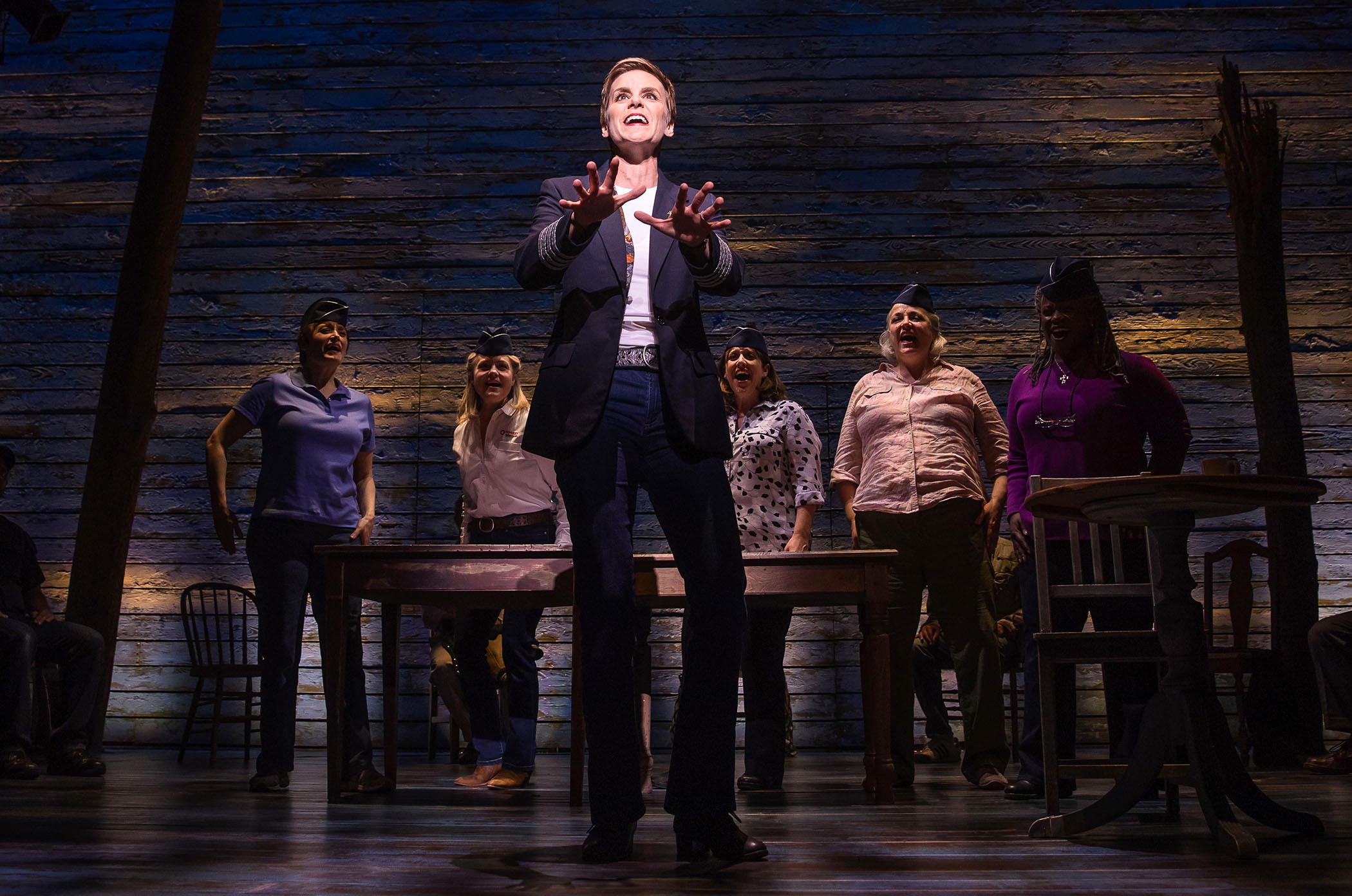
Jenn Colella and cast
The composing duo live in Newmarket, Ontario. But this week, they will be splitting up. Hein will go down to Manhattan, where there will be a Come From Away reunion concert at the Perelman Performing Arts Center September 13—PAC is located across the street from the former sites of the World Trade Center. The concert will feature cast members of the Broadway and national touring production. It will be simulcast online for those who cannot attend in person.
Meanwhile, Sankoff will head up north to Gander, where a local production of Come From Away is running until September 13. That performance feels particularly bittersweet considering the current trade war instigated by President Trump against Canada. This point brings up a slight grimace in Hein, before he says: “It’s a wonderful reminder that our countries at one point worked very well together, and that Canada came out and helped the world because that was just the right thing to do.”
Below, Sankoff and Hein recall what it was like to be in New York City during 9/11—the two were living in Harlem at the time. They recall how those tragic events inspired them to make art, bring people together, and get married. The conversation below has been edited for length and clarity.
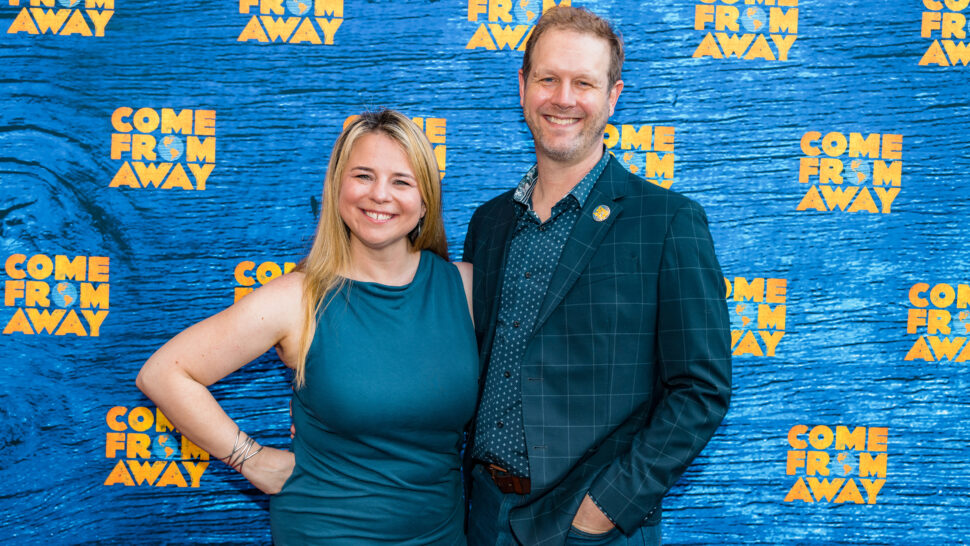
Irene Sankoff and David Hein
(Heather Gershonowitz)
What kind of feelings are the 25th anniversary bringing up for you right now?
Irene Sankoff: Oh my gosh! The idea that we were living in New York … We were living in an international student residence uptown at the 125th Street station. I was going to grad school for acting, and David was working for my uncle in a recording studio. I remember him calling my uncle, and being like, “Are we going into work?” And my uncle, it was also his birthday, was like, “No, we’re not going in to work.” And I remember my dad was the last person to call and get through to anybody in Manhattan, because the phone rang and he just said, “You’re not going to school today. Stay out of the subways, just in case. There’s been a terrorist attack.” And I’m like, “No no no no no. It’s just a helicopter that hit a building yesterday. And yesterday, a car plowed into a bunch of people in Times Square. This is just New York.” And he was like, “Turn on the TV.”
David Hein: My cousin was in the towers, but fortunately she got out. She was working on the first floor, and when she heard the noise, she just ran. And there were a lot of people in our residence—everyone was waiting for news. I think Irene’s dad was the last person to get in through a cell phone to Manhattan.
Sankoff: Oh no, landline.
Hein: Oh yeah, landlines. I remember, our neighbors came over and knocked on our door to see if we were okay.
Sankoff: They hadn’t seen us because we kind of went into shock and just stayed in our apartment.
Hein: They brought us out. We all ate together. People played music for each other. That night, we stood on the roof of our building and watched the smoke. And everyone was there for each other, but also worried about what was going to happen and how our families were doing.
Sankoff: Seven hundred students from 110 different countries. And we all gathered in this big common area and just dealt with each other. There were so many different reactions. There was no hostile reactions. Later, when we were in Gander hearing the stories, it sort of reminded me of our own experience, which was that basically everything else got set aside, and our first priority was one another. By that evening [of 9/11], I think the last of our residents, who’d been working down in the financial area, came home. They had walked, so it had taken the entire day. So there was a little bit of, like, over and over again: “Oh okay good, you’re okay. Oh, this person’s in shock, we need to help them.”
Hein: Our experience was so similar to what we saw in Gander, because the initial experience was people taking care of us and people taking care of one another.
Sankoff: We were on seizure watch for one guy.
Hein: I remember so much of New York was like that. New York’s quickness and that amazing instinct to help, the blood banks and food drives and the posters. Everything was incredible. And then the other thing that happened was Irene and I were engaged at the time.
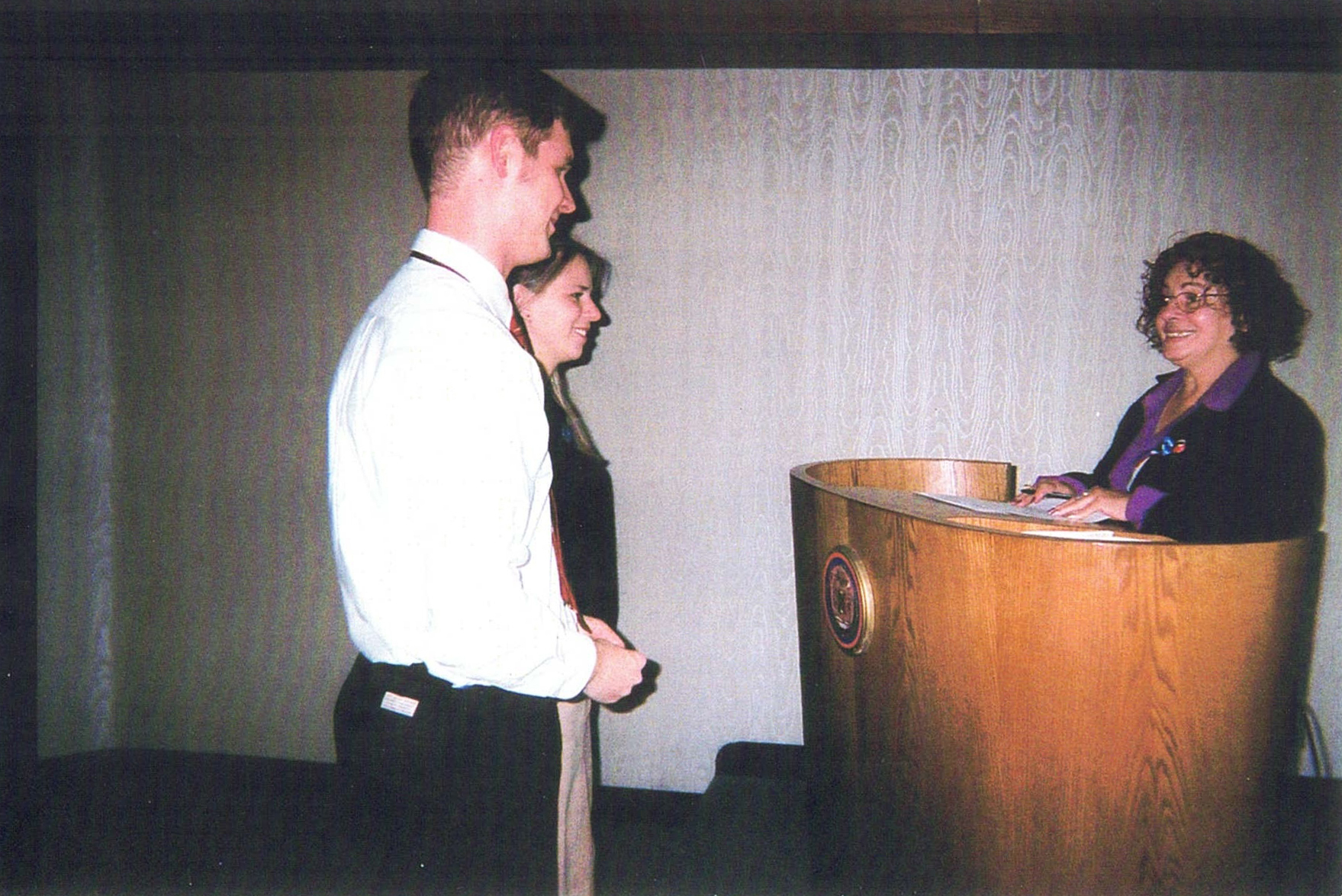
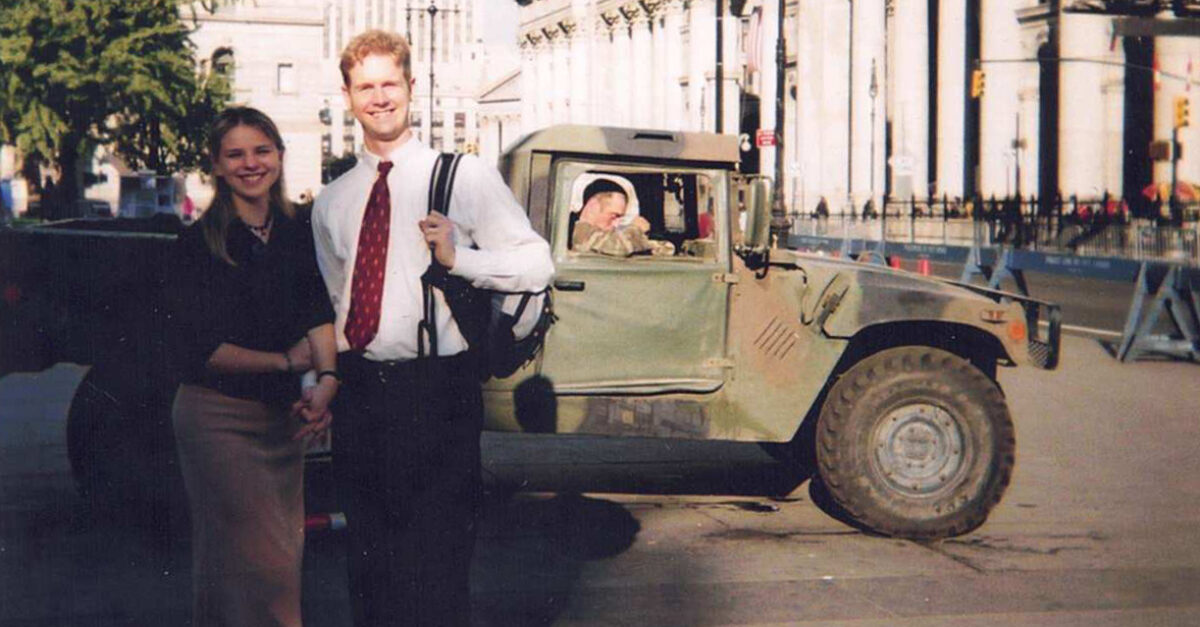
Irene Sankoff and David Hein get married October 12, 2001 in NYC City Hall.
(Courtesy of Irene Sankoff and David Hein)
How long had you been dating?
Sankoff: Seven thousand years! [Hein chuckles] No, since January 1995. This was 2001, so a minute. But we were pretty young. Our parents were a little surprised.
Hein: We were engaged, and we were going to be getting married a year later in October. And after all of this had happened, I think there was this sense of seizing the day and living for the moment, especially in New York.
Sankoff: I remember the sun was shining, and we rolled over in bed, and you said to me, “Why don’t we just get married on our pre-anniversary?” [Our official wedding ceremony] was coming up October 12, 2002, and he was like, “Why don’t we just do it? It’ll be the same anniversary because it’s October 12. Let’s just seize the day.”
Hein: We went down to City Hall, and my cousin came to be our witness. My cousin who had been in the towers, she hadn’t been back downtown since then. And it was a beautiful, simple ceremony that was just for us. Then we left and we were married and we took some pictures outside. There were tanks down there.
Sankoff: It was impossible to get a picture that didn’t have a tank in the background, or a large piece of tarp.
Hein: My cousin showed us the path that she escaped from, and we walked down there.
Sankoff: The stores are still closed, and everything was covered in dust. I still have the picture of “Heroes live forever” written in dust over one of the shops. And the air was still not great.
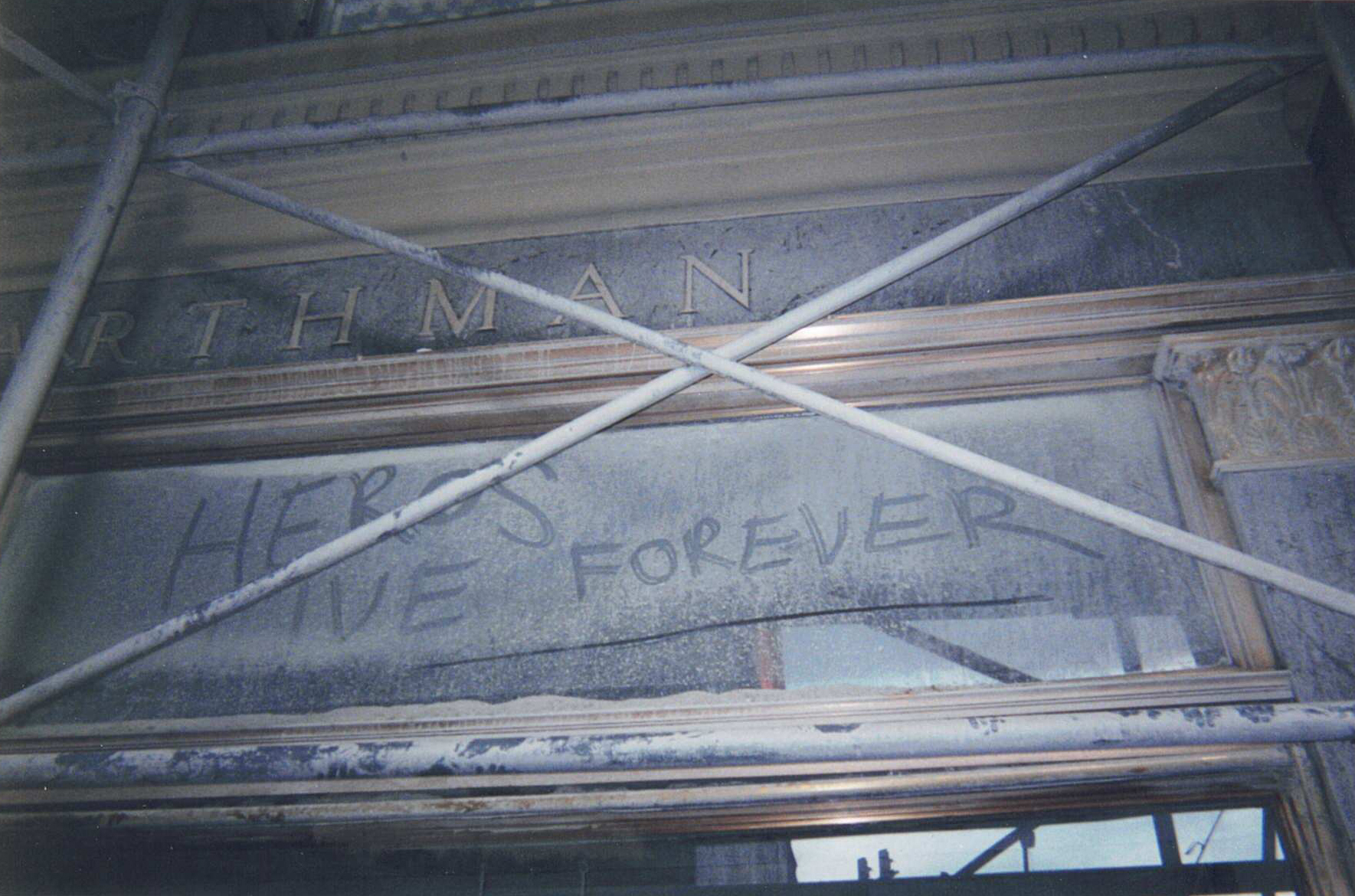
Lower Manhattan a month after 9/11.
The attack happened on September 11 and Broadway reopened September 13. What do you remember about what it was like in the artistic community and the conversations that were happening about what do you do as artists?
Hein: We were actually both working on shows, Irene was acting in a show, and I was doing the set design for a show. She was doing an Ionesco festival.
Sankoff: The Bald Soprano and Rhinoceros.
Hein: And I was working on The Dreamer Examines His Pillow.
Sankoff: The John Patrick Shanley play.
Hein: What I remember is walking along the street towards the theatres and seeing candles.
Sankoff: I was afraid to go out. And I remember going out, and everyone had a lit candle, and it was dark out. But I totally felt like I was being carried to the subway by these little points of light.
Hein: The audience was full. We expected no one to come out, and everyone came out to be together.
Sankoff: I was so thankful for the laughter. I think that first Friday was the most responsive audience we had.
Hein: My memory of the days after, 9/12 and going forward, was that people were so good to one another. And so careful and scared, but bonding together because of that. That feeling really infused Come From Away because it was the same thing happening there, and it was the same thing happening around the world. Which is part of why the story resonates with so many people. It continues to happen that in times of tragedy, we often focus on the horrible things that happen. And in the days after, it’s the wave of support and the wave of people who are doing good that doesn’t get highlighted enough.
I read that you were initially hesitant to even write Come From Away in the first place. When did you have the realization that making the musical isn’t disrespectful, it’s a contribution?
Hein: When we interviewed Mayor Claude Elliott in Gander, he told a story of his own experience of being asked to come to Washington, D.C. to receive a community resilience award on behalf of his community. And he was on stage between a mother who had lost her son and the CEO of Cantor Fitzgerald [whose 658 employees at the WTC died on 9/11]. He just felt like, “Why am I here? I should not be here.” And he told the story of what happened in Gander. And afterwards, the mother came up to him and hugged him and said, “Thank you for giving me hope again. Thank you for reminding me that there’s good in the world.” And the CEO shook his hand. He realized that there was a reason to tell this story. There’s a reason why he was there.
And I think time and again, what we’ve seen is that whenever we’re nervous—we originally thought that high school students in Canada were going to be forced to do this as a history project … I think we realized the same message that Mayor Elliott did, which is that telling stories like this can be healing. It can be valuable, and that it’s important to remind ourselves again and again. And we’ve been very blessed that we get to be reminded of the inherent power of kindness, and that people have the potential for good over and over. It’s what we’ve raised our daughter with, by seeing the show so many times around the world.
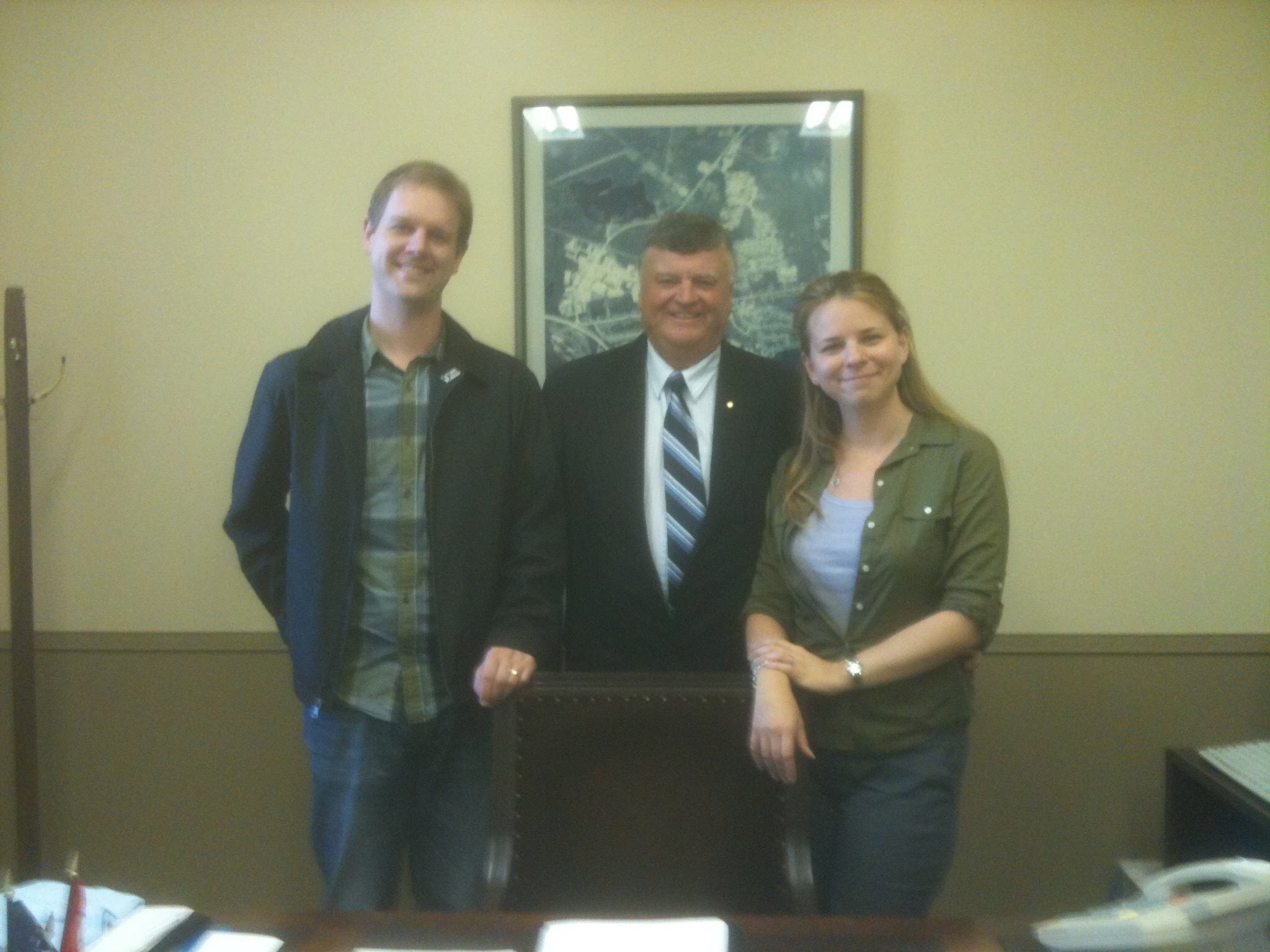
Irene Sankoff and David Hein with the Mayor of Gander, Clause Elliott, in 2011.
(Courtesy of Irene Sankoff and David Hein)
Sankoff: I remember being out in Gander and being like, “If we could just like capture what’s happening out here in a bottle and put it on stage. That’s what needs to happen.” It’s not even an interpretation. It was more of a replication of what had happened. The part that we did figure out was, like, we say the word “terrorist” once. We say “9/11” once. We just really avoided triggering words, and that was a decision. This isn’t to re-traumatize people; this is supposed to be a salve. This is supposed to be the same salve that the people of Newfoundland gave to the stranded passengers, and that our community gave to us while we were uptown in Manhattan.
And yes, music and storytelling is part of that. It’s a huge part of that. It’s what people turn to. I think one of the things we didn’t get into the show was the fact that Newfoundlanders, they weren’t just cooking and they weren’t just driving people around. They got out their instruments and started just playing at the front of the Legion Hall, because they just knew people needed distraction and they needed to be calmed down.
Hein: And the passengers from around the world would also play instruments. It really was a kitchen party there. We had many friends in our residence who were Manhattan School of Music students, and I remember a piano was pushed off to the corner, and Stefano and a couple of the guys just pulled it out. And at first, I was like, “Oh God, what are they doing?” And then he just started playing quietly, and then eventually, people were making requests, and people were going back to their rooms and getting their violins or whatever. And I don’t know how late we stayed up that night, but we were all there. I think there’s a way that art and theatre and music helps us heal in times like this. At the very least, it brings us together and reminds us that there’s more of us who want to help, and more of us who want to be together than those who want to divide us.
Since Irene, you’re going to be in Gander, and David, you’ll be next to the World Trade Center, what are you looking forward to at these anniversary events?
Sankoff: I’m looking forward to seeing everybody again. It’s been so long since we’ve been out there. I love running into people. I’m doing an interview in this SPCA office that Come From Away helped rebuild. It was falling down; after the very first student workshop we did, we passed a bucket so that we could start a spay and neuter program out in Gander. There’s a CFA wall in the SPCA, so it’s kind of neat to see what was built because of this [musical]. The fact that they’re embracing it so much, like in the College of the North Atlantic, there’s a big Come From Away sign in the parking lot, like, “Part of Come From Away happened here.” It’s right where David and I had parked our rental car [during our research trips for Come From Away].
Hein: What’s wonderful when I’ve been back recently is seeing the restaurants full. There’s now a museum and the airport talks about it. The town has grown and commemorated its role as an important story on that day, that we can be good to one another. It’s wonderful to come back.
For me, coming back to New York feels important to commemorate what happened to us 25 years ago, and to reunite with friends. Our Broadway cast is coming back together to do a concert on the 13th—the community that was forged by creating the show, and it’s a very hard show to do, there’s a lot of shared trauma of, “Where do your chairs go?” that has bonded them together. But also, there’s so many New Yorkers in that cast, and so many New Yorkers and people from around the world who have seen it in New York. And that meant something. So, to be able to commemorate the days after 9/11 is what I’m looking forward to doing with them.

What are you working on now?
Sankoff: We just did a presentation of a musical in Palo Alto, California, called Vienna, and it’s about neurodiversity. It’s about multiple timelines. We follow a timeline of kids being treated in a clinic in Vienna. And we follow a timeline of the first boy in America to be diagnosed with autism, and the way his community just embraced him, and he was able to grow and thrive. Not only that, but people realized how much he had to offer, and they just embraced him for who he was. They just became a community. It’s about being in a moment in time where we’re faced with the same decisions of: Are we going to just embrace and appreciate our differences or are we going to go down a path of divisiveness and fear?
Hein: We just finished Act Two and shared the full thing in TheaterWorks Palo Alto and TheaterWorks Silicon Valley [in California], and it was wonderful. A friend we know quite well came out and said, “This is exactly where Come From Away was several years before it was shared with the world.” So that feels really wonderful. We’re also working on a number of other shows.
I’m doing the book for Waking Ned Devine, which has been wonderful, and also is now a legacy piece. Glen Hansard’s tragic passing has been really awful. But we have these amazing songs that he created about loss and remembrance. I hope we can honor him by sharing them and doing justice, so we’re working through that and hopefully sharing it soon.
Sankoff: I’m working on something with Wayne Kirkpatrick and Chely Wright. She was the first major country singer to come out of the closet, and it tanked her career pretty much. But she knew that would happen, and she knew that someone needed to forge the way of acceptance. And now, when she’s not in country music, she does a lot of corporate work about acceptance and diversity, and just helping people be recognized for the gifts that they have, in a world that focuses a lot on capitalism.
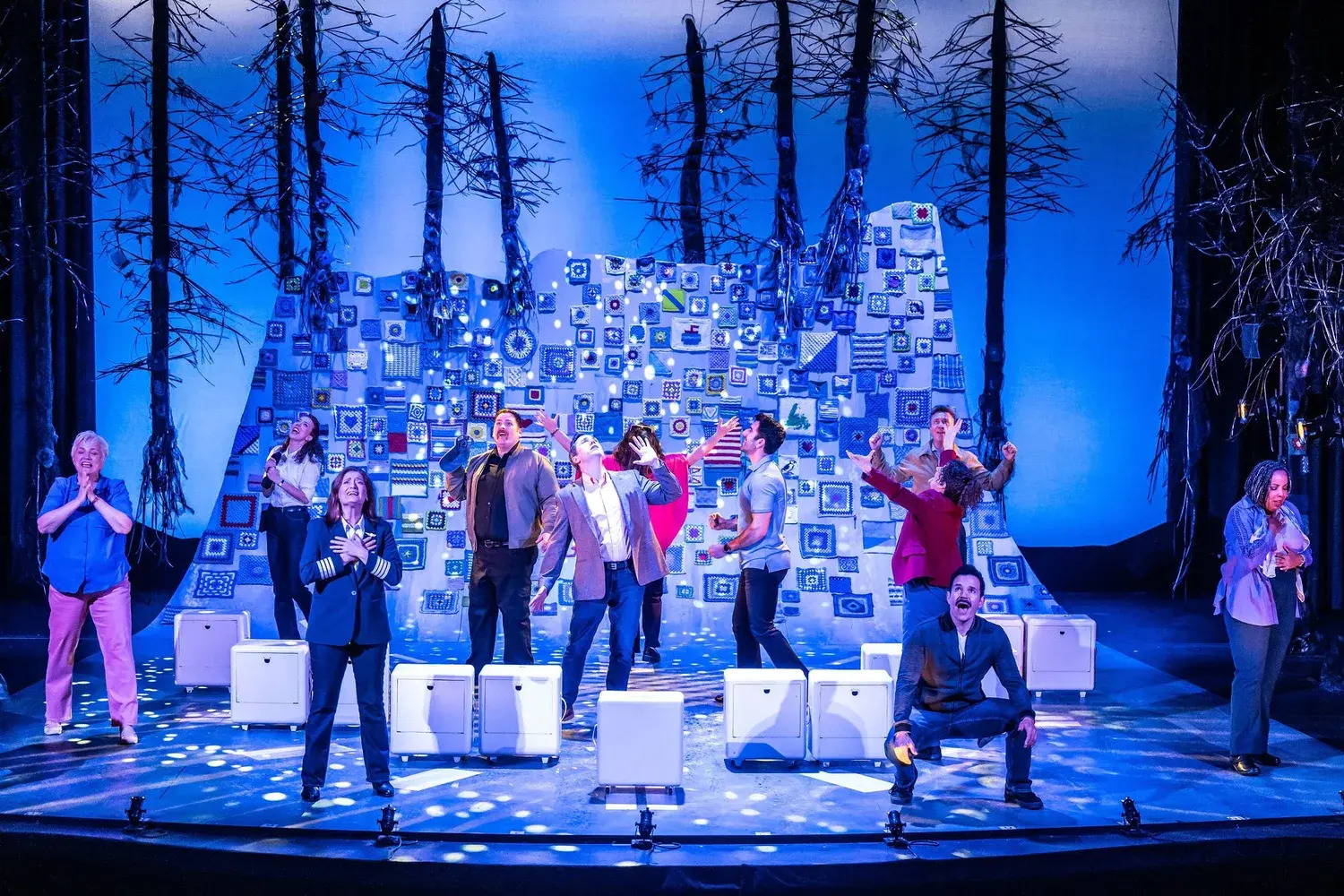
Come From Away in Gander, Newfoundland, in 2024
(Dahlia Katz)
Sankoff: I think I misunderstood the question about not thinking Come From Away was a musical. We were out in Gander, and there was a moment when I was like, “I don’t know how this is a musical. There are so many stories.” I was thinking something more like The Laramie Project would be the good way to do it. But then David just kept saying, “Just please wait, wait ’till we’re at this benefit concert this evening and just hear the music.” And as soon as I heard the music, I was like, “Oh my God, you’re right! It’s a musical.”
Hein: I had grown up on Newfoundland music, and everyone in Newfoundland plays an instrument. And so, when this concert began at the 10-year anniversary [of 9/11], everyone—the locals and the “come from away”s and us and the executives from Lufthansa—all just jumped up and started swinging each other around. It was so life-affirming, and it was so clear that this was how people get through tragedy: by coming together, by playing music, by telling stories. It’s how Newfoundlanders have have done it for for years and years and years. Because they have such horrible winters, they come together in times of hardship to share food, share stories, to share song. If we learn nothing else, we learn the power of that.