


Curriculum IV: Spin and Spin! Turn! Turn! Turn! rehearsals. Pictured: Wyeth Walker, Justin Rainey, Phillip Strom, Barrington Hinds, Rosa Allegra Woolf, Hannah Seiden, Babou Sanneh, Ryan Charles-Marc, Mak Thornquest, Babou Sanneh, 2026. Photo by Cole Witter, courtesy of the Lower Manhattan Cultural Council
On September 12, 2001, the Lower Manhattan Cultural Council (LMCC) planned to present a dance performance from choreographer and National Medal of Arts recipient Bill T. Jones. The site was specific: a special stage constructed between the Twin Towers, where LMCC also housed two of its artist residencies.
Of course, that performance would never take place—the day before it was set to open, the events of 9/11 shattered the country and left lower Manhattan devastated, forever changing the neighborhood LMCC was established to serve.
In the immediate aftermath, LMCC provided assistance to artists and the broader arts community. It also established the River to River Festival in 2002 to help draw people back to lower Manhattan while creating space for healing, joy, and reflection.
“The festival has always been a celebration of what is possible when artistic creativity, cultural institutions, civic bodies, and corporate entities come together in mutual support, and we recognize the importance of this ecosystem to the health, vibrancy and future of our city,” the LMCC website states.
In 2002 at the inaugural River to River Festival and again in 2022, LMCC invited Jones back to present iterations of that original piece performed in Battery Park. For the 25th anniversary of 9/11, LMCC saw another opportunity to use the performance as a point of departure.
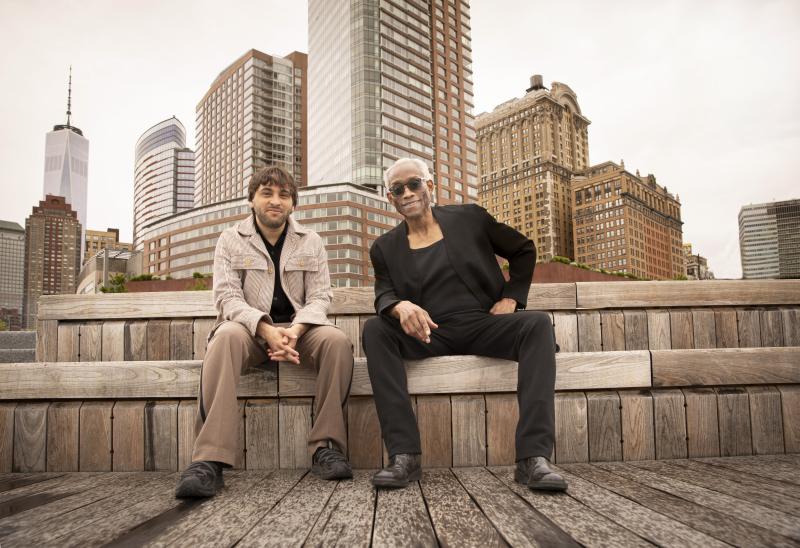
Composer Samora Pinderhughes and choreographer Bill T. Jones, 2026. Photo by Monique Carboni, courtesy of the Lower Manhattan Cultural Council
With support from a $60,000 National Endowment for the Arts grant, LMCC has commissioned Jones and composer Samora Pinderhughes to reimagine the piece to be performed near the Ground Zero campus timed with the 9/11 anniversary. The resulting work, Curriculum IV: Spin and Spin! Turn! Turn! Turn!,
will also conclude LMCC’s 2026 River to River Festival.
“I wasn’t here for 9/11, but I have a deep sense of what this city has gone through and what lower Manhattan has gone through,” said Moe Yousuf, LMCC’s chief executive officer and artistic director. “Revisiting this every year is an act of resilience. It’s the 25th anniversary, and there is an opportunity for further reflection.”
Today, lower Manhattan has been revitalized. It is once again a thriving financial center, with lush parks and what Yousuf describes as an “undefined cultural district”—one that continues to evolve through investment and partnerships, including LMCC’s collaborations with Battery Park City Authority and Jones’ New York Live Arts on this performance.
The Curriculum IV performance will take place at Robert F. Wagner Jr. Park, on the southwest tip of Manhattan, just blocks from the Ground Zero site and in view of the Statue of Liberty. The location is intentional—close to the hallowed grounds where the Twin Towers fell, and a public space that can host intentional audiences as well as passersby.
Just as the city looks different than it did 25 years ago, Yousuf knew that a commission revisiting the original performance could not look the same. Jones’ new work responds not only to what happened then, but also to how the world has changed since.
“[The 2001 performance] could never ever be the thing it was [supposed to be] because it’s so specific to that location and to those people and to who he was as an artist at that moment,” Yousuf said.
Art has often helped people come together and process trauma in times of crisis. Creative arts therapies are used by service members and veterans recovering from traumatic brain injuries sustained in the line of duty and communities who have experienced profound loss, such as Uvalde, Texas. and the arts have supported recovery in communities affected by natural disasters, including western North Carolina following Hurricane Helene.
Yousuf believes art is particularly valuable when responding to such events.
“If someone asked me what an artist does, I think they create order out of disorder,” he said. “To me, that doesn’t mean any chronology— it doesn’t mean coherent—but it means really looking at a bunch of different things and putting them in an order that means something to someone. Then they take that work, they show it to someone, and they say, does this mean something to you?”
Of Curriculum IV, Jones said, “To respond to this moment in the past when the world stopped, l am looking for a portrait of the external and the internal world of individuals like myself living in contemporary New York trying to be a responsive participant in the world right now. This is the curriculum I’m studying — what does it sound like? What does it move like? I would like to say that the piece wants to be bigger than the bodies that will be my company, that it will be a reflection of what’s seen in the families, speaking every language in the globe, out there by the water looking out at the Statue.”

Camille Phelps, Ryan Charles-Marc, 2026. Photo by Cole Witter, courtesy of the Lower Manhattan Cultural Council
Each person’s experience of 9/11 is different, and each person’s response to and engagement with Curriculum IV will be different as well. Yousuf said the performance is not intended to impart a specific takeaway. Instead, meaning can be found in the simple act of gathering in lower Manhattan on this particular anniversary.
“I don’t know if this is corny or not, but [I hope] that we can look around and acknowledge that we are separate but together,” he said. “Maybe we have different values. We came from different places. We are different people, but we are here. We’ve been brought here together and then try to understand what that symmetry is.”