
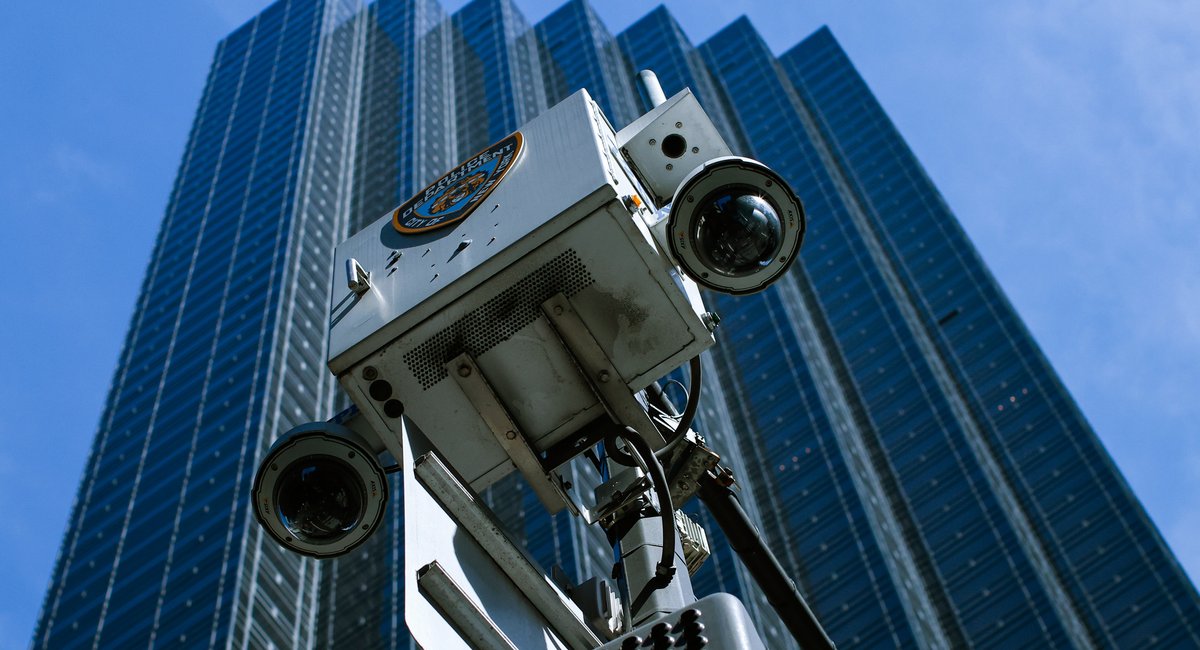
Joseph Pascarella expected more pushback from the public.
As a former NYPD captain, he responded to Ground Zero after the Sept. 11, 2001 attacks on the World Trade Center and watched firsthand as the city began to build a vast video surveillance network to prevent future terrorism.
Early efforts culminated in 2008 with the development of the so-called Lower Manhattan Security Initiative, giving police access to thousands of cameras on public and privately owned property south of Canal Street.
“ I was like, ‘There’s no way the public’s going for this,’” Pascarella said.
But most New Yorkers accepted the system, which was unprecedented in the United States at the time, despite scrutiny from civil liberties groups.
“ That’s when I realized that it’s just going to keep going where it is today,” said Pascarella, who now chairs the criminal justice department at St. Joseph’s University. “ You say ‘terrorism,’ and the public kind of gives the government a pass on all these technologies.”
The initial focus on Lower Manhattan evolved into a vast citywide surveillance network that now relies on what former Mayor Eric Adams described as more than 80,000 cameras to feed real-time footage into the NYPD’s comprehensive “Domain Awareness System,” which also compiles data from license plate readers, acoustic sensors and other records. Law enforcement deputizes private residents and business owners, who provide surveillance footage from closed circuit television and ubiquitous doorbell devices or have signed up to share tape from more than 5,500 cameras with the NYPD.
A quarter-century of technological advances and incentives have also fueled the rise of commercial tools, like AI-powered license plate readers, devices sold by the corporation Flock that are installed on private property, and facial recognition entry devices mounted on apartment buildings’ front doors.
The tools have proliferated despite scrutiny over identification errors, their concentration in low-income neighborhoods of color, the perpetuation of systemic biases and their use in the targeting of activists.
Constant surveillance is the ocean most New Yorkers now swim in. It’s no longer a question of whether our movements are captured on camera, but whether the technology has identified us through facial recognition or other biometric information, along with how long our data is being stored and who has access to it.
Pascarella now educates students who were born years after the terror attack and are accustomed to being watched on the street and tracked on their smartphones.
“You just assume there’s a camera now,” Pascarella said. “ Most of my students assume they’re under surveillance all the time.”
“It’s hard to dispute their perception,” he added.
In a written statement, NYPD spokesperson Bradley Weekes said the agency “enters into memoranda of understanding with private organizations that allow the department to access feeds from their closed-circuit televisions systems.”
“Access to the camera feeds and use of the footage obtained from the cameras are governed by department policies and applicable law,” Weekes added. “These cameras are a critical crime fighting tool to keep all New Yorkers safe.”
According to department policy, the agency does not have uniform records retention rules for all surveillance data. The department is required to delete surveillance video from some closed circuit cameras after 30 days, but can retain information in the Domain Awareness System indefinitely. The information can only be used for “legitimate law enforcement purposes or other official business of the NYPD,” policy states.
From terror to street crime
Surveillance experts draw a straight line from law enforcement responses, federal funding and public fear following the 9/11 attacks to the modern surveillance system that is now used to tackle street crime and monitor New Yorkers.
“ Sept. 11 really accelerated the infrastructure development and kind of opened that Pandora’s box that we no longer can go back to what things were like before,” said Michelle Dahl, executive director of the Surveillance Technology Oversight Project. “ So what we’re seeing now is private individuals being surveilled even in their own homes and buildings with the surveillance infrastructure that’s been built up by the private sphere.”
The system continues to expand.
In 2024, the Adams administration announced a new program to encourage even more local business owners to give police access to their surveillance cameras. Adams billed the effort as a tool to “gather real-time intelligence on crimes and swiftly apprehend individuals who are responsible” following a spike in offenses.
Two-and-a-half years later, business and building owners have registered more than 5,500 additional cameras through the “Connect New York” initiative, a partnership with the private firm Axon Fusus, according to city data.
The city is now attempting to link another 20,000 cameras in New York City Housing Authority complexes to its Domain Awareness System, a plan top police officials described at a City Council hearing last year. The effort spurred backlash and an ongoing lawsuit filed by tenant associations at two public housing complexes.
Pascarella credited the city’s surveillance network with helping to drive down crime over the past 25 years, but said there are drawbacks and serious unanswered questions.
“What’s the long-term management of this data, and who’s holding the government accountable with all this data that they’re collecting?” he said. “What is going on with this data?”
Civil liberties advocates have focused on those questions for years, seeking to curb the use of surveillance technologies and questioning their crime-fighting utility even as they have become more sophisticated and pervasive.
An October 2025 report by the Surveillance Technology Oversight Project said the city’s Domain Awareness System “circumvents Fourth Amendment protections by creating a dragnet around New York City.”
“We can’t walk, drive or take public transit anywhere without being captured on time-stamped, location indexed and easily searched camera footage,” the authors wrote.
Dahl, the Surveillance Technology Oversight Project’s executive director, said the rise of public and private surveillance challenges the constitutional protections against warrantless searches.
“It’s really a much larger issue about what costs are we as a society willing to pay in terms of our civil rights and liberties,” she said.
Technological innovation vs. civil liberties
Surveillance cameras predate the 9/11 attacks by many years, and investigators have long used footage from privately owned devices to solve crimes. A 1998 tally from the New York Civil Liberties Union counted 2,400 surveillance cameras across Manhattan.
“As long as we’ve had video cameras, we’ve had police looking at private video cameras,” said Bryce Peterson, an adjunct professor at John Jay College of Criminal Justice.
But Peterson said government regulators, including New York City, have struggled to keep pace with the development of new centralized technologies, like artificial intelligence-powered social media surveillance and facial recognition tools.
“A lot of time we’re learning these technologies on the fly,” Peterson said.
A 2020 law approved by the City Council required the NYPD to publish regular descriptions about its use of surveillance technology, like facial recognition. But a report three years later by the city’s inspector general determined the NYPD’s generic reports failed to “achieve appropriate transparency with the public.”
The Council strengthened the requirements last year and the NYPD published a revised policy around the use of facial recognition in February.
Councilmembers have now set out to regulate surveillance and facial recognition by private property owners.
Landlords have installed facial recognition technology in buildings across the city. City Council legislation intended to ban landlords from installing biometric tools that identify specific individuals has so far stalled.
“Innovation should not come at the expense of fundamental rights,” Councilmember Carmen De La Rosa, the technology committee chair, said at a hearing on the measure earlier this year. “Clear guardrails are essential.”
Pascarella, the former NYPD captain now in academia, said police and investigators will use whatever information they have access to.
“If you allow law enforcement to do anything, they will do anything,” Pascarella said. “They’ll just keep going until you tell them, ‘Oh, you can’t do that.’”