
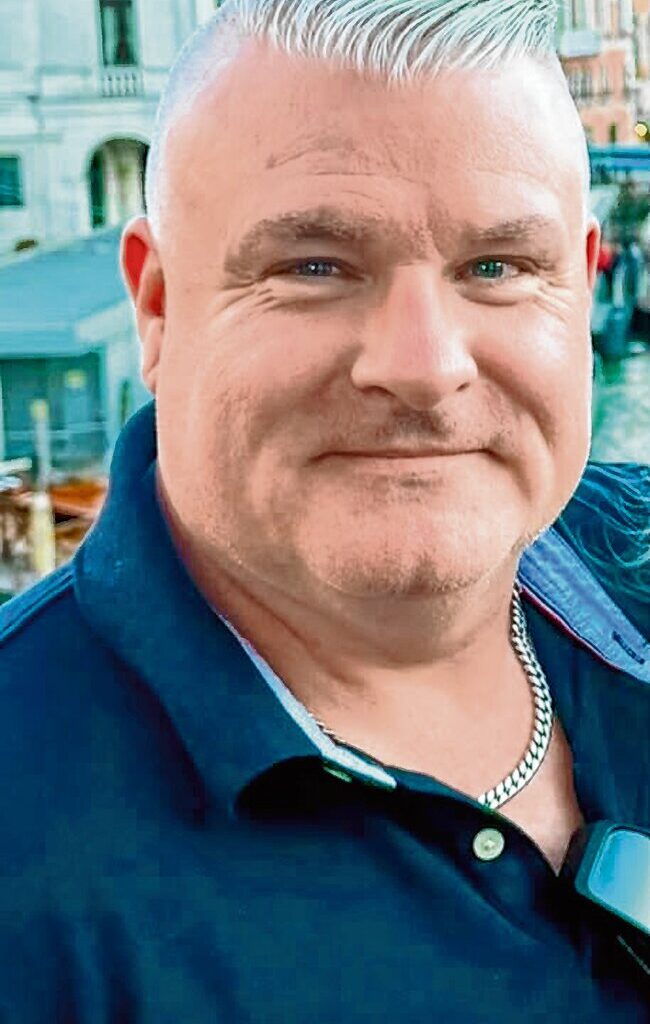
For Michael McNelis, Sept. 11, 2001, began with an answering machine message.
McNelis, 54, was home in Malverne preparing for his overnight shift with the New York City Police Department when he was told to report to work. A member of the NYPD since 1997, he was assigned to the 110th Precinct in Corona, Queens.
McNelis, who grew up in Oceanside, had desired to become a police officer since childhood.
“I wanted to be a police officer since I was a child,” he said. “I wanted to be a detective, it was as simple as that.”
A 1991 graduate of Kellenberg Memorial High School, McNelis earned a bachelor’s degree in criminal justice from John Jay College and later received a master’s degree in security management in 2018.
On the morning of the attacks, McNelis quickly dressed and drove toward Queens, navigating roads and parkways that had been closed. When he arrived at the precinct, officers — including some who had been on vacation — were reporting for duty.
“They didn’t know what to do with us because it was all so unusual,” he said.
McNelis was eventually assigned to the rear of a convoy transporting equipment into Manhattan. As the convoy approached Lower Manhattan, the scale of the destruction became increasingly clear.
“You have airplanes that go over your head,” he said. “But you ever hear a fighter plane that goes over your head? … It was so loud.”
Dust and debris made it difficult to follow the convoy, and McNelis became separated from the group near City Hall. Another officer warned him not to continue toward the World Trade Center site.
“I remember he said to me, ‘You do not want to go that way. You may not come back out,’” McNelis said. “That’s when the danger became too real.”
In the days that followed, McNelis returned to Lower Manhattan for 12-hour shifts. He described streets covered in ash, debris, broken pipes, flooding, burned vehicles, and shattered glass.
“It was like a volcano exploded,” he said. “Once you smell it, it just never goes away.”
During one assignment, McNelis and other officers moved toward the World Trade Center site to see whether they could assist workers on the pile. Suddenly, a warning sent hundreds of people running as officials feared another structure could collapse.
“The next minute, my sergeant was grabbing me by the neck,” McNelis said. “We’re running behind a building, but we never knew which one was safe and which was going to fall.”
That uncertainty continued in the weeks following as officers guarded buildings, transportation routes and other locations while authorities assessed the possibility of additional attacks.
Still, McNelis said the experience did not make him reconsider his career.
“I didn’t really get turned off from the job,” he said. “I knew I had work to do. So, I just went back to work.”
McNelis became a detective in 2003 and later worked in the Organized Crime Bureau and Special Victims Unit. In 2016, he joined an NYPD squad assigned to the Manhattan district attorney’s office, where he investigated computer crimes, online fraud, cryptocurrency cases, and child exploitation.
His career also reflected the changes in policing after 9/11.
“Training became more about counterterrorism than anything,” McNelis said. “There were so many new procedures. We got masks that we were required to carry in case we came across something hazardous. We never had to do that before.”
He also saw increased coordination among police, fire and other agencies.
“They tried to put all that together so that everything would work seamlessly,” he said.
More than two decades later, McNelis continues to deal with the effects of his time at the World Trade Center site. He has been diagnosed with several health conditions attributed to his exposure and receives care through the World Trade Center Health Program.
McNelis retired from the NYPD in December 2022 and now works in protective security services.
For McNelis, answering the call on Sept. 11 was not the end of his service.
“There’s always something to be done,” he said. “I had to do what I had to do.”
McNelis’ career is a reminder that for many first responders, answering the call did not end when the smoke cleared — it became a lifelong commitment to serving and protecting others.
To read more from the Herald’s Remembering 9/11, 25th anniversary special section, click here.