
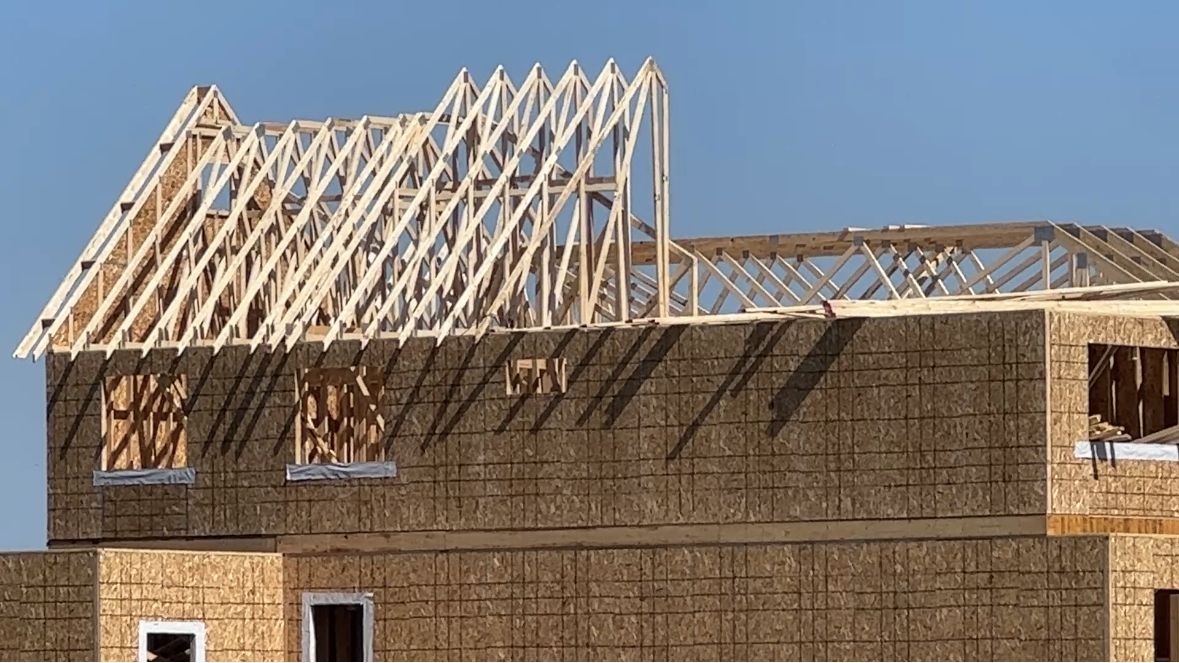
Another drawn-out budget battle could be brewing over potential changes to New York state’s scaffold law.
A new poll from the right-leaning think tank Empire Center has generated some buzz around changing New York’s scaffold law, with 67% of New Yorkers surveyed supporting responsibility-based limits on workplace injury liability.
The poll more broadly found respondents in the mood for tort reform and legislation that tackles insurance fraud and limits on what the poll describes as frivolous lawsuits.
New York’s long-standing statute holds contractors as well as business and property owners fully responsible for certain gravity-related injuries when required safety protections fail, except in some limited circumstances.
Multiple legislative sources tell Spectrum News 1 they are bracing for a battle over the law in the upcoming budget cycle if Gov. Kathy Hochul, a Democrat, wins reelection and ultimately puts forward a proposal, as they expect her to. Hochul is no stranger to picking intense policy fights with the heavily Democratic state Senate and Assembly, and they say it could become as contentious as this year’s fight over auto insurance policy changes, which lasted into May and helped propel the latest state budget in 15 years.
The governor’s office did not weigh in when asked by Spectrum News 1 if Hochul plans to propose changes in her executive budget if she wins in November.
The statute places a nondelegable responsibility on owners and contractors to provide required safety protections, and advocates like Charlene Obernauer, executive director of the New York Committee for Occupational Safety and Health, say that’s how it should stay.
“When they’re working from heights, they have the scaffold safety law and it allows them to sue their employer and that’s a protection they have that encourages them to keep their job sites safe,” Obernauer said.
In the wake of Hochul’s successful push to alter the serious injury threshold for auto insurance, amid other changes in an effort to bring down premiums, those in favor of taking on the Scaffold Law see momentum building for further tort reform.
Andrew Rein, president of the Citizens Budget Commission, argued New York is an outlier in having a Scaffold Law exist alongside the workers’ compensation system and said that, by driving up the cost of building through high construction insurance rates, the law stands in the way of multiple measures intended to tackle affordability.
“New York is the only state in the nation where owners, contractors, and employers pay full damages even if the injured worker is at fault because they ignored training or were intoxicated. Not only is that unfair, but it drives up the costs of building housing, schools and transportation,” Rein said, though courts have recognized limited circumstances in which a worker’s conduct can be the sole cause of an injury.
Like the car insurance fight, the push for change is raising questions over whether limits on individuals’ ability to seek damages could leave injured workers like Brian De Jesus, injured by a falling steel beam while performing general maintenance on a job site, with fewer options for seeking recourse.
“The rope snapped and the metal beam came down and it hit the scaffold and once it hit the scaffold it fell on my head,” De Jesus said. “I just want Albany to keep us protected and I hope the legislature can hear stories like mine.”
But Tom Stebbins, executive director of the Lawsuit Reform Alliance of New York, insisted that much of the opposition is coming from the state’s trial lawyers, who he argued stand to gain from a litigation-based system.
Stebbins pointed out that most other states did away with their scaffold laws decades ago as policies around workplace safety modernized.
“They got rid of it in the 1910s and 1920s when the workers’ compensation system came about. That is what the workers’ compensation system is for; even if these reforms come about, workers will always be compensated,” Stebbins said.
The state’s trial lawyers association has previously blasted insurance companies for pushing the reform effort in their favor.