
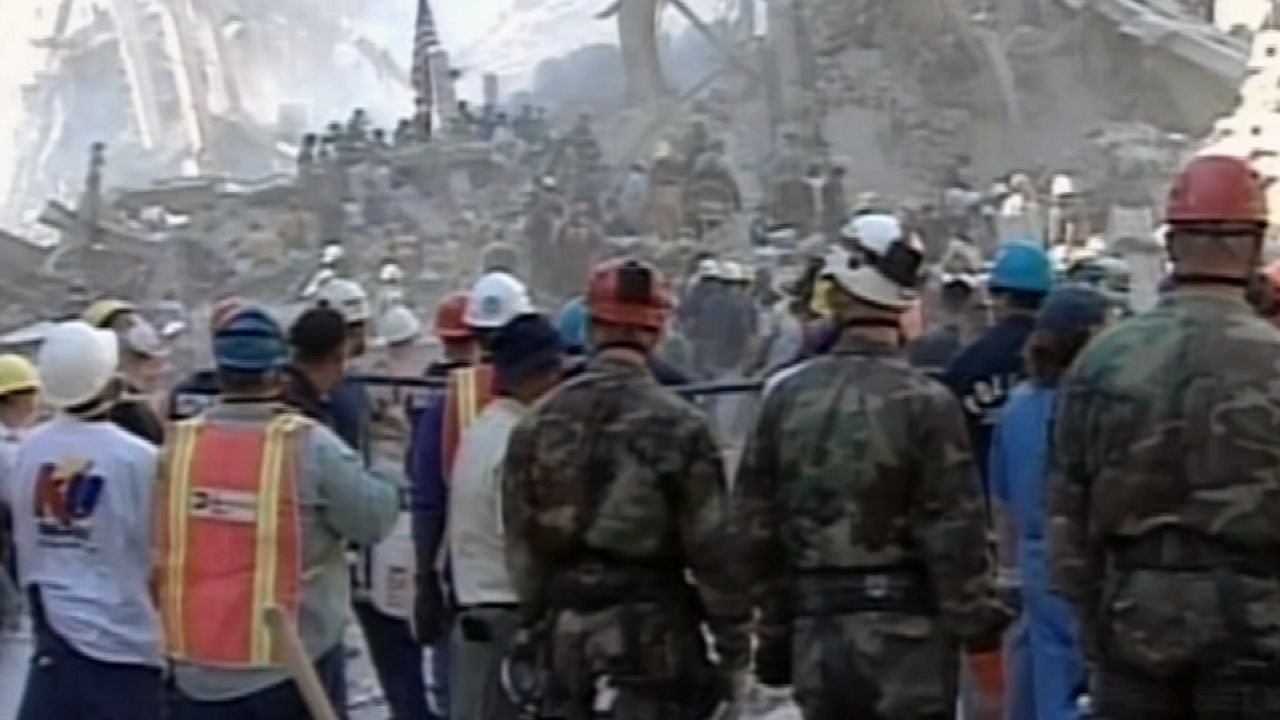
As the dust settled in Lower Manhattan, Nadia Vizueta, a then 20-year-old journalism student at New York University, set out to document the aftermath of Sept. 11.
“I had to interview survivors and business owners and residents in the area to tell their story,” Vizueta recalled.
Nineteen years later, Vizueta, by then a mother of two young children, was diagnosed with a rare and aggressive form of breast cancer.
“I thought I was too young for cancer,” she explained.
Vizueta eventually joined a support group, where she encountered women with similar diagnoses who had also been exposed to toxic material.
“I had never really made the connection,” she continued.
The group encouraged Vizueta to enroll in the World Trade Center Health Program, a federal program that provides no cost medical monitoring and treatment for certified 9/11-related health conditions.
Vizueta told NY1 her condition affects only about 1% of people diagnosed with breast cancer and has required expensive and, at times, experimental treatment.
“Because I was in [the World Trade Center Health Program] it really alleviated a lot of the concerns, like, ‘Will I be able to financially handle some of this treatment?’” she said.
“When you have a cancer diagnosis, you’re almost up against a clock,” Vizueta added.
Now, after six years with no evidence of disease, Vizueta is helping the program reach a group officials say remains dramatically underrepresented — people who were children or young adults when the attacks occurred.
The city’s Department of Health has estimated that approximately 100,000 children were potentially exposed to toxins in the aftermath of 9/11. Yet of the roughly 150,000 people enrolled in the World Trade Center Health Program, only about 3,000 were children at the time of the attacks, according to Capt. Kristi Anderson, MD, the program’s administrator and chief medical officer.
Anderson said one obstacle to reaching that population is a lingering misconception about whom the program serves.
“I think there’s a misconception that a lot of people believe the program, the World Trade Center Health Program, is really only for responders,” Anderson said. “And so this is an opportunity for us to make sure that people know.”
The program also serves eligible survivors who lived, worked or attended school in areas affected by the attacks and their aftermath.
Anderson said low enrollment among people exposed at young ages has implications beyond individual medical care. She explained that it has contributed to gaps in researchers’ understanding of the long-term health effects of 9/11 exposure on children and young adults — including those who were exposed in utero.
The uncertainty is one reason Anderson is encouraging eligible people not only to enroll in the health program but also to participate in its research initiatives.
“Overall, that’s better care for our members, but also can help inform disaster response in future, potentially, God forbid, future disasters,” Anderson said.
The World Trade Center Health Program was launched a decade after the attacks under the James Zadroga 9/11 Health and Compensation Act.
Ben Chevat, the executive director of the 9/11 Health Watch, told Spectrum News that city officials concealing the scope and seriousness of toxin exposure after the attack — concerns recently amplified by robust document release he helped trigger — contributed to the delay.
When asked about such concerns, Anderson stressed that increasing program enrollment — particularly among those who were young at the time of the attacks — could help close research gaps and improve medical outcomes for both current members and future patients.