
Just months after the twin towers collapsed to the ground 25 years ago in New York City, most of the steel that fortified the 110-story buildings in Manhattan had been shipped overseas to feed the global scrap metal market.
But many of the pieces that remained stateside — nearly 2,000 of them — have gradually made their way to all 50 states to be put on display as part of solemn memorials, including several installed in Colorado. Some steel made its way across the world to serve as part of overseas memorials, to places as far-flung as New Zealand, Italy and Canada, according to a new book about the fate of the steel that came crashing down.
On Friday’s anniversary, the broken and shattered strands of steel stand as reminders of the tragic events of Sept. 11, 2001, the day that 19 Islamic radicals hijacked four planes and crashed them into the World Trade Center in New York, the Pentagon in Virginia and a field in Pennsylvania — the last one occurring after passengers and crew tried to rush the cockpit.
Nearly 3,000 people died as a result of the terrorists’ actions that day, though few bodies were recovered because of the extraordinarily violent impacts and the ferocious fires the commandeered planes caused.
“The agony of the steel — the twisting — is a metaphor for the people who died that day,” Max Holleran told The Denver Post this month. “Bringing this steel to all parts of the country gives communities closure — a kind of burial.”
He and his brother Sam, both of whom spent a significant chunk of their childhoods in Boulder, wrote the newly released book “Scattered Steel,” which tells the story of what happened to the tons of steel that once supported the nearly 10 million square feet of floor space the towers contained.
Around a dozen pieces of gnarled metal ended up in memorials in Colorado, including at fire stations in Louisville and Denver and at sites in Grand Junction, Colorado Springs, Broomfield and Pueblo.
With few burials possible following the attacks, “alternative death rites” were needed to memorialize the tragedy of that day, the Holleran brothers write in their book, with “proxy funerals and mourning rituals … performed not on bodies but on an architectural component: structural steel.”
That structural steel holds a special place in the heart of 84-year-old Don Addy. Addy served as president of the National Homeland Defense Foundation, a now-defunct Defense Department program that supported military personnel and their families.
He is responsible for bringing a half-dozen pieces of World Trade Center steel to Colorado Springs, most of which went to the military bases that give the city so much of its identity. Standing under a large, mangled I-beam memorial at Fort Carson’s Gate 1 this week, Addy thought back to the countless 9/11 ceremonies he had attended and spoken at.
“If you look at that, you can’t possibly misunderstand the power of the destruction and damage caused by these buildings’ collapse,” he said, pointing to the contorted 17-foot-long beam. “That’s the way I brought it in.”
As years have passed, the ceremonies honoring those who died on 9/11 — and in the wars that were launched in response to the attacks — have evolved, Addy said, as those alive on the day have become fewer. In fact, his search for steel pieces in New York in 2010 was prompted by a colonel at Fort Carson.
The colonel told him a memorial could help his young soldiers, who were just 10 or so years old in 2001, better understand the day’s significance.
“Why are we in these wars? Why are we doing this?” Addy said, pointing up to the twisted steel monument. “Because of that.”
Now, 16 years after the memorials were unveiled, that generational disconnection is even more pronounced, with nearly a third of Americans now either too young to remember 9/11 or not yet born when it happened. That has created fertile ground for new, and often pernicious, narratives to form around that day, Addy said.
That includes comments from Colorado Democratic House candidate Melat Kiros, who is heavily favored to represent Denver in Congress starting in January. The democratic socialist, who was a young child on 9/11, was sharply criticized in recent months after saying the attacks on the United States were “inevitable,” a comment that U.S. Rep. Diana DeGette, whom Kiros had challenged in the Democratic primary, said “shocked and disgusted” her. Kiros beat DeGette by double digits in the June 30 primary.
Addy feels comments like Kiros’ are a rewriting of history that shifts blame from the terrorists who carried out the attacks to the country that was attacked.
“I’m very worried about the rhetoric that has popped up around that day,” Addy said. “It’s propaganda.”
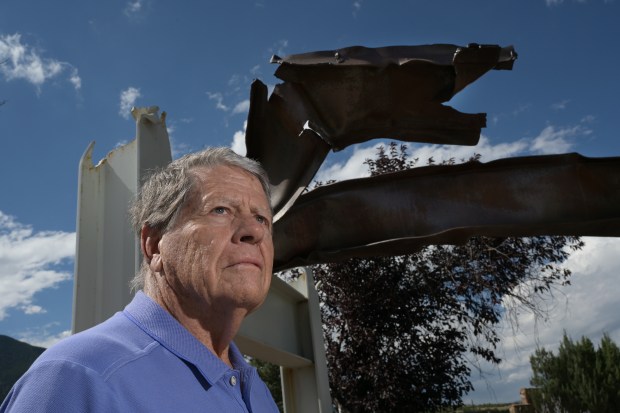 Don Addy poses for a portrait in front of a sculpture that contains steel from the World Trade Center at Fort Carson in Colorado Springs on Tuesday, Sept. 8, 2026. (Photo by Hyoung Chang/The Denver Post)
Highest ‘steel-to-citizen’ ratio
Colorado Springs is cited in “Scattered Steel” as the city with “one of the country’s highest steel-to-citizen ratios” when it comes to World Trade Center remnants.
Memorials can be found at Fort Carson, Peterson Space Force Base, Schriever Space Force Base, the Cheyenne Mountain Complex, the U.S. Air Force Academy and the campus of the University of Colorado at Colorado Springs.
“In a place where so many people were lost in the War on Terror, it becomes a way of talking about their sacrifice and of rationalizing these wars that were not going very well,” Holleran said of the country’s extended conflicts in Afghanistan and Iraq following 9/11.
Most of the memorials in Colorado Springs are on base, behind military checkpoints, but the ones at Fort Carson and on the CU campus are accessible to the public. The memorial at Fort Carson sits just feet from a tribute to soldiers from the base killed during the wars in the Middle East over the last quarter-century.
“In the years since 9/11, steel has become the de facto language of memorialization, and the placement of hundreds of salvaged steel beams in local memorials has spread the grief of the attacks to every U.S. state,” the Hollerans write in their book. “These scattered memorials are relics of a new kind, diffusing the national grieving process.”
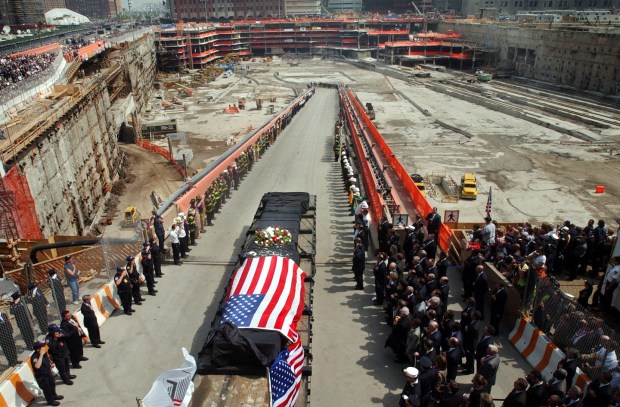 A flatbed truck carries away the last piece of steel salvaged from ground zero, the site where the World Trade Center once stood, during a ceremony marking the end of recovery and cleanup efforts in New York City on May 31, 2002.(Photo by Helen H. Richardson/The Denver Post)
The steel relic mounted on three beams at Fort Carson’s Gate 1 was brought from a hangar at New York City’s John F. Kennedy International Airport in 2010 on a flatbed truck driven by a father-and-son team and paid for by the then-Coors Brewing Company, Addy said.
The steel had been stored at the airport, “and, for several years, (was) largely forgotten about,” the Hollerans write.
“People want to touch it,” Addy said, looking up at the beam this week. “This is where people died.”
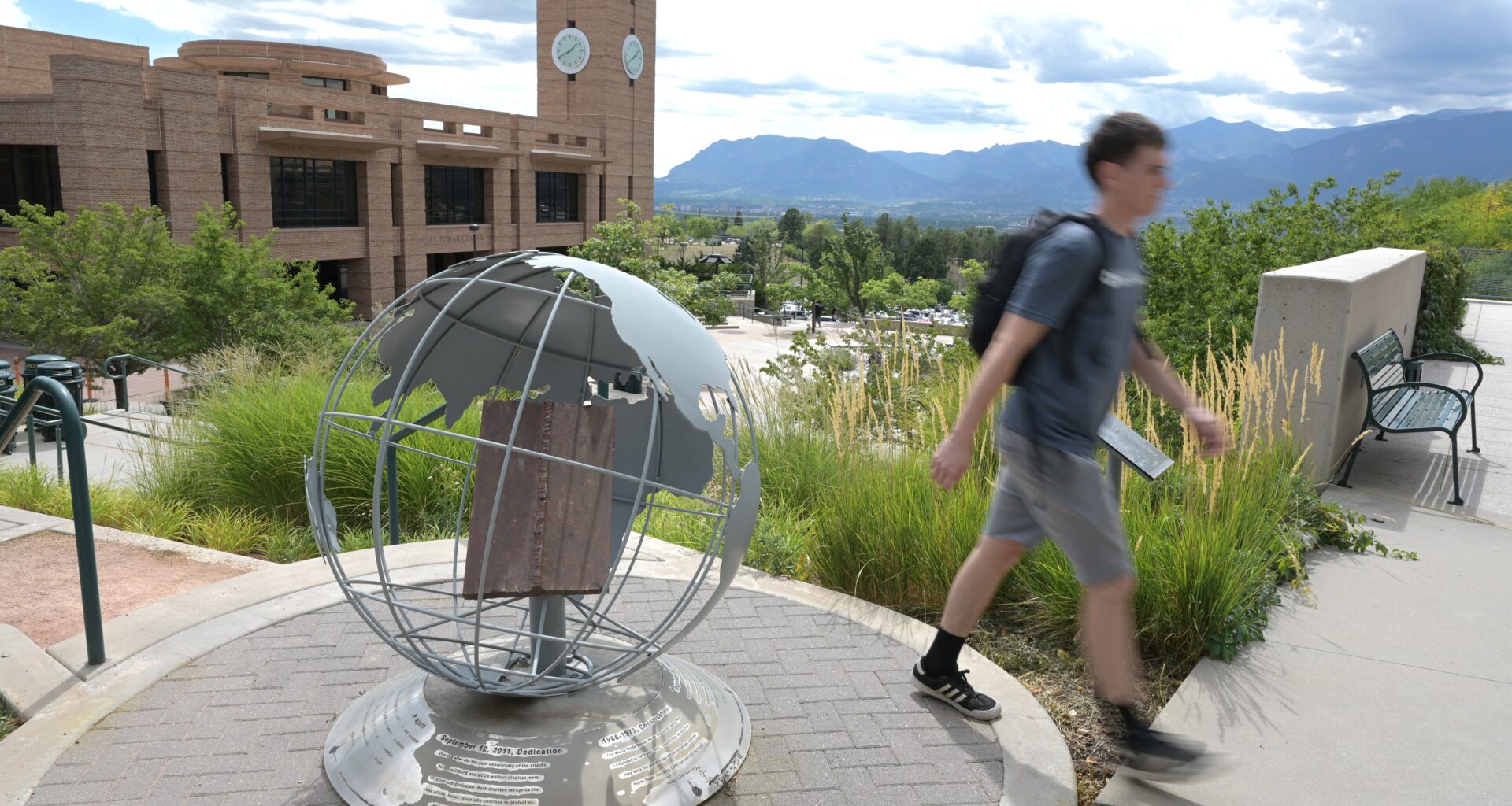
There is no better place in the city than the CU campus to provide the tactile connection that so many seem to want when they come across a piece of 9/11 steel, Addy said. A small team of students in the school’s College of Engineering and Applied Science spent the better part of a year designing and building a large memorial for Cheyenne Mountain.
They made a smaller version, complete with a globe partially shrouding a piece of World Trade Center steel, for the CU campus. It was dedicated on Sept. 12, 2011 — one day after the 10th anniversary.
The steel inside the globe is rusted and looks rough — and that’s on purpose, said Peter Gorder, the engineering department’s chair. He oversaw the students’ work on the memorials.
“We wanted it to look like it looked when it was dropped off on our front step,” he said. “And the globe concept reflected that this was a world-changing event.”
Gorder, 63, was in his second year as a professor at CU when 9/11 happened. His son was watching SpongeBob SquarePants on the kitchen TV that Tuesday morning when his wife told him to switch the channel. He saw a plane crash into the second tower.
“It was a very meaningful event in my life,” he said of 9/11.
What Gorder remembers most about the process behind the fashioning of the memorials was the need people had to touch the steel while it sat in the department’s machine shop.
“We had people coming from all over campus to put their hands on that beam,” he said. “People just wanted to be in its presence.”
In “Scattered Steel,” Gorder said that 15 years after the memorial was put in place at the top of an outdoor staircase between two engineering buildings, hundreds of people a day walk by it — but they pay it little attention.
“Which is, I don’t know, maybe not unexpected, but kind of sad,” he told the authors.
That was the case for Jacob Biles, a 19-year-old student at the university now. He said he passed the memorial half a dozen times a week but had no idea what it represented — that is, until his parents visited him on campus and told him what it was.
“It should be something people think about,” he said this week. “It’s still affecting us to this day.”
A few minutes later, senior Clara Aziz walked past the steel-in-globe sculpture. Until that moment, the 22-year-old had no idea what it was.
“I just thought it was a metal sculpture of the globe,” she said. “I guess it doesn’t affect me as much as someone who was alive at the time (9/11 happened).”
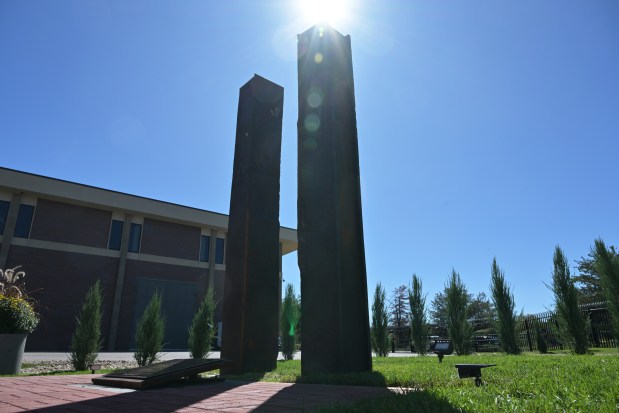 A new 9-foot, 11-inch monument made from steel from the wreckage of the World Trade Center stands outside the United Airlines Flight Training Center in Denver on Thursday, Sept. 10, 2026. (Photo by Hyoung Chang/The Denver Post)
‘Never forget’
United Airlines Captain Miles Morgan, who is managing director of flight training for the airline, said he oversees young pilots who weren’t alive when 9/11 happened.
That’s why he is excited to unveil a memorial made of 9/11 steel — Colorado’s latest — in a ceremony Friday at United’s flight training center in Denver. It comprises two nearly 10-foot-tall steel beams representing the World Trade Center towers that once dominated the skyline of Lower Manhattan, he said.
Eighteen United employees died in the attacks, he said.
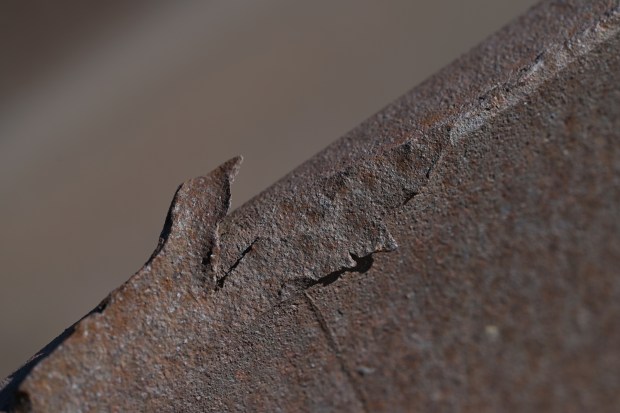 Steel that was once part of the World Trade Center is part of a memorial outside Fire Station 35 in Denver, as seen on Wednesday, Sept. 9, 2026. (Photo by Hyoung Chang/The Denver Post)
For Morgan, it’s personal. Over his 31 years as a United pilot, he said he flew both of the United jets that were deliberately crashed that day 25 years ago, one into a World Trade Center skyscraper and the other into the field near Shanksville, Pennsylvania.
“It was a horrifying thing to watch,” he said. “That’s why the monument we’re dedicating Friday is so special to us.”
Max Holleran, now 41, was a student at Boulder High School on 9/11. He watched the day unfold on a TV in the school’s library.
He hopes that at some point people can come to terms with the solemnity of the day, and honor those who died that day, while at the same time leaving space for discussions about U.S. foreign policy and religious extremism.
At Colorado’s most extensive and comprehensive 9/11 memorial in Broomfield, all was quiet at midday on a workday this week, as the collection of bronze placards mounted to stone bases told the story of what happened on Sept. 11, 2001.
Tucked between two pieces of flagstone, below a sculpture of a fireman resting his head on a beam — the bottom of which was buttressed by a piece of steel from ground zero — was a handwritten note written in pink magic marker. Below it sat a solitary red rose.
“Keep America free from all enemies foreign and domestic,” the note said.
And then, in all capital letters on the back: “NEVER FORGET.”
Get more Colorado news by signing up for our daily Your Morning Dozen email newsletter.
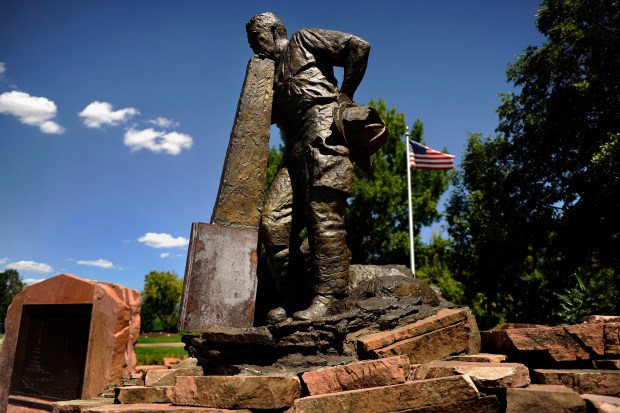 A sculpture depicts an FDNY firefighter resting on part of a steel beam at the Broomfield 9/11 Memorial on Aug. 23, 2011, in Broomfield. The bottom part of the beam in the sculpture is steel from the remnants of the World Trade Center building in New York. (Photo by Joe Amon/The Denver Post)