
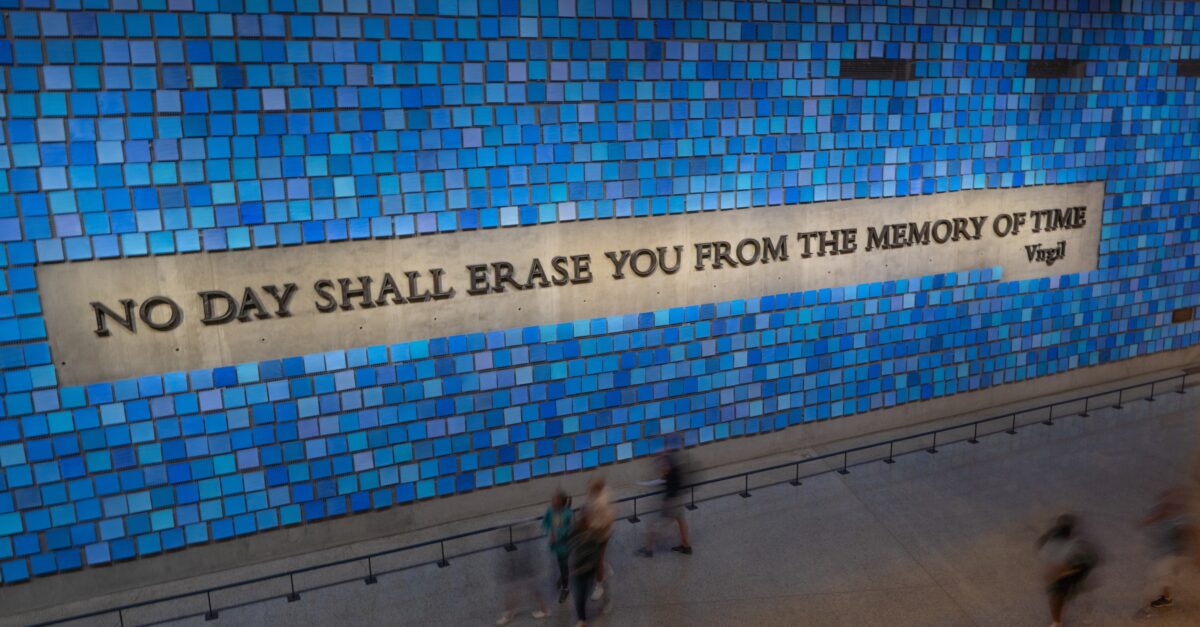
“Terrorist Attack at NYC’s World Trade Center Shuts Down Bway Theatres,” read the headline on Playbill.com on September 11, 2001. As New Yorkers emerged from the fog of shock from that horrific September morning, the question on everyone’s minds were: What do we do? What can we do?
For theatre artists working in New York City at the time, September 11 was a day to go dark as sirens rang throughout the city. Instead of lighting up the stage, the Shubert Organization sent its stage lights from the Belasco Theatre down to Ground Zero, to illuminate the site and helped first responders see as they performed their heroic rescues. Then on September 12, as Broadway went dark for another day, New York Mayor Rudy Giuliani told then Broadway League President Jed Bernstein that Broadway needed to reopen as soon as possible—preferably on September 13. But for theatre artists—some of whom were in the middle of performing shows, while others were getting ready to open new shows—getting back to work came with a mix of emotions.
For the 25th anniversary of 9/11, Playbill reached out to theatre artists, many who were working at the time. Their reflections are below.
READ: The Creators of Come From Away Recall Living in NYC During 9/11
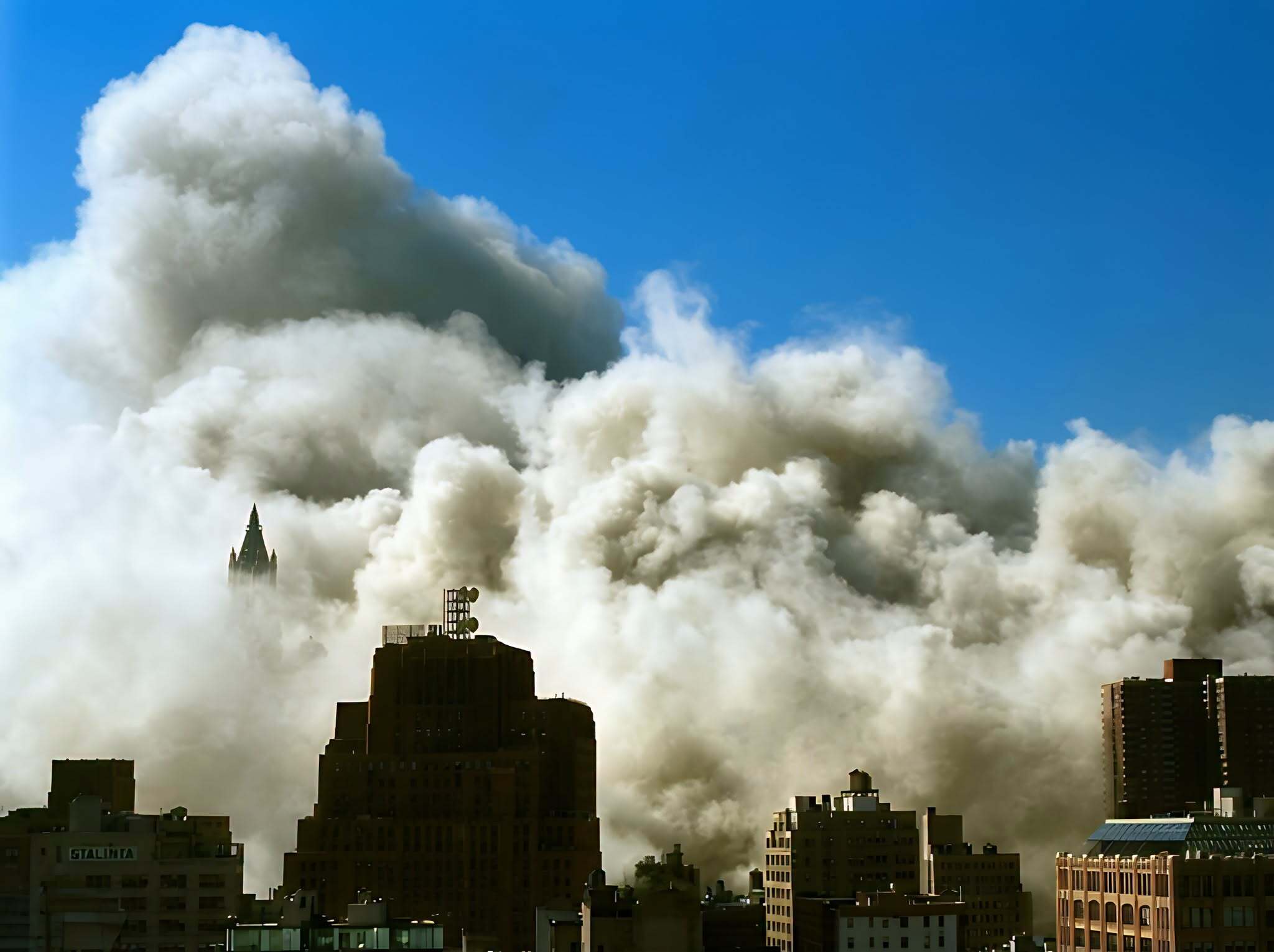
Lower Manhattan on 9/11, as seen from Richard Jay-Alexander’s home.
(Courtesy of Richard Jay-Alexander)
Director/producer Richard Jay-Alexander lived blocks away from the World Trade Center. He shares some of his memories from the day below.
Richard Jay-Alexander: It’s so unbelievable that 25 years have passed since that day that seemed like a nightmare. I was asleep when the first building got hit, and what woke me was the non-stop phone ringing. I pick it up, drowsy, and hear, frantically, “Richard, is Mommy there?” It was one of the daughters of my housekeeper, Golen. I told her, “No, not yet. What’s wrong?” And the screaming started on the other end of the phone. Golen used to come over in the mornings, from Jersey City, via World Trade Center. I was told to turn on the television. I am in shock. The phone calls, in sequence, are my dad and Bernadette Peters.
The second plane crashes, and I go out onto my terrace to look. I am, literally, just blocks down the street from the event taking place. I’m on the phone, now, with Bernadette, as we are supposed to begin the Rodgers and Hammerstein album the next day.
All of a sudden, the building collapses (the second one hit fell first), and I see everything rolling down the street. I hung up on Bernadette and jumped back into my apartment, closed the terrace door, and turned off the air conditioner, when I am suddenly surrounded in white and can no longer see outside. Just me and my dog, JoJo. She knows something is wrong.
Next call: My lawyer, who I’m hysterically telling what’s going on, and he says, “It’s a beautiful day here in midtown.” Now, I’m freaking out, and the story is becoming clearer from the television reporting. When the second building falls, collapsed (it the was the first one hit and had been burning longer), that debris also came rolling down the street, and, now, we are surrounded by blackness.
I’m going to leave the story at this point, as it was a long, dramatic, horrifying day. Finally, that night, we located Golen in midtown (they had all been escorted north). The firemen stormed our building of 20-plus floors asking us to evacuate, fearing a gas explosion in Lower Manhattan. So, JoJo and I hit the East Side Highway and trekked until we found someone we knew at home. That happened to be Amy Irving and her family, who took us in. No subways, no phones—nothing.
I took hundreds of photos that day and night and the days that followed. Today, I will take that thumb drive and relive it, which is always very difficult. This is the first time I have written about that day. We must never forget…
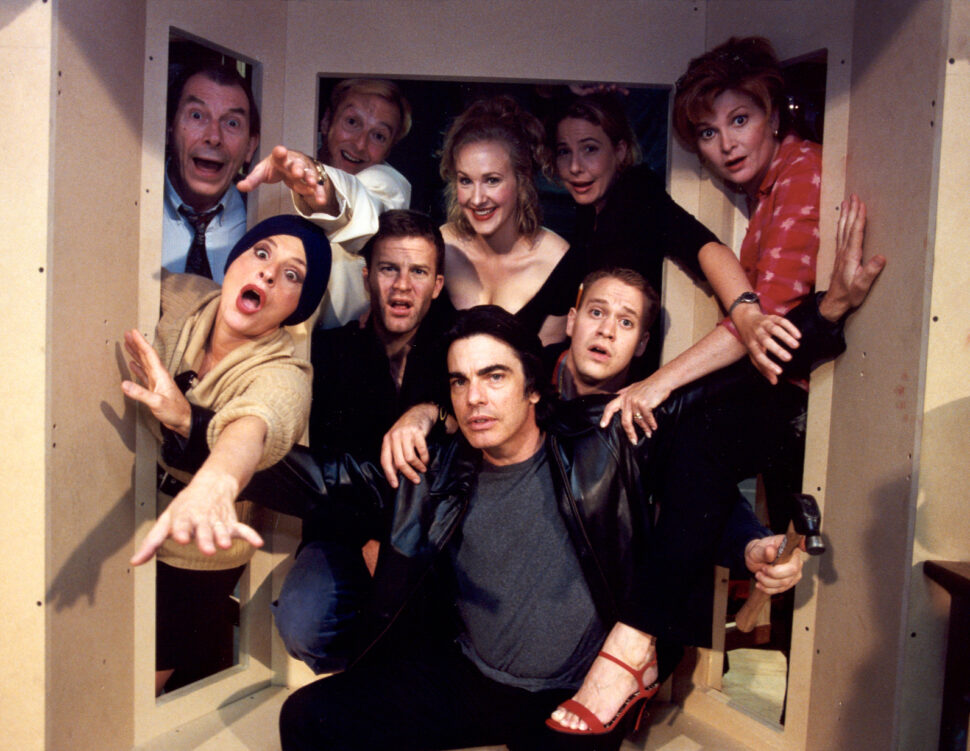
Company of Noises Off
(Joan Marcus)
Patti LuPone was set to star in Noises Off on Broadway. After 9/11, she continued with the show and recorded “New York, New York” with other theatre artists, for the “I Love New York” commercial that was made to encourage audiences to come back to Broadway.
Patti LuPone: We were rehearsing Noises Off on 19th Street. And I was staying with a friend on 16th Street. That morning she had the TV on, and I came out of my bedroom and I heard her say, “We’ve been attacked.” I got in the car to go to rehearsal, and I looked to my right down Sixth Avenue when you could see the World Trade Center. And literally my thought was, “Oh, the smoke is gray. It’s not so bad.” I immediately went into survival mode or denial mode—I couldn’t tell you which one it was. I got to rehearsal, and most of the cast was assembled. Everybody was in shock. Jeremy Sams, the director, wanted to continue rehearsing, and somebody said, “We’ve just been attacked.” And without having an official dismissal, people wandered off.
Robin Weigert and I went to Scott Wittman‘s apartment, which was on 20th Street, and tried to come to grips with what had happened. We left Scott’s apartment, and the first thing that we saw, as we passed St. Vincent’s Hospital, were all the Xeroxed pictures plastered wherever there was space. I could cry right now; it was intense. It didn’t hit home until then. We went into Union Square, and tons of people were gathered there singing.
The next day, we went back to rehearsal. The producers came down, and they said the best thing for all of us is to continue rehearsing. And I was incredibly ambivalent. I didn’t know why we were doing it. I thought, “This is useless. This is superfluous. People are dead, and we’re putting on a comedy.”
I remember on the third day, when I was walking back to the apartment on 16th Street, that’s when I actually cried—because I smelled burning electrical wires and flesh. The smell was so horrible.
Nothing’s been the same since. It changed the Theatre District forever. Just trying to get into a theatre now is absolutely insane. Going through metal detectors and having people check your pocketbooks—it used to be an area where you’d walk through the lobby, the attendant would take your ticket, and then you go in. And now there’s a lot of security. A lot of security in airports, a lot of security on Broadway. It changed everything; it does feel like our freedom was robbed.
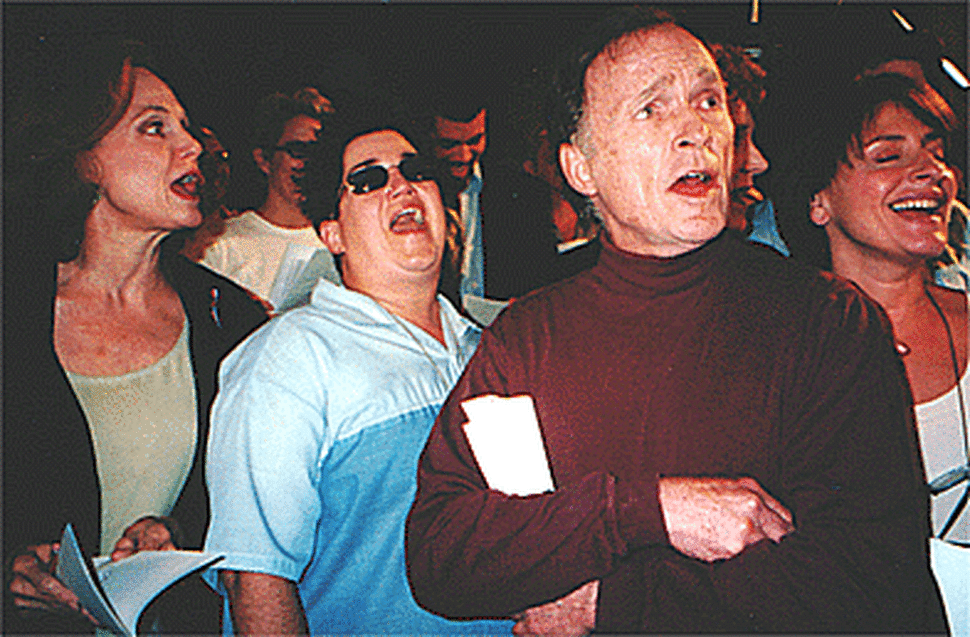
Valerie Harper, Lea Delaria, Dick Cavett, Patti LuPone record “New York, New York” for the “I Love New York” commercial that aired after 9/11.
(Photo by Aubrey Reuben)
But we opened Noises Off and we played. Noises Off is a very funny play. And if people bought tickets to see it, I think they wanted to laugh. Laughter is the best cure. So, I think that once we had an audience and we were performing and people were laughing, it started to heal us all.
It’s not a drawing room comedy. It’s slapstick, there’s a lot of door slamming. A door got stuck one night, and then it just threw everybody off that was going to go through that door; it became a pileup. But after hearing the constant sound of sirens all day, when you perform, you just go into another gear, into another head space. And I was very happy that people were laughing.
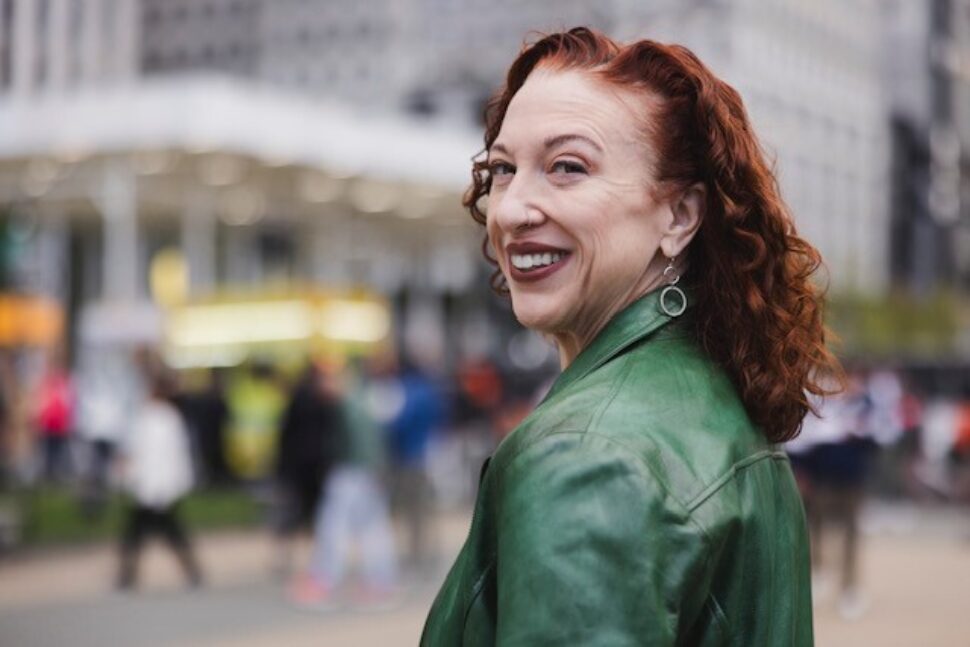
Stacie Johnsen was a young actor who was working at the World Trade Center on 9/11. These days, she is (mostly) retired; her credits include shows Off-Broadway and the national tour of Oliver! She is an active volunteer with NYC Pride, Free Mom Hugs, New York Cares, and 911Day.org. Below, Johnsen reflects on theatre helping ease her PTSD.
Stacie Johnsen: I was a young, newlywed actor trying to figure out how to get my acting career off the ground while still making rent when I found myself in the World Trade Center on September 11, 2001. Working a Wall Street job wasn’t the plan I had in mind when I moved to New York City, but this city and the life of an actor both require sacrifices and concessions.
When the first plane hit, I was at my office window looking up to see why I was hearing thunder on a clear day. That thunder was actually the plane, and I watched it hit. The office window bowed inward with the explosion. What followed was the most chaotic and traumatic experience of my life to this day.
As the entire country took a pause, the theatre did as well. There was so much uncertainty. When do we start back up? Is it even okay to start back up? How are we supposed to do something that feels so frivolous at a time when lower Manhattan still smolders and first responders are still searching for victims?
Patti LuPone, in rehearsals for the 2001 revival of Noises Off, struggled with that along with the rest of the community. As I started to emerge from my Post Traumatic Stress-induced fog and expose myself to media again, I read that Patti had expressed those concerns openly; that she and the company questioned resuming the production. This struck me, so I e-mailed her. I wanted her to know, from a survivor, that it wasn’t just okay to return to the work, but that the world needed art and joy more than ever. The one thing in critically short supply was laughter. We needed that shared experience of sitting in the dark together shutting out the world and just laughing. She responded immediately. We exchanged a couple of e-mails where she shared her reticence to get back to the work of making theatre in the midst of what we were dealing with, but agreeing that laughter is healing and thanking me for reaching out, signing off, “You must be aware by now that you’ve got a lucky angel on your shoulder. God Bless You. Love, Patti.”
Stacie Johnsen
(Sundae Cruz)
When I went to see the show a few months later, she graciously invited me to her dressing room after the show and spent some time with myself and my husband just chatting. She gave me a big, warm hug.
These days I spend the anniversary doing interviews, speaking engagements, and volunteering. I am an active mental health advocate and certified Mental Health First Aider.
My message to the theatre community is this. The current political climate and state of the world can leave us feeling defeated, sad, hopeless even. You are needed. Art is needed. Joy is needed. So please keep creating. You never know who is out in the house watching whose life you changed, if even for just a couple of hours.
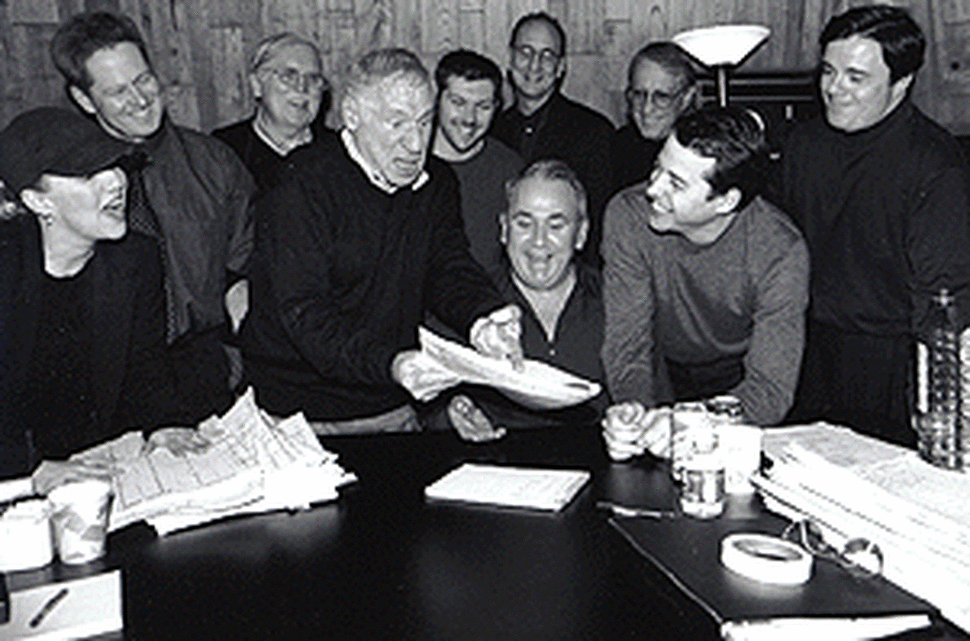
Susan Stroman, Glen Kelly, Thomas Meehan, Mel Brooks, Doug Besterman, Peter Gelb, Hugh Fordin, Steven Barush, Matthew Broderick and Nathan Lane in rehearsal for The Producers.
(Photo by Jimmy Katz)
Susan Stroman was directing The Producers, starring Nathan Lane and Matthew Broderick. She was also overseeing Contact, The Music Man, and was in auditions for A Christmas Carol at Madison Square Garden. Below, she reflects on that first performance back for The Producers.
Susan Stroman: On the morning of September 11, 2001, I was in my bedroom watching NY1 as I was getting ready for my day. The news anchors were discussing the first plane crash, mistaking it for a tragic accident. Then, as I watched along with millions of others, the second plane hit. For two days, the world came to a halt. Everyone was grieving. Typically, when someone is grieving, they have friends or family members to turn to. However, the entire city was in mourning. The only real place to find some relief was the theatre.
Theatre owners and producers believed that if they could get The Producers up and running, the rest of Broadway would follow suit. And so, two days later, Broadway reopened. At first, the audience at The Producers was tense, quiet. Then the laughter came—it rolled in like a huge wave and never stopped. It was such a relief to hear laughter. I remember specifically changing out the explosions and gunshots in the show for drum hits—not to alarm the audience.
At the curtain call, Nathan and Matthew led the audience in a moving rendition of “God Bless America.” Onstage was a line-up of our greatest comic actors united in a defiant stance against the terrorists. Not unlike Mel Brooks and his defiant stance against Hitler. Throughout history, especially during times of war and national tragedy, the primary role of the theatre is to act as a life force, to keep moving ahead and provide people with an outlet, a community. And in the face of devastation and loss, Broadway responded with such resilience and unity. I was, and always will be, incredibly proud to be part of this remarkable community.
I still remember clearly an article in The New York Times that ran just a few days after the attacks about a couple returning to their destroyed apartment at Ground Zero. Dust everywhere, windows blown out—they grabbed their tickets to The Producers and left.
Donna McKechnie
Donna McKechnie: I woke up early that morning, having just flown back the night before from Chicago where I had been performing. Like so many people, I remember gazing out the window and seeing a beautiful blue and cloudless sky. With a cup of coffee and the New York Times at hand, I felt so happy that morning to be home after my travels and looked forward to a couple of weeks of relaxation before my next job.
I turned the TV on, and as I adjusted it, I saw the first plane fly into the first tower. I honestly couldn’t get a mental grasp of what I was seeing. My brain was trying to process this, and then I saw the second plane go into the second tower. That’s when everything shifted in me, and while my brain couldn’t make sense of this event taking place, I felt it in my body, in my gut, that our world at that moment, as we knew it, changed and would never be the same. The feeling of great sadness and helplessness came over me as I watched thousands of lives lost—and those feelings never really left me.
After 9/11, I had an engagement at Archie’s Supper Club on Park Avenue South two weeks later. It hadn’t been canceled, but I wondered if anyone would show up and if I would be even able do it. They showed up and I performed. It was a difficult moment but also very reassuring, to see how people could come together and be in the world again trying to move forward.
I also witnessed so many acts of kindness, courage, and sacrifice from people helping people, the first responders, the police, the firemen climbing those stairs knowing that they might not return—they are all heroes to me. I honor them and will be listening to their loved ones say their names, again, this year.
Rachel E. Reiner was the manager of membership services at the League of Broadway Theatres and Producers (now called The Broadway League). Below, she recalls how the “I Love New York” campaign, to inspire audiences to come back to the theatre, was created. She’s currently the director of audience engagement at the Broadway League.
Rachel E. Reiner: Multiple League members and industry partners lost family members on September 11th. I remember how devastating it was to hear about each one of them and feeling very helpless in the face of so much grief. All of the shows were suffering, as ticket sales were abysmal and people were afraid of coming to Times Square, which was still viewed as a potential target and had more armed police visibly patrolling than ever before.
We were all happy to be a part of the Mayor’s message that to help NYC recover, people should come and see a show. Several key players in the industry got together to create the “Let’s Go On With the Show” print campaign, the I Love NY Theater website and marketing campaign, and the iconic gathering of representatives from every Broadway show in the middle of Times Square later that month. The commercial featuring almost every famous person on Broadway singing “New York, New York” was something we used for years afterwards. The intention was to show that we were open for business and that Times Square was still a vibrant and safe area to visit.
There were many conversations about ways to work with the other Times Square area businesses, such as restaurants and hotels, which were also suffering financially. We focused on local residents and incentives to encourage them to see shows with new promotions, discounts, packages, etc.
Despite the emotional turmoil everyone was experiencing and the turbulent economic times, I felt very proud to be a part of an organization and a community that came together in an inspiring and impactful way. Broadway, New York City, and the entire country changed irrevocably that day, and so did I. As a result, I appreciate each day more, place more value on the interpersonal relationships I have built, and have a greater perspective about how vital theatre is to my life both personally and professionally. Twenty-five years later, I am still honored to be working at the League and contributing to meaningful industry-wide initiatives. I think back on that time and the aftermath as a period of resilience, strength, and growth for me and for the industry.
The “I Love New York” commercial was filmed in Times Square September 28, 2001, featuring hundreds of Broadway artists. Among them was Bernadette Peters.
Bernadette Peters: The day of this wonderful event was the always-resilient Broadway community coming together to say, “We are strong. We will not let people scare us or put hate in our heart, nor change the love we have for one another. We are here in New York. Come join us.”
Betty Buckley
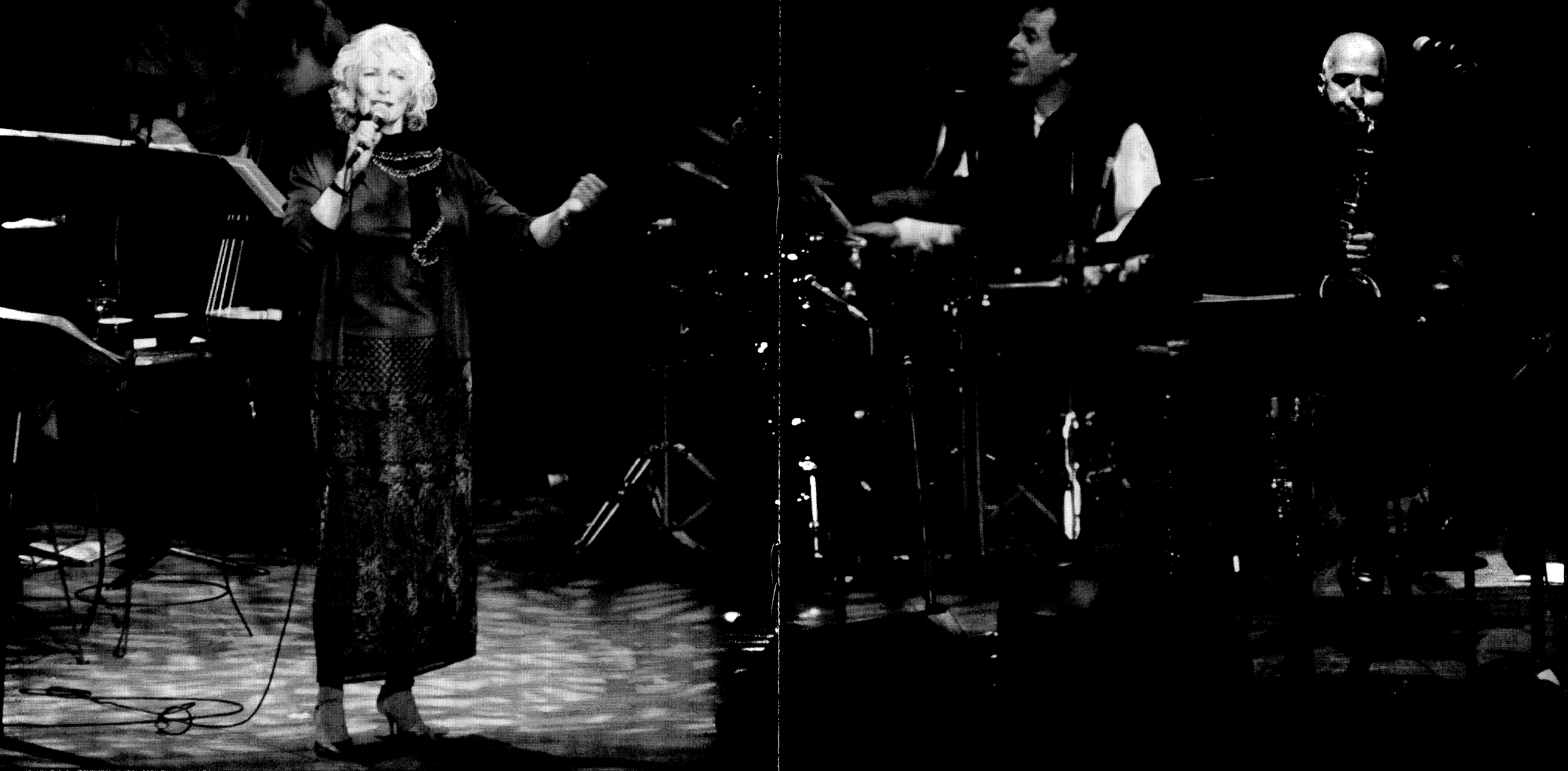
After 9/11, Betty Buckley performed two concerts at Lincoln Center September 19 and 20. She was also part of the “I Love New York” commercial. Below, she reflects on what it was like to hold one of the first events in New York City after 9/11.
Betty Lynn Buckley: On the morning of September 11, it was impossible to comprehend what we were seeing on the television as the first tower was hit. Sitting in my apartment uptown on 108th Street and Riverside Drive, my personal assistant, Cathy Brighenti, and I thought it was an accident from a small, misguided plane—some weird hoax.
As the truth began to sink in, after the second building was hit, a cold sobriety started to take hold. It was early afternoon, and Cathy and I decided to get my car at a nearby garage and drive to try to donate blood, to see how we could help. We went to two different blood donation stations. No one wanted our help. They said they didn’t need the blood.
We had a previously booked engagement at Alice Tully Hall for two nights of concerts with my musicians on September 19 and 20. As the city shut down, I fully expected that the dates would be canceled. Instead, we got a call from Lincoln Center producer Jon Nakagawa, saying that Mayor Giuliani had called and requested we proceed with the concerts. He wanted us to offer evenings of healing music for the community. I was so relieved and grateful for the opportunity to have an assignment to assist in some way.
I remember driving to New Jersey to meet with my pianist/MD Kenny Werner to create our set list. I brought a lyric with me called “The Doorway” about grief and redemption. Allen Farnham set it to music, and Kenny arranged it. On the drive through the Lincoln Tunnel, seeing the smoke from the World Trade Center, it was still incomprehensible to grasp what had happened.
Our rehearsal was fraught. Kenny and his wife, Lorraine, were processing their own fractured feelings. We worked on the music for several hours that day, picking songs that we hoped would offer healing.
I drove home sobbing most of the way, talking to my friends Jim Nadeaux and Cathy on my Blackberry, about virtually inexpressible sadness. Their words and love helped me find my way home.
Our concerts were the first event in the city after 9/11. My musicians were Kenny, Tony Marino, Jamey Haddad, Billy Drewes, Rick Martinez, Daduka Da Fonseca, and Todd Reynolds. It was the purest sharing with audiences I have ever experienced. The audience, all of us onstage and backstage, wept openly through the music, a night of shared communal grief.
In the days following, sleep was difficult. Every loud sound, every car backfiring or sirens were terrifying. In the year that followed, and despite the intense love that I have always felt for New York City, I made the decision to fulfill my childhood dream to buy my first Cutting Horse and move to a ranch in Texas. It had become radically clear to me that none of us knows how much time remains, and we need to get on with living the lives we dream about.
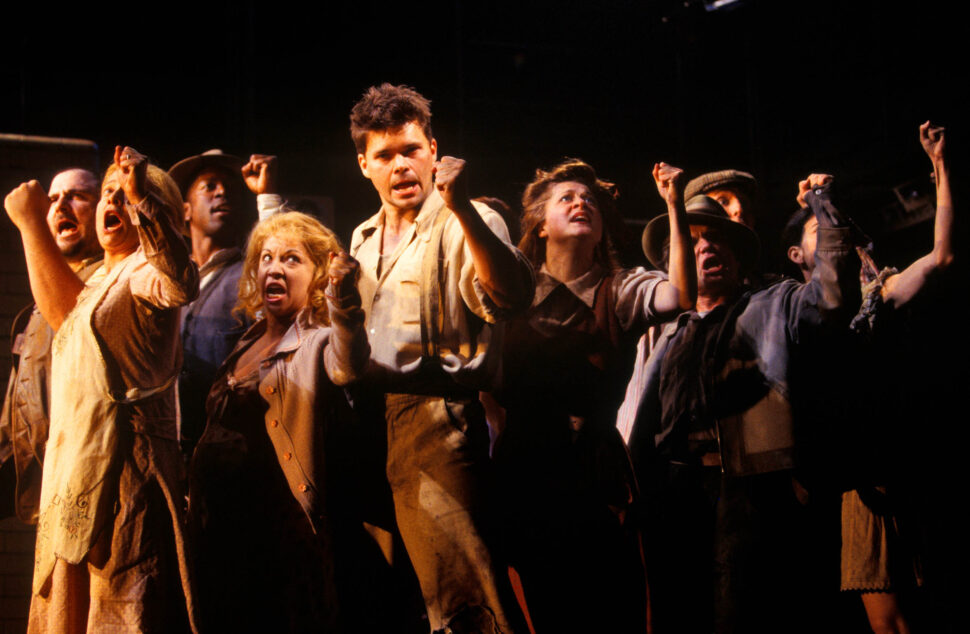
Hunter Foster and cast of Urinetown.
(Joan Marcus)
Hunter Foster was in previews for the musical Urinetown on Broadway (his wife Jennifer Cody also starred in the show). Below, Foster reflects on being part of the first Broadway show to open post-9/11. This month, Foster will direct Come From Away, a musical about the days after 9/11, at the Sharon Playhouse in Connecticut.
Hunter Foster: Lower Manhattan was still burning and covered with smoke when we woke up on September 12. It felt like the end of the world. I couldn’t imagine doing a show anytime soon. I was thinking it would take weeks before our show could come back. Then our mayor, Rudy Giuliani, spoke and said Broadway needed to come back. That the city had to get back to normal, and if we didn’t, then the terrorists win.
Trust me, the last thing I wanted to do was perform. But, there was a feeling that maybe if we did, we could bring a little hope back to this terror-ravaged city.
So, on September 13, the night that we were supposed to open, we trickled into the Henry Miller Theater [now the Stephen Sondheim] and prepared for our show. The producers gave out free tickets to anyone who wanted to get away from the news and be entertained for a couple of hours (we were a comedy!).
We gathered in the stairwell. Some of us visibly upset that we had to do a show at all, and then John Rando, our director, said something I will never forget: “We can’t work down at Ground Zero or dig out the rubble, but we can put on a show and help take people’s minds off of what’s happened. We can help people get back to normal.” We were reminded that the British theatre continued even as German bombs were being dropped on London.
Of course there were the threats of nuclear bombs going off in Times Square or other terrorist attacks on Broadway theatres. We had a joke that our theatre looked so boarded up and in such bad shape (by design), why would any terrorist waste their time?
So, we did the show. It was one of the hardest nights of my life. There was a moment in the show, when my character, Bobby Strong, gets thrown off a building. This moment was usually met with tons of laughter—on how it was absurdly staged; but tonight, there wasn’t a sound. The cold reality of the moment hit everyone hard.
But we soldiered on, and we finished the show. The audience leapt to their feet as many of us cried on stage. The whole time, I kept wondering, “Why?” Why do this when so many people are suffering? When there was so much work that needed to be done at Ground Zero and around the city. Why were we even here? None of us wanted to be here.
Then as we left the theatre, we walked out the stage door to find almost the entire audience.…waiting for us. Right there on 43rd Street. And for about an hour we all hugged, cried, and shared our experiences as fighter jets roared overhead—the air patrol that was now protecting the island from another attack.
The audience members thanked us. Told us how brave we were to perform again, and how much they needed this. We were all still in shock from what had happened, and to have that basic human interaction was something only a live performance could provide. Not only what we gave the audience but what they gave back to us.
We opened Urinetown a week later on September 20. The first show to open after the events of 9/11. Twenty five years later, it all feels like a dream or a movie that I watched many years ago. A little faded on the edges, but the emotions are still heavy every time September comes around. But that night—and the feeling of human connection in the midst of so much fear and anxiety, the mix of audience and cast members, strangers laughing and crying while the city was still recovering—remains one of the most memorable and beautiful experiences of my life.
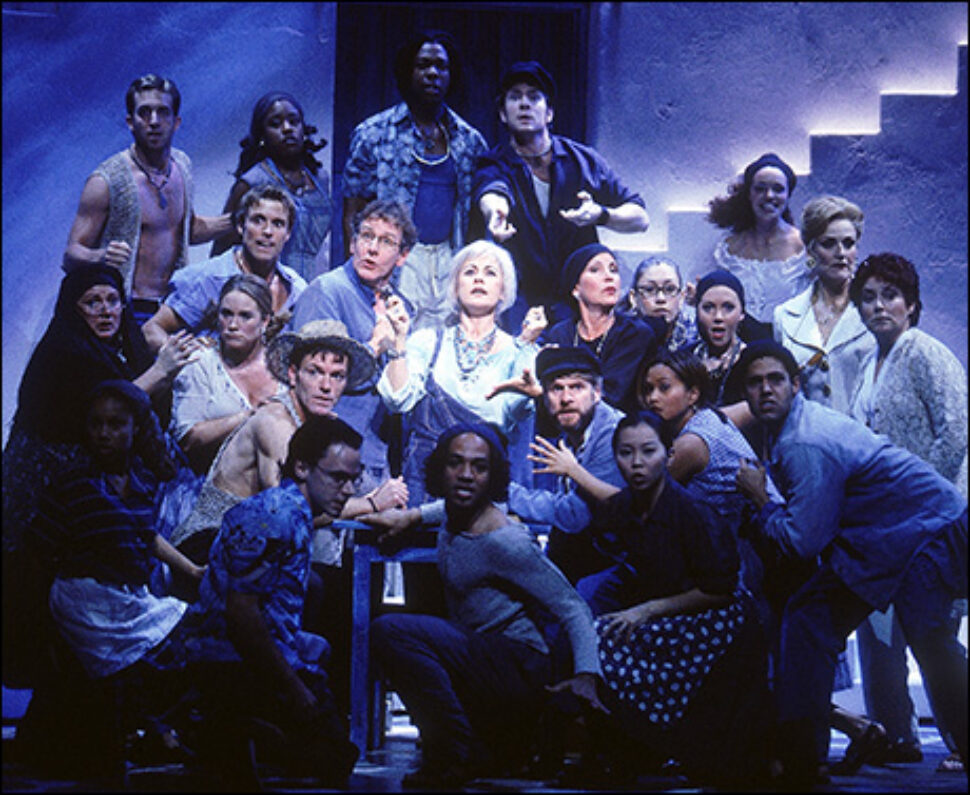
Louise Pitre (center) and the cast of Mamma Mia!
(Photo by Joan Marcus)
Louise Pitre: I had moved to New York three weeks before and was rehearsing Mamma Mia! Rehearsal was canceled that day and the next involved sitting in a circle and just talking…and crying. The producers considered delaying previews but decided to go ahead. I have never felt so loved. So many people waited at the stage door and ran with open arms to give the biggest hugs and say, “Thank you for giving us two-and-a-half hours of respite.” It was a searing experience of the profound power of theatre.
Tom Chiodo is a playwright, actor, director, and press agent. In 2001, he was senior vice president of the press agency Rubinstein, who helped organize the talent for the “I Love New York” commercial. He is currently executive producer of national productions at WETA, the flagship PBS station in Washington, D.C.
Tom Chiodo: It took many years before I could walk into the 9/11 Memorial. When I finally did, it was a life-changing experience. At one of the first exhibits, I shed my first tear, when I saw a large section of the original 2001 New Year’s Eve Ball—195 of its 504 crystal triangles were engraved to honor the victims of the September 11, 2001 attacks: the World Trade Center victims, the Pentagon, and the police precincts, Port Authority units, firehouses, and court officers. It was called Hope for Healing. And I had been fortunate to be part of the communications team that arranged for these heroes to be honored on December 31, 2001, with the lowering of NYE Ball and a moment of silence.
Like yesterday, I remember the words of our firm’s CEO, Howard Rubenstein, on September 12: “Your only job from this day forward is to help bring back the City of New York. You will help your clients make the best decisions. And if anyone seeks to take advantage of this disaster in any way, don’t allow it, and I will back you up.” That was the feeling I felt everywhere in the city: What can we do to help bring New York back?
One of the most memorable opportunities to help in the weeks immediately following 9/11, began with a call from the League of American Theatres & Producers, asking our firm to donate our services to help manage the shoot for a PSA, intended to help bring back the devastated Broadway community.
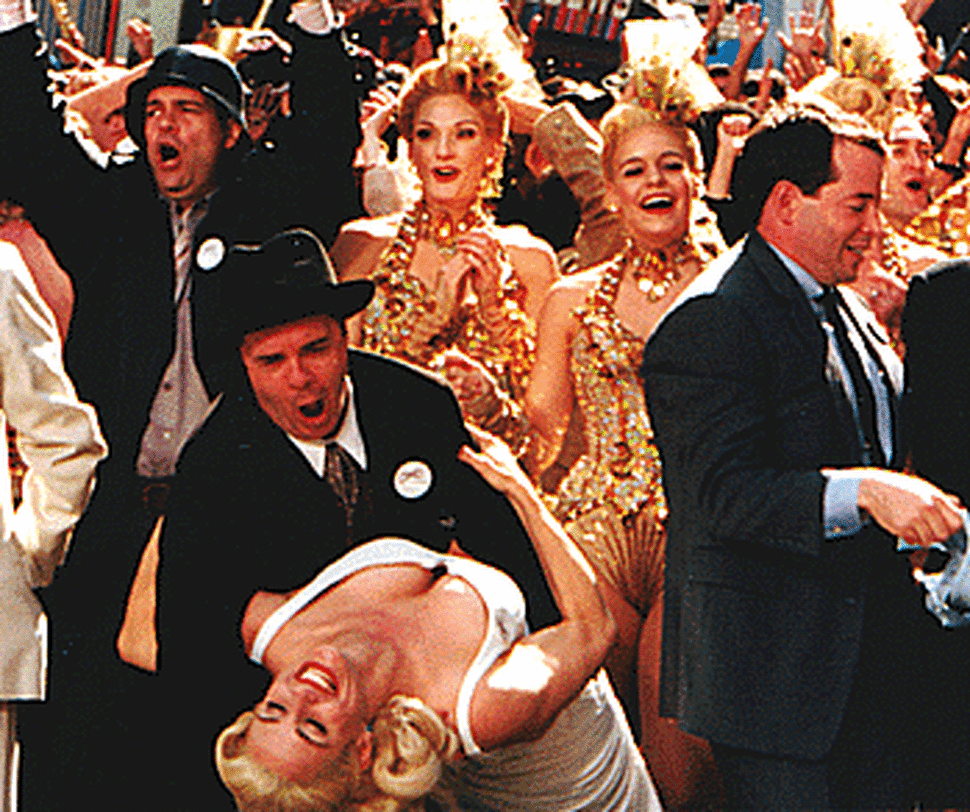
The Producers Nathan Lane dips co-star Cady Hoffman during the filming of the “I Love New York Theatre” commercial
(Photo by Aubrey Reuben)
We helped to coordinate a swiftly arranged SRO recording session of “New York, New York,” featuring great Broadway voices like Bernadette Peters and Nathan Lane. Within days, that recording was played in Times Square as performers from Broadway productions, dressed in costume, gathered to sing it live. The front rows were packed with legends from across the entertainment world—not just the stage, but film and every facet of television, from talk shows to soap operas: Betty Buckley, Dick Cavett, Joel Grey, Glenn Close, Susan Lucci, Bebe Neuwirth, Valerie Harper, Elaine Stritch, Michele Lee, and Matthew Broderick. The news spread, and it seemed that everyone wanted to be part of the effort.
The weather was perfect, and the feeling was extraordinary. Everyone was one family that day. I can’t recall all the faces, but I remember stars walking up to us, taking our hands, and saying, “Just tell me what to do—anything.” It was a rare and joyous, communal day, following three months of a continuous sea of sadness. More importantly, the day was marked by countless intimate moments among strangers and members of the greater Broadway community—showing their love, generosity, and respect for one another.
It took me many years to come to terms with the impact of those days. For at least three years, I wouldn’t celebrate my birthday on 9/13, and even today, it feels a bit irreverent. There have been thousands of lived experiences and life stories told, retold and imprinted on our souls over the past 25 years. But at no other moment in my life have I felt a stronger sense of community than I did that day in Times Square. And lest I ever forget, I look up at the framed photograph in my bedroom, above my desk. It’s the image that ran in The New York Times
and around the world. I still get lost in that picture of a theatre community standing side by side and singing with one voice.

The Theatre District firehouse: FDNY Engine 54, Ladder 4, and Battalion 9, in 2017.
(Shutterstock)
Below are two reflections from Playbill’s leaders. One from our Chairman & CEO Philip S. Birsh, and the other from our publisher Jolie Schaffzin—both of whom were in the Playbill offices in Midtown on 9/11.
Phil Birsh: On the second morning after the September 11th terrorist attack, I was sitting on a chair at home simultaneously reading the New York Times and watching then-Mayor Giuliani hold a press conference. I was like all New Yorkers that day. We were all in a state of shock—sick with worry about our city, the human toll it had taken, and I wondered what would become of our beloved Broadway community.
Our hearts were also heavy from the horrific losses suffered by our beloved Theatre District firehouse, FDNY Engine 54, Ladder 4, and Battalion 9, located at 782 Eighth Avenue. They had lost 15 firefighters, the entire on-duty shift responding to the World Trade Center. Their nickname was the “Pride of Midtown” and were famous for the motto, “Never Missed a Performance!” They were our firefighters who worked with our theatres to insure everyone’s safety. They suffered the heaviest loss on 9/11 of any fire station.
During the news conference, a reporter asked Mayor Giulani what could the average New Yorker or American do to help our city most. Without missing a beat, Mayor Giuliani said, “The best thing you can do for our city is take in a Broadway show.”
I thought I was hallucinating and said to myself out loud: “WTF.” Mayor Giuliani not only went on to repeat this mantra again in that moment but also for the next many weeks. He repeatedly doubled down on this message throughout the fall of 2001.
His remarkable support of our industry gave Broadway a lifeline that made it feel patriotic to attend a show and thereby support a deeply wounded New York City. I remember my friend, veteran theatre publicist Chris Boneau, saying, “That was the best thing he could have done, and it was the best thing that happened for Broadway after 9/11.”
Just three weeks later on September 28, our industry organized an event in which 450 actors volunteered to come together in Times Square to sing “New York, New York.” Our industry came together like I had never witnessed before. Labor contracts were adjusted, the city and state gave Broadway grants, and Playbill, like many media companies, created gratis advertising deals with the shows. We were all in this together.
Miraculously, by March of 2002, our industry was back in a healthier place. It wasn’t without our own casualties. Many people in our community, like countless communities, lost family, friends, and first responders that day. Many shows were lost, but so many were saved. We all remember so much from that day and time. What I remember most involving our beloved world of theatre is the spirit, grit, and perseverance of our community. That will stay with me forever.
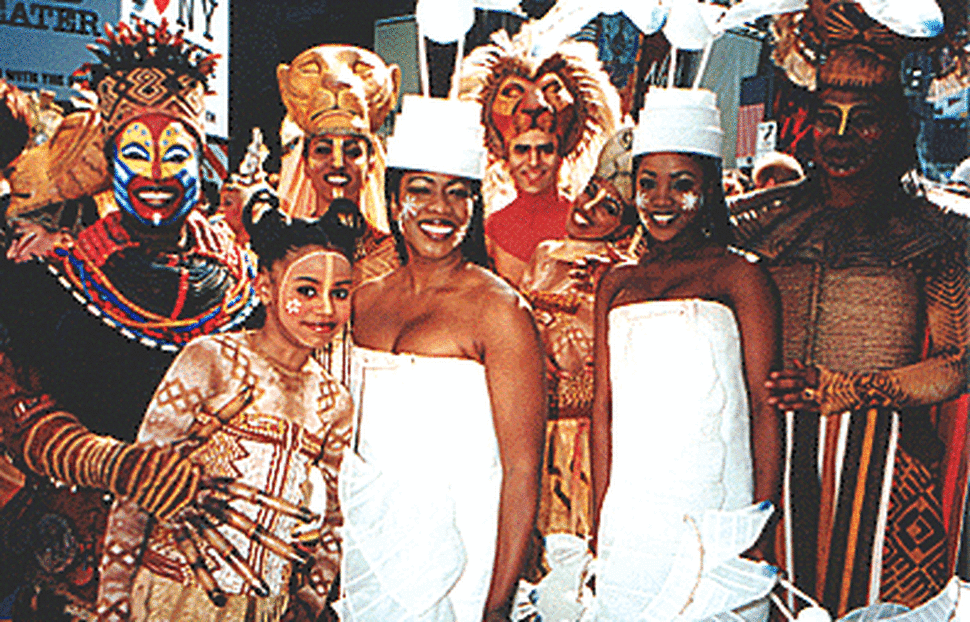
Cast members from The Lion King, during filming of the “I Love New York Theatre” commercial.
(Photo by Aubrey Reuben)
Jolie Schaffzin: It was primary election day. I am usually in the office earlier than most, but that day I was running late because I voted. It was also the only time I have ever taken the bus to work. By the time I got in, the first plane had already hit the first tower. On a TV in the Playbill office, we watched the second plane crash.
I jumped on the train and made it home in no time.
When Broadway announced they were returning on September 13, a mere 48 hours following the attack, my emotions were mixed. The pile was still smoking, people were still missing, so many were in mourning. Because I worked for Playbill, people asked what I thought about that. I remember saying, “The show must go on.”
It did. I didn’t go to theatre on the 13th, but I did go the following week. I went back to see Beauty and the Beast, figuring family shows would suffer most. I mean, who would want to bring their kids to Times Square then? I cried when Beth Fowler sang the theme song (it still makes me weepy to hear it). But I also laughed. I felt joy, I felt guilt…. But mostly, I was grateful to have theatre. It made me feel normal.
Broadway’s return was, for me, the most certain indicator that New York, its people and institutions are resilient beyond belief. I am so proud to be a New Yorker.