
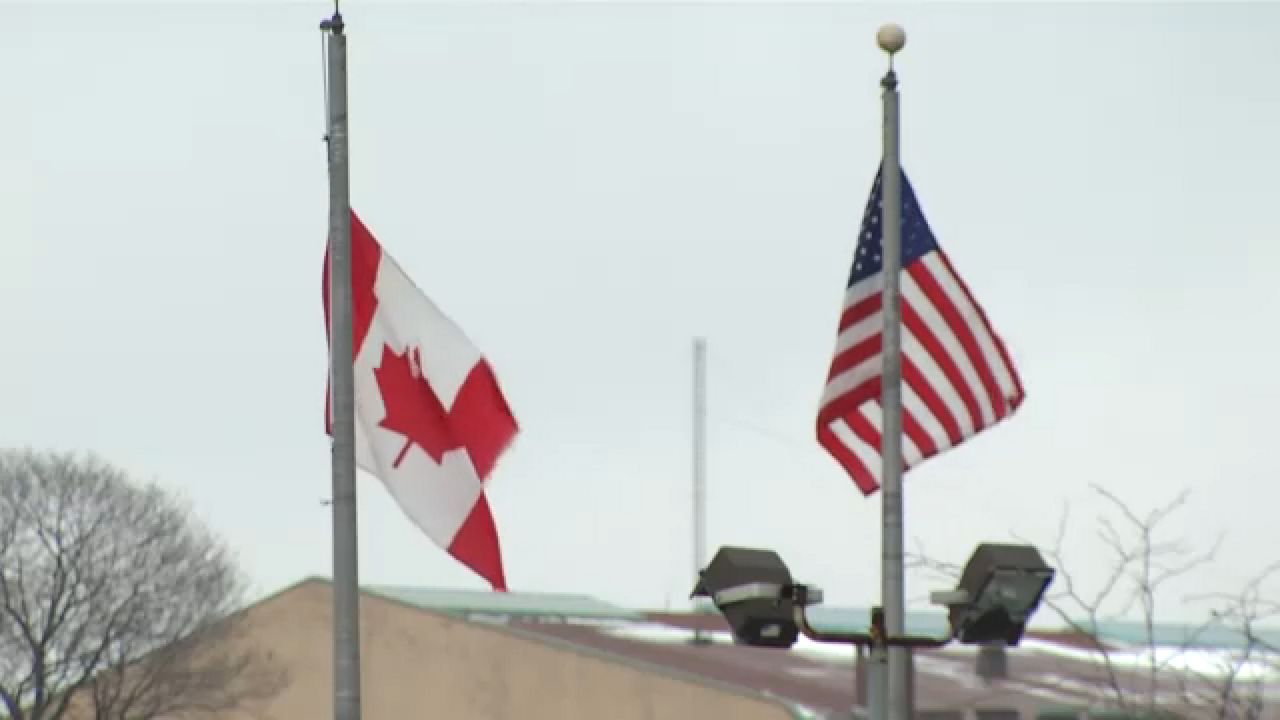
BUFFALO, N.Y. — Twenty five years after Canada opened its airspace and communities to thousands of stranded passengers following the Sept. 11 terrorist attacks, the relationship between the United States and Canada is facing one of its most tense periods in decades.
After the attacks in 2001, the United States closed its airspace to incoming international flights. Canada took in more than 220 diverted flights carrying more than 33,000 passengers.
Communities across the country provided food, shelter and other assistance to stranded travelers.
Today, the relationship looks very different.
The two countries are confronting each other over tariffs, trade and the future of an economic and political partnership that has been built over decades.
Don Abelson, a political science professor at McMaster University in Ontario who specializes in Canada-U.S. relations, said the current tension stands out historically.
“I don’t think I have ever seen this much tension between traditional allies,” Abelson said.
Trade has become one of the biggest sources of conflict.
The Trump administration has imposed new tariffs on certain Canadian goods, while Canada has responded with tariffs of its own on billions of dollars worth of U.S. products.
The Trump administration has also announced plans to block certain Canadian products from entering the United States later this month as the dispute continues.
“We’ve gone very quickly from being an ally to an adversary, and that fundamentally changed the nature of the relationship,” Abelson said.
The strain is also showing up at the border.
Federal transportation data show personal vehicle crossings from Canada into the United States fell 18.8% in 2025, dropping from about 22.6 million crossings in 2024 to 18.3 million last year.
At Buffalo/Niagara Falls, personal vehicle crossings fell more than 16%, from about 4.4 million to 3.7 million. Buffalo/Niagara Falls still remained the busiest northern border gateway for personal vehicles.
“Fewer Canadians crossing the border. Fewer Canadians spending money in the United States. Fewer Canadians taking vacations in the United States, in large part because they have felt unwelcome by the Trump administration,” Abelson said.
The decline adds another layer to the contrast between the relationship today and the one demonstrated after Sept. 11, 2001.
In places such as Gander, Newfoundland and Labrador, residents welcomed thousands of passengers after their flights were unexpectedly diverted to Canada.
“Canada always had a willingness to help those in need,” Abelson said. “For the government of Newfoundland and Labrador to reach out to American airliners carrying predominantly American passengers, it wasn’t surprising.”
The future of the economic relationship is also coming into focus as the United States, Canada and Mexico prepare for the required review of the U.S.-Mexico-Canada Agreement.
Abelson said Canada is already reconsidering how heavily its economy should depend on the United States and looking toward deeper economic relationships with Europe and Asia.
That means even if political tensions ease under a future U.S. administration, the relationship may not simply return to what it was before the current trade fight.
For two countries that have spent decades building one of the world’s closest economic and political partnerships, the larger question is whether the current dispute is temporary or the beginning of a more permanent shift.