
ALBANY, N.Y. — It began as a trip to watch a Yankees/Red Sox game and ended with Sen. Joe Griffo experiencing first-hand a tragedy which swept the United States into a horrific, yet life-affirming, tragedy 25 years ago.
Griffo, then serving as mayor of Rome, arrived in New York City on Monday, Sept. 10, 2001, along with former Rome treasurer John Nash and former Rome administrative assistant Brendan Ryan to watch the game – which would be rained out – and then finalize a bond sale the morning of Tuesday, Sept. 11.
“The next morning was a beautiful day,” Griffo said. “We were watching the news on TV before our appointment when we saw something bad happening on live TV. At first, people thought the first plane crash was a horrible accident. When the second plane hit, everyone realized something really evil was happening.”
Terrorists under the command of Al-Qaeda leader Osama bin Laden had hijacked four passenger planes with the intent of crashing them into selected targets.
A pair of the planes hit the World Trade Center in lower Manhattan. Hijackers flew American Airlines Flight 11 into the North Tower at 8:46 a.m. and United Airlines Flight 175 into the South Tower at 9:03 a.m. Both skyscrapers eventually collapsed, devastating lower Manhattan. In New York City, 2,753 people died.
Hijackers also crashed American Airlines Flight 77 into the western side of the U.S. military headquarters in the Pentagon in Arlington, Va. at 9:37 a.m. During the Pentagon crash, 184 people died, including 64 on American Airlines Flight 77 and 120 in the building along with the hijackers.
Passengers and crew on United Airlines Flight 93 fought back against the hijackers, forcing the plane down into a rural field near Shanksville, Penn. at 10:10 a.m. and preventing it from hitting its intended target in Washington, D.C. On Flight 93 40 passengers and crew members died along with the four hijackers.
The Eastern Air Defense Sector in Rome scrambled a pair of F-16 fighter jets.
“We went to bond hearing in lower Manhattan then moved to mid-town,” Griffo said. “We saw it all unfold. It was not a direct view, but you could see smoke out window as well. There are two things I remember from that day. They shut Manhattan down to traffic and evacuated all the buildings.”
Griffo said New York City had no cellular phone service and he had to contact his family by landline.
“We went to the law firm and saw chaos, but not panic, throughout Manhattan,” Griffo said. “Street vendors had their radios out and people gathered around them for news. It was surreal.”
“I remember military jets flying overhead,” Griffo continued. “Everyone around us were wondering what was happening, wondering if will they would attack the Empire State Building, but they were overall calm.”
The South Tower fell at 9:59 a.m. and the North Tower fell at 10:28 a.m. A total of 2,977 victims died during all four attacks. This included civilians, first responders and the 19 hijackers.
“I remember the air was very pungent in Manhattan because of the burnt buildings and the dead bodies,” Griffo said. “We volunteered to give blood, but the authorities said no. Then we realized most of the people in the towers were dead.”
Griffo and his colleagues attended Mass led by Cardinal Edward Egan at St. Patrick’s Cathedral. The cathedral hosted funeral and memorial Masses on September 16 and September 17.
“We saw the worst of humanity represented by Al-Qaeda and the best of people in the military, the firefighters and police and rescue workers coming and the sense of unity across the country as well,” Griffo said.
Numbered among the dead were 343 firefighters, 23 NYPD officers and 37 Port Authority police officers. Law enforcement has suffered hundreds of subsequent 9/11 illness fatalities, bringing the total number of line-of-duty deaths connected to the attacks to well over 660.
“We saw firefighters and rescue workers during our time in New York,” Griffo said. “We saw the exhaustion and pain on their faces. We and the emergency workers shared a glance and we made a connection with nothing being said.”
Griffo sent resources to emergency workers on behalf of Rome and Utica sent 12 firefighters to assist. And Griffo hosted families of Rome residents in a large hotel room to help them connect with families of those who had been in New York City when the attacks happened.
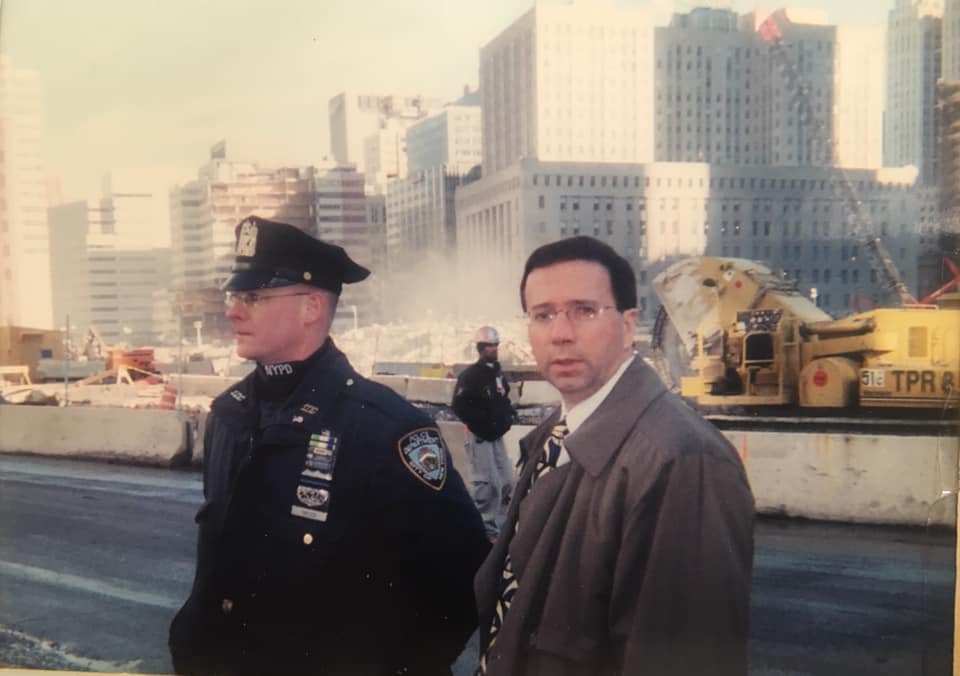
Griffo and a group of mayors from across New York joined then-New York Mayor Rudy Giuliani to tour Ground Zero – the site where the WTC towers collapsed – a couple of months after the attacks.
“The world is so much more complicated today than it was twenty-five years ago,” he said. “We are a polarized nation and we need to restore unity among ourselves.”
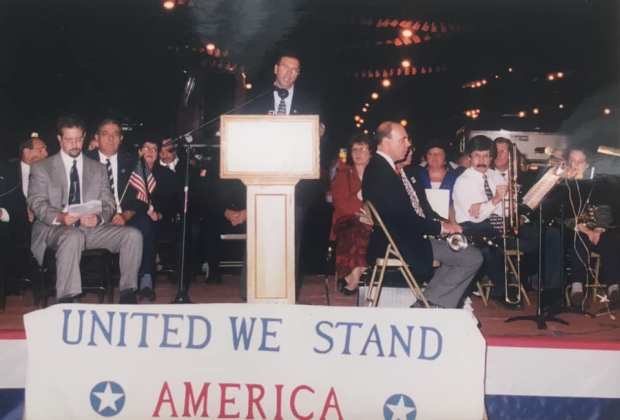 Griffo speaks at a gathering of other mayors circa 2001. (Provided)