
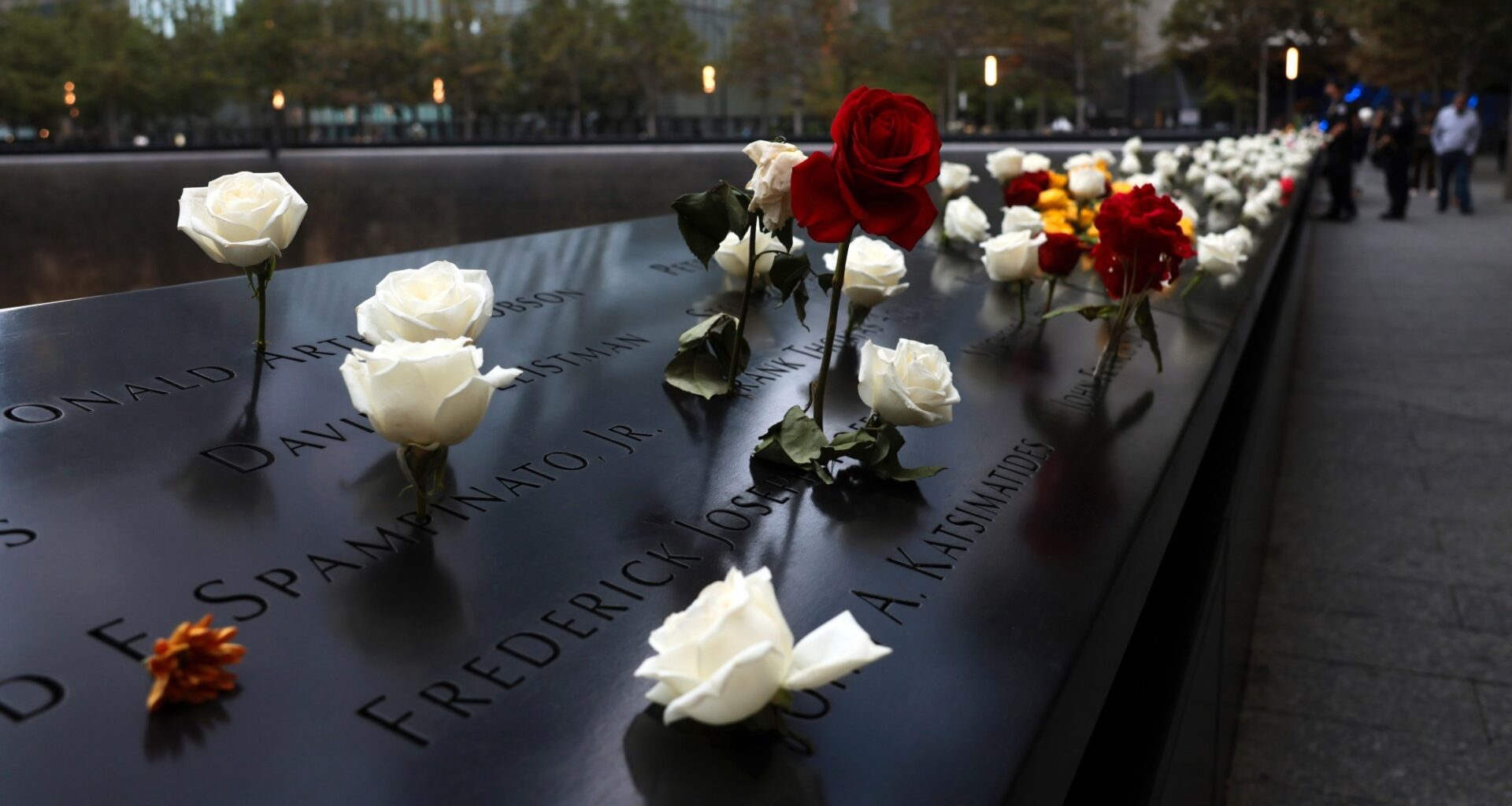
At sunset on Sept. 11, 2001, Americans were too shaken by the day’s cascade of horrors to contemplate the course of the next 24 hours. The future was suddenly shrouded in doubt. Hijacked passenger planes crashed into the World Trade Center and the Pentagon and a field in rural Pennsylvania shattered forever the illusion of America as an impregnable fortress immune to organized foreign attack.
A popular song released in the early aftermath of the 9/11 attacks expressed a widespread sense that the world had “stopped turning.” The unimaginable was suddenly an inescapable reality. Looking forward seemed futile, even disrespectful of the nearly 3,000 lives taken on that terrible Tuesday.

The twin towers of the World Trade Center burn behind the Empire State Building in New York on Sept. 11, 2001. (ASSOCIATED PRESS FILE)

Smoke billows from one of the towers of the World Trade Center and flames and debris explode from the second tower, Tuesday, Sept. 11, 2001. In one of the most horrifying attacks ever against the United States, terrorists crashed two airliners into the World Trade Center in a deadly series of blows that brought down the twin 110-story towers. (ASSOCIATED PRESS FILE)

A military helicopter takes off after dropping off personnel at the Pentagon, Sept. 12, 2001, after a terrorist crashed a hijacked airliner into the building the day before. (ASSOCIATED PRESS FILE)

In this Sept. 16, 2001 file photo, FBI personnel continue excavating the site where United Flight 93 crashed after the jet was hijacked during the 9/11 terrorist attacks, near Shanksville. (ASSOCIATED PRESS FILE)

In this Sept. 12, 2001 file photo, firefighters work in the rubble of the World Trade Center towers in New York. (ASSOCIATED PRESS FILE)
Show Caption
1 of 5
The twin towers of the World Trade Center burn behind the Empire State Building in New York on Sept. 11, 2001. (ASSOCIATED PRESS FILE)
At sunrise on Friday, Americans looked back on the 25 years since, collectively commemorating America’s darkest day and the aftershocks that still rumble as the world keeps turning.
On ‘The Pile’
A quarter century later, Vicky Castagna still struggles to share what she witnessed working in the ruins of Ground Zero in the days and weeks after the twin towers fell.
She remembers the pain, shock and rage that radiated from the rubble, but prefers to focus on the unity, humility and resilience she saw rising from the ashes all around her.
“This is probably the first year I think I feel ready to talk about it,” she said in an interview at Moscow Fire Department headquarters, where she’s a longtime volunteer. She’s been invited to speak at many 9/11 memorials over the years, but usually declined. On Friday, the Sterling Twp. retiree agreed to stand up and share her story at a local VFW post and in a letter published in Media News Group newspapers, including The Times-Tribune.

In this Sept. 11, 2001 file photo, firefighters work beneath the destroyed mullions, the vertical struts which once faced the soaring outer walls of the World Trade Center towers, after a terrorist attack on the twin towers in New York. (ASSOCIATED PRESS FILE)

Police officers rush to help after terrorists crashed two planes into the World Trade Center on Tuesday, September 11, 2001. In a horrific sequence of destruction, terrorists hijacked two airliners and crashed them into the World Trade Center in a coordinated series of attacks that brought down the twin 110-story towers. (AP Photo/Diane Bondareff)

Firemen gather on a debris-covered street after the collapse of the twin towers of the World Trade Center on September 11, 2001 in New York City. (ASSOCIATED PRESS FILE)
Show Caption
1 of 3
In this Sept. 11, 2001 file photo, firefighters work beneath the destroyed mullions, the vertical struts which once faced the soaring outer walls of the World Trade Center towers, after a terrorist attack on the twin towers in New York. (ASSOCIATED PRESS FILE)
“I’m really trying to focus on the service aspect of it,” she said. “The tragedy part of it, that’s the part that’s hard.”
Born in the Red Hook neighborhood of Brooklyn, Castagna, 73, remembers watching the World Trade Center being built. In her early career as a probation and parole officer for the U.S. District Court for the Southern District of New York in Manhattan, she was a frequent visitor to the twin towers.
Castagna transferred to an SDNY satellite office in Middletown and moved to Milford in 1992. A social worker by education, she served as an EMT in the Pike County borough and completed extensive training in treating physical and emotional wounds.
In the blackened wake of 9/11, it was the latter skills that were needed most. Part of a federal “critical incident stress management counseling team,” Castagna was frustrated by delays caused by the immensity of the destruction.
“We were put on standby in Milford, and I spent two to three weeks real anxious and upset that I wasn’t able to do something,” she said. When she and her team reached Ground Zero in early October, the fires were still burning. The team was assigned to support rescue crews working on “The Pile,” a 14.6-acre wasteland of debris, dust and ruined steel where the towers once stood.
“The first day we got there was a Sunday,” she said. “We worked 12-hour shifts. The dogs alerted to a body (in the rubble). The next shift, they were able to uncover the body.
“I happened to be close to where the body was being exhumed, and the most startling thing for me, standing on The Pile, was everybody stopped. There was not any movement at all. The only thing you heard was the roar of the diesel (equipment) in the background.”
While grieving the dead was a daily weight, Castagna said being of service to the living lifted her spirits in ways that still echo today.
“One of the great things about my experience down there was the people,” she said. “They couldn’t say ‘thank you ‘ enough. Getting to The Pile and leaving The Pile, the people outside could not do enough to support us.
“And so for me, I try to focus on that. (Thinking about) people flying out of the towers and the collapses just brings me down. It just hurts. It’s sad and I can’t focus on it.
“I don’t want to lose the tragedy of the day, but I certainly don’t want to lose how we came together as people that day.”
National Guard ‘transformed’
On 9/11, Judah Whitney was a newly minted major in the Pennsylvania Army National Guard. The 55th Battalion headquarters in Scranton was recently equipped with several televisions so personnel could stay on top of the news.
“One of my sergeants came and said, ‘A plane just hit one of the trade centers,’” Whitney said. “I wandered out to where the TV was, and we were watching the trade center, all the smoke coming out of it, and then we saw the second plane hit. We all knew this was not a coincidence. Something was up.”

A jet crashes into the World Trade Center in New York, Tuesday, Sept. 11, 2001. Terrorists crashed two planes into the World Trade Center, and the twin 110-story towers collapsed Tuesday morning. (ASSOCIATED PRESS FILE)

As rescue efforts continue in the rubble of the World Trade Center in New York, then-President Bush stands with firefighter Bob Beckwith on a burnt fire truck in front of the World Trade Center during a tour of the devastation, Friday, Sept. 14, 2001. (ASSOCIATED PRESS FILE)

In this Tuesday, Sept. 11, 2001 file photo, People run from the collapse of one of the twin towers of New York’s World Trade Center. (ASSOCIATED PRESS FILE)
Show Caption
1 of 3
A jet crashes into the World Trade Center in New York, Tuesday, Sept. 11, 2001. Terrorists crashed two planes into the World Trade Center, and the twin 110-story towers collapsed Tuesday morning. (ASSOCIATED PRESS FILE)
At the time, Whitney’s late father, famed New York chef Henri-Etienne Levy, lived in Manhattan.
“I called him almost immediately and I said, ‘Something’s going on. You should get out,’” Whitney remembered. “My dad had lived through World War II as a refugee, and he’d seen some awful things, and he just said, ‘I’m fine. I’m busy. I gotta go.’
“And then I couldn’t get through to him for days because all the phone lines were down and he didn’t have a cellphone, so, personally, it was scary.”
Military service is a Whitney family tradition. Over a 32-year career in the Guard, Judah, 60, served in several overseas missions, including tours in Bosnia-Herzegovina and Afghanistan. His wife, Maj. Kathleen Quigley Whitney, served in the first Gulf War and other deployments and is now an aeromedical physician assistant with the state Guard. Their daughter, Hannah, was a first lieutenant in the Army. Their son, Nathan, is an Army sergeant.
Whitney retired as a lieutenant colonel in 2016. He and Kathy live in Covington Twp. Whitney said 9/11 was the catalyst for a “transformed” Guard.
“The National Guard was kind of a Moose lodge with heavy artillery,” he said. “It was pretty bad. There were pockets of excellence, but as a rule, it was not a very good organization. 9/11 transformed it.”
Older citizen-soldiers who couldn’t meet the physical requirements of combat were phased out. Younger soldiers were pushed forward and gained experience that prepared them for leadership.
“What 9/11 did for the National Guard is it transformed it from a strategic reserve to an operational reserve,” he said. “It was no longer the third string, it was the second string, but it was a heck of a lot closer to the first string.”
‘Rakkasans’ reunion
On Friday, retired Lt. Gen. Frank Wiercinski commemorated the 25th anniversary of 9/11 at Fort Campbell, Kentucky, with hundreds of fellow “Rakkasans.” The nickname, coined during World War II from the Japanese word for “falling down umbrella men,” aptly describes the legendary 187th Infantry Regiment of the Army’s 101st Airborne Division.
“It’s a big deal,” the Dickson City native said in a phone interview. “All our guys are old enough now to say, ‘Man, it’s been 25 years. That day, 9/11, changed our lives.’ It absolutely changed my life.”
Wiercinski graduated from the United States Military Academy at West Point in 1979 and began a 34-year career in which he earned the third-highest wartime rank in the Army. After the military, Wiercinski, 69, held executive positions with Raytheon, Lockheed Martin and other defense and security companies.
Fully retired, he lives in Hawaii with Jeannine, his high school sweetheart and wife of nearly 47 years.

One World Trade Center, center, rises above the National September 11 Memorial and Museum at the World Trade Center, Thursday, Sept. 6, 2012 in New York. (ASSOCIATED PRESS FILE)

People hold candles during the Brooklyn 9/11 Wall of Remembrance Candlelight Ceremony in Coney Island on the eve of the 25th anniversary of the Sept. 11 World Trade Center attacks, Thursday, Sept. 10, 2026, in New York. (ANGELINA KATSANIS/ASSOCIATED PRESS)
Show Caption
1 of 2
One World Trade Center, center, rises above the National September 11 Memorial and Museum at the World Trade Center, Thursday, Sept. 6, 2012 in New York. (ASSOCIATED PRESS FILE)
Wiercinski’s experience leading Army Ranger paratroopers in combat in Panama during “Operation Just Cause” to oust dictator Manuel Noriega in 1989 made him a good fit to lead “Operation Anaconda,” the initial American assault in Afghanistan.
It was America’s first official military strike against the Taliban, the Islamic extremist regime that harbored the al-Qaida terrorist network behind 9/11. The Rakkasans were determined to make a permanent impression.
“Nobody had in their mind revenge or retribution. … We wanted to get in there and dismantle any potential for anybody ever trying to do this again,” Wiercinski said. “That was our mindset going in.”
The operation touched off 20 years of American military presence in Afghanistan, much of it while also fighting an insurgency in Iraq. Wiercinski served tours as a commander in both wars. His last deployment was 16 months in Iraq.
While the weapons of mass destruction (WMD) that served as the predicate for the American invasion never materialized, Wiercinski bristles at criticism based on comfortable hindsight. He points out that Saddam Hussein was a brutal dictator who used chemical weapons on his own people and threatened to deploy them against the U.S. After 9/11, he said American leadership had little choice but to take the madman at his word.
“This man has already demonstrated the capability of using it — having it and using it — and now he has threatened you and told you that he has (WMDs) and he’s going to use them on you,” Wiercinski said.
“What would you do? Sit back and say, ‘Well, you know…’ It’s a hard question. I don’t expect anybody to answer it. I still can’t answer it, but I do know it was a viable threat and it was made by the man himself.”
Mistakes were made in the wars in Iraq and Afghanistan, but Wiercinski said the professional, all-volunteer U.S. military achieved its objectives with honor and distinction. Al-Qaida was driven from its safe haven and the people of Iraq were given a chance at self-rule.
The wars also sent a clear message to America’s enemies in the Middle East.
“We’ll fix everything we broke, but then we’re going home,” Wiercinski said. “You have a chance to start fresh. We’re going to help you start fresh, but if you screw it up again and they come out of here again and we can prove it, we’re coming back.”
Wiercinski said bringing back all of the soldiers he led into Operation Anaconda alive was the greatest victory of his storied career.
“You couldn’t pin a medal on me or some kind of accolade or testimonial or anything better than going into Anaconda with 1,411 soldiers, being in direct combat for two weeks and bringing home 1,411 soldiers.
“That’s miraculous. … That’s the greatest gift I ever received.”
‘Good Morning America’
The first hours of the “Good Morning America” broadcast on Sept. 11, 2001, offered viewers typical programming: It was the beginning of Fashion Week in Manhattan; Michael Jordan was considering a return to the NBA; a “new break” was made in the cold case of missing labor leader Jimmy Hoffa; and President George W. Bush was in Florida to kick off Education Week by reading a children’s book, “The Pet Goat,” to a class of elementary school students.
A recently slimmed down Sarah Ferguson, the former Duchess of York, was giving an interview about her endorsement deal with Weight Watchers at 8:46 a.m. when American Airlines Flight 11 — with 76 passengers, 11 crew members and five hijackers on board — struck the north tower.
At 9:03, United Airlines Flight 175 — carrying 51 passengers, nine crew members and five hijackers — struck the south tower. Last week, students in a University of Scranton classroom watched it all happen “live.”
The course, “Sept. 11 & Beyond,” developed by Department of Political Science Professor and Chair Mike Allison, Ph.D., is designed to help today’s students relate to a historic tragedy that happened before they were born.
Professor Gretchen Van Dyke, Ph. D., is teaching the course this semester. A New York native, Allison usually begins with the decades of complicated history that preceded 9/11. Van Dyke starts with the day and works back to its gnarled roots.
Watching the news coverage as 9/11 unfolded offers students an immersive opportunity to connect with the emotions of Americans who watched as it happened.
“I would say it does have a bit of, like, almost a mythical quality for us, because we’ve heard so much about it,” said Jack Foley, a 22-year-old senior majoring in political science.
“When I was growing up, every year on 9/11, our classroom would have a whole lesson dedicated to it, but it wasn’t something that we ever had a first-person perspective of knowing. It was always someone else telling us about it. And there’s a lot of gravity to that, but not the same, I think, as if we had experienced it.”
Asked what it was like to experience the day’s news coverage 25 years later, Foley shrugged.
“It’s history,” he said. “I understand it’s jarring for people who went through it, but for us, I think of it as history.”
Van Dyke and Allison are diligent in pointing out current concerns rooted in changes that came in the wake of 9/11. Flock cameras, the controversial surveillance network inspiring civil rights protests across the nation, can be traced back to the Patriot Act. The Department of Homeland Security was also created in response to the attacks. The war in Iran is evidence that America’s relationship with the Middle East remains fraught with pitfalls.
Van Dyke, 64, and Allison, 52, lived through 9/11 and are dedicated to teaching every aspect of the tragedy, including personal reactions that are troubling in retrospect.
“I remember I was not a very good person after the attacks, watching them take place and wanting revenge or violence, which was awful, particularly because I lived with a Muslim guy from Turkey,” Allison said.
“I was friends with a lot of Muslim people who felt the ire of people in our country, the distrust. It was awful.”
Van Dyke remembered teaching a class on the Thursday after the attacks. A student suggested “nuking” Afghanistan “back to the Stone Age.” Another student rebuked him.
Van Dyke explained that Afghanistan was one of the poorest, most oppressive countries on Earth. Another student was upset by Van Dyke’s response.
“She was frustrated with me. She was frustrated with the class, and she said, ‘Dr. Van Dyke, what would you tell the people who jumped out of the buildings?’ I’ll never forget what I said to her and to the class. I said, ‘I would tell people two things. I would say that we have to figure out who committed these crimes, and we have to bring them to justice.’
‘There’s a difference between justice and retribution. We don’t want to go the retribution route. We want justice.’”
What followed after that class is history.
Still falling
A quarter century later, the 9/11 attacks are still claiming American lives. According to the World Trade Center Health Program, more than 9,000 survivors and first responders have died from illnesses related to their work at Ground Zero. On 9/11, 343 New York Fire Department personnel lost their lives. More than 600 died of related causes over the 25 years since.
Vicky Castagna undergoes yearly testing for long-term impacts of her time working on “The Pile.” So far, she is healthy and doesn’t dwell on the potential long-term effects of her exposure. Castagna feels blessed to have been of service when her fellow Americans needed her most.
“I think my experience at Ground Zero broadened my sense of what it means to help,” she said. “I was in my niche. I was there when it mattered. It still does.”
Contact the writer: ckelly@scrantontimes.com