
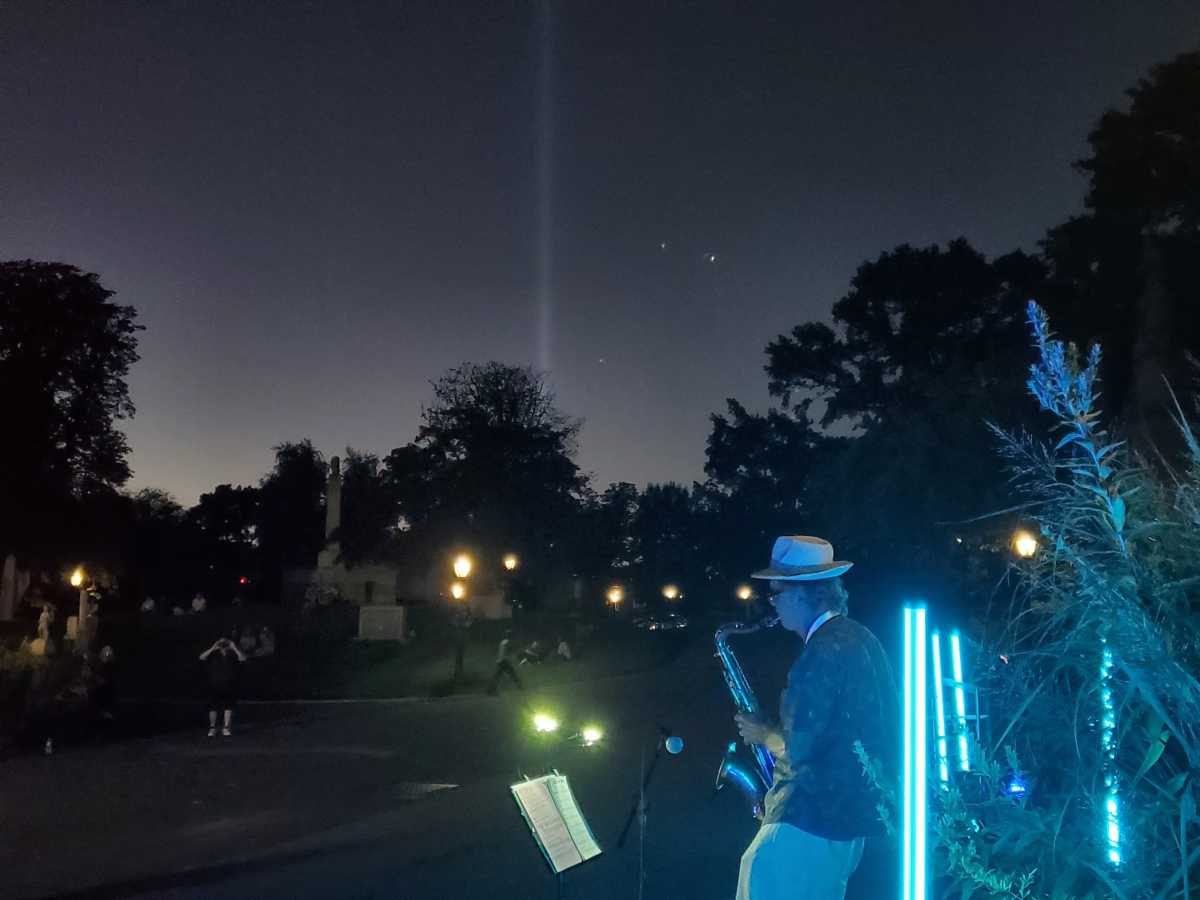
Far from the spotlight at Ground Zero and the 9/11 Memorial and Museum in Manhattan, families and friends of victims on the 25th anniversary of the attack gathered on a hill at Green-Wood Cemetery, where many of the attack’s victims are buried or have remains interred.
They united on the evening of Sept. 11 in a ceremony, held for the previous two years as well, involving music, readings and community to remember together and look toward Lower Manhattan, where symbolic Twin Towers made of blue light could be seen, appearing as a single beam from the cemetery.
Those buried here typically lived in, worked in or grew up in Brooklyn, including firefighters, police officers, first responders and people who worked in the Twin Towers.
More than 100 people who died on Sept. 11 or from related illnesses in the years that followed are interred at Green-Wood.
“It’s a combination of people buried here, people who were cremated here and people interred or cremated here as a result of the toxins,” Memorial Counselor Theresa Wozunk said. “It’s clearly about the people of Brooklyn. Not everybody buried here lived in Brooklyn as far as 9/11 victims, but they may have had Brooklyn roots.”
Flower arrangements were placed on some graves on a day when police officers and firefighters arrived at the cemetery in uniform to honor those whose lives were lost.
“On 9/11 every year, many people, especially first responders come and honor the people interred here,” Wozunk said. “People come from fire houses, ladder companies, precincts, to put memorials at grave sites.”
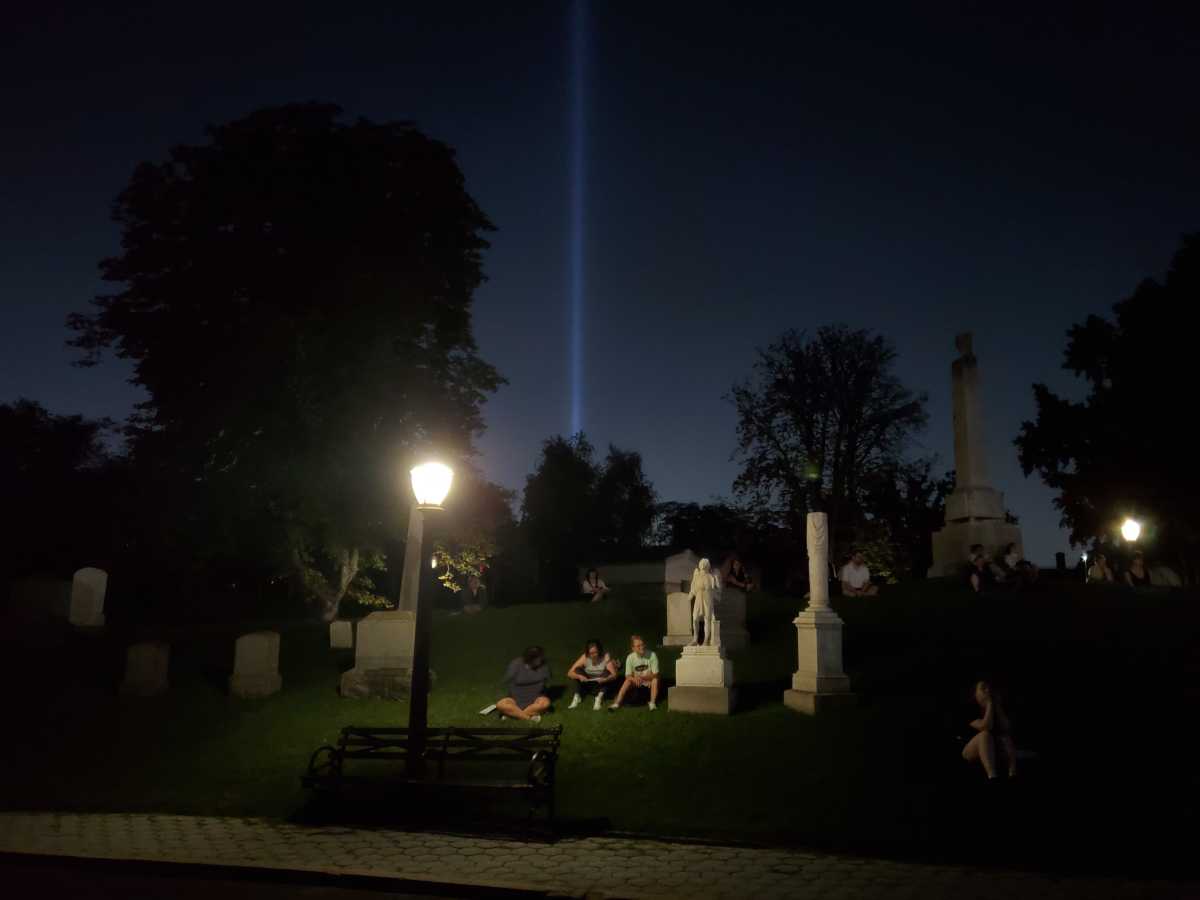 Green-Wood Cemetery visitors gather for an evening memorial honoring those who died on Sept. 11, 2001, and in the years that followed.Photo courtesy of Green-Wood Cemetery
A large number — the majority of the people interred here from 9/11 — are in the same area of the cemetery where graves were available at the time for new burials.
Michael Bocchino, a firefighter who has a nearby street named in his honor, is buried here, as is Rosa Feliciano, who was married to cemetery employee Isaac Feliciano, lived in Brooklyn and worked at Marsh McLennan in Tower 1.
“People have come all three years, the other two years,” Wozunk added. “A lot of the people who come feel the need to be among other people and take a moment to remember.”
Green-Wood Cemetery President Meera Joshi said in written remarks read at the event, attended by hundreds, that it was a time to “remember the day through lights, music, prayer, silence and most of all coming together.”
The group, at a memorial held without speeches, listened to the reading of “notes of tribute,” poems related to 9/11 read as part of a program the cemetery developed to honor victims of the tragedy.
Music performed included songs by Bob Dylan, Bruce Springsteen and Jim Croce, among others, beneath stars like shiny dots scattered and almost sewn into the black fabric of the sky.
“People have come all three years. A lot of the people who come feel the need to be among other people and take a moment to remember,” Wozunk said. “We make it not about speeches. Its’ about giving people the space to mourn.”
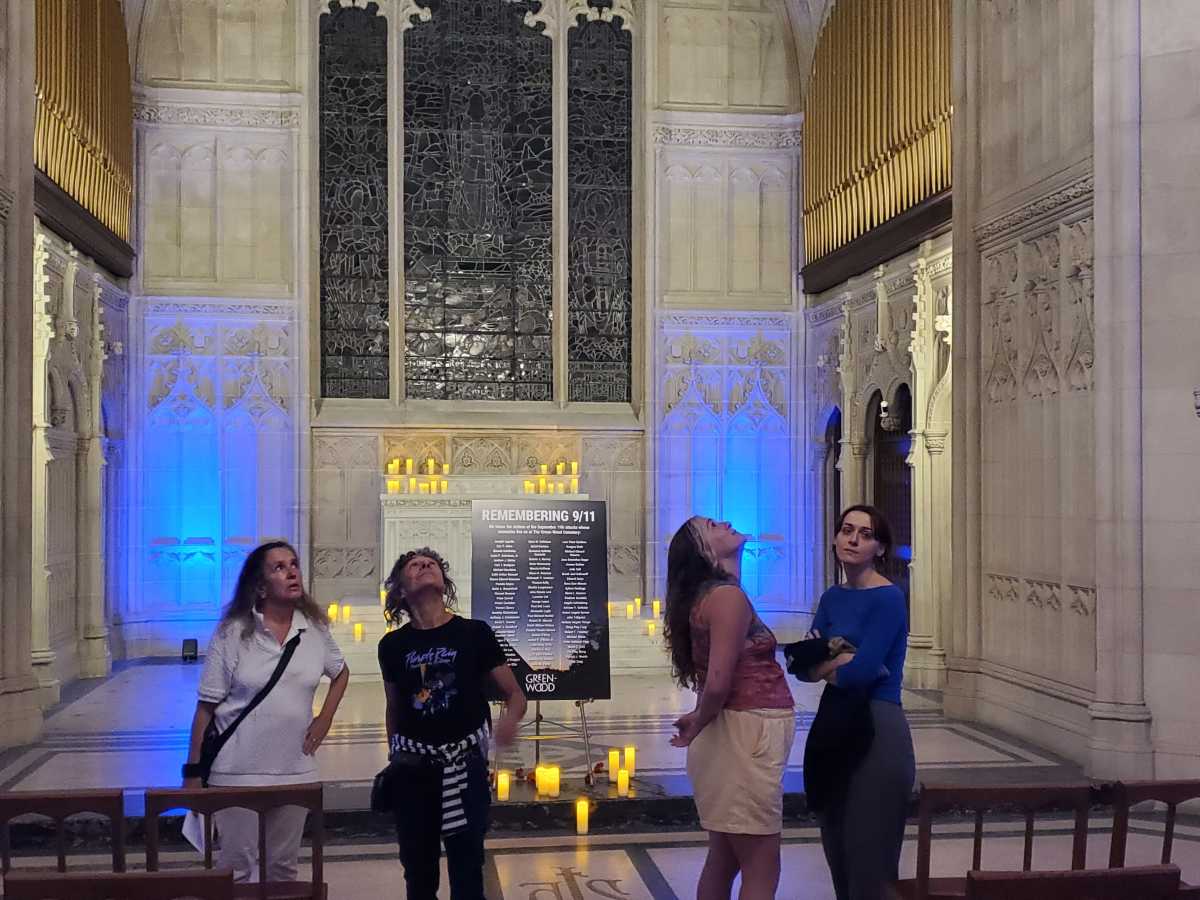 Green-Wood Cemetery’s 9/11 memorial honors those who died in the attacks and those who died from related illnesses in the years that followed.Photo courtesy of Green-Wood Cemetery
With simple words of remembrance and music, those who attended meditated and reflected on loved ones’ lives, losses and the passage of time.
“The focus is on remembering the innocent loss of life and celebrating the people who helped,” Wozunk said. “Let’s not forget those who perished and those who suffer now because of the efforts of helping.”
The night included readings of poetry related to 9/11 and hundreds of attendees, including “Untitled” by Cait Hynes, daughter of FDNY Capt. Walter Hynes, read by Toni Franco; “On Waking, After Almost a Decade,” written and read by Dana Leslie Goldstein, about a friend who died that day and dedicated to his widow; and “Mirar,” written and read by Carla Zanoni about grief in the city after that day.
“They are poems written in response to the events of the day,” Wozunk said. “It is a memorial service, but for many, many people, not just one person.”
Green-Wood Cemetery, which opened in 1838, is the first “rural” cemetery opened in New York City, inspired by the first rural cemetery in the nation, Mount Auburn Cemetery, which opened in 1831 in Cambridge, Massachusetts.
A National Historic Landmark, Green-Wood welcomes more than 500,000 visitors annually to its 478 acres, with more than 30,000 people attending its programs in 2025. These include gatherings such as its Battle of Brooklyn commemoration, Día de Muertos celebration and Nightfall.
“This is particularly important. It is a cemetery, a place of memorialization,” Wozunk added. “Because we have such a large number of 9/11 victims, we feel it’s important to keep their memory alive and acknowledge the day.”
Although the event was held in Brooklyn, Manhattan was visible as attendees’ eyes crossed distance and time.
“It happens to be a hill,” Wozunk said of the view of Manhattan. “From that hill you can see lower Manhattan through the trees.”