
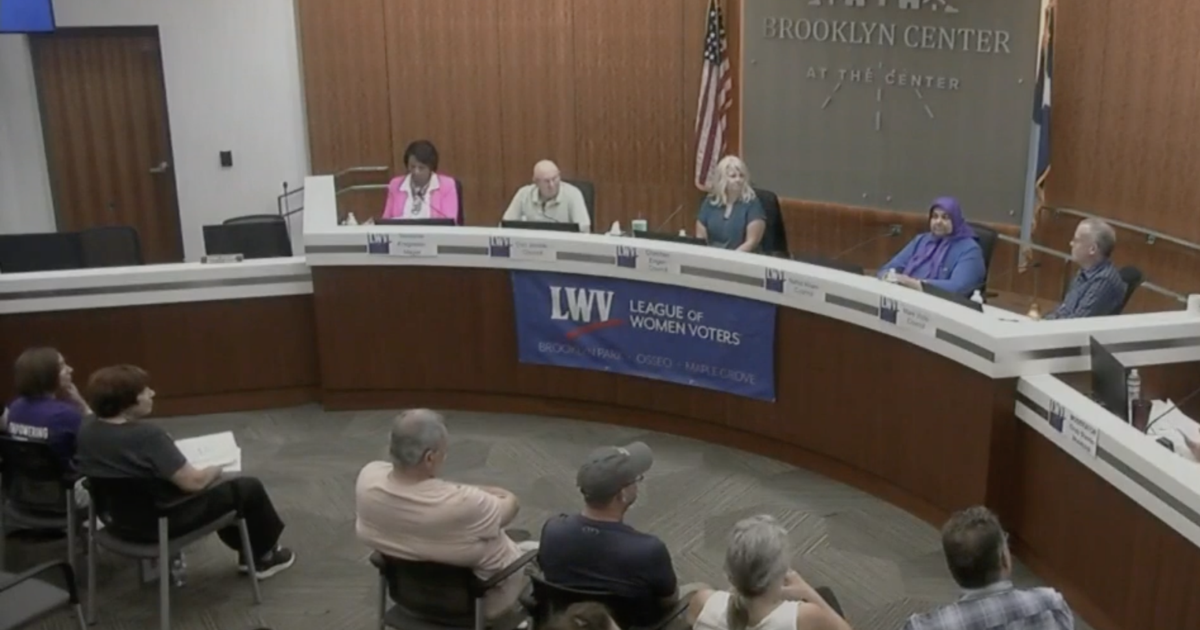
The local chapter of the League of Women Voters sponsored a Sept. 8 candidate forum featuring four individuals running for Brooklyn Center City Council and one running for mayor.
Brooklyn Center Mayor April Graves is not running for reelection, and the Aug. 11 primary narrowed the field of four candidates to two: Council Member Teneshia Kragness and Planning Commission Chair Alexander Koenig.
Koenig was not present for the candidate forum, and during the moderator’s closing remarks, she noted Koenig had been invited but did not participate.
Kragness’ current term will expire at the end of this year, meaning she will no longer hold a seat in the council chambers if her bid for mayor fails.
Four candidates for Brooklyn Center City Council will be on the ballot Nov. 3, vying for two at-large seats. Council Member Dan Jerzak is the sole incumbent running for reelection, with Nahid Khan, Mark Viste and Gretchen Enger also in the race.
All five candidates present at the forum fielded the same batch of questions asked by area residents and compiled by the league. Their responses to some of those questions are recapped below. The forum can be viewed in full at bit.ly/4inBpUS.
Vision, policy
Candidates were asked to share their respective visions for the future of Brooklyn Center and what policies they believe are most urgently needed.
Kragness said she wants a future where people feel safe and heard, businesses want to invest and “families feel like they belong” in Brooklyn Center. As for policies, she emphasized the need to fill unused properties.
“We have a lot of empty space here. We have a lot of potential spaces for businesses, for homes and I believe we need to have something put into place where we start acting on that,” Kragness said. “Everyone has a vision of what we could do, I think we should start doing things now.”
Khan said her vision involves “rebuilding” the city government by “diversifying sources of funding” and therefore reducing the financial burden on taxpayers. “We have tapped out our residents and property tax revenue, however, there is a lot of other money available at other levels of government,” she said.
Applying for grants and supporting small businesses were noted by Khan as additional priorities.
Jerzak said his plan for the city’s future needs to reflect the wants and needs of residents. “I meet with people who disagree with me, I return phone calls,” he said. “I think robust discussion is healthy when it’s done with respect and taking in all the perspectives of other people.”
The incumbent council member notably took time out of his answer to compliment the current mayor for seeking consensus during her time in office and said Kragness “will do a good job of bringing us together” if elected to fill Graves’ seat. “I wanted to give you that compliment, because that is a fact,” Jerzak said directly to Kragness.
Enger said her vision for Brooklyn Center is a place where people call home. “I think you’ve heard it before, and you’ll hear it again — safe neighborhoods, businesses that see Brooklyn Center as worth investing in. Good housing options, and that includes quality rentals and real paths to home ownership.”
As for policy changes, Enger noted she would only be one vote and said she would work with the rest of the council.
Viste said his vision for Brooklyn Center involves a “broad approach to public safety” that also honors first responders. “One policy I think we need to change is expand the use of mental health workers and social workers in our public safety structure,” he said. “This expansion is cost effective and reduces the burden on stressed officers.”
Police alternatives
Candidates were asked if any of Brooklyn Park’s expanded response programs — which deploy mental health professionals, social workers and other law enforcement alternatives to some 911 calls — should be merged, cut or otherwise changed.
Kragness said expanded response programs should be viewed as assets. “As far as merging or cutting anything, I don’t believe that is needed,” she noted. “When someone is calling for help, you want to make sure that you’re sending the best person with the best resources to help solve that issue.”
Khan said she agreed with Kragness and noted it is important to maintain diversity and variety in non-police safety responses. “Many of the non-police safety responses help de-escalate problems, whereas the presence of law enforcement would escalate problems,” Khan added.
Jerzak said he is supportive of expanded response but suggested Brooklyn Center consider regional partnerships to potentially reduce costs. “I’m also convinced that there are certain departments that do better with those types of responses than others.”
Enger said she fully supports expanded response, but “before deciding what’s next,” she “wants to see results.” She noted her goal is to get the right response to the right people based on data gathered by the programs so far.
“I want to use that type of data to see what we’ve learned so we can choose the model that works best for Brooklyn Center,” Enger added.
Viste suggested that the city might need to invest more in expanded response programs, not less, but he plans to look at the data before making decisions. “In general, I don’t think that merging is likely to be useful, I think expansion is the likely path the data would lead us in,” Viste said.
Surveillance
Candidates were asked to share their stance on the use of Flock cameras or similar camera technology in the city. The Brooklyn Center Police Department has deployed 10 automated license plate readers with funding through a Minnesota auto theft prevention grant.
Four of the cameras are along Brooklyn Boulevard, another four on Shingle Creek Parkway and two along Logan Avenue North.
Kragness said she “supports tools that law enforcement needs” but is “against invasion of privacy.” She claimed residents might have been more accepting of the ALPRs if there was more outreach and education prior to their implementation. “I did police ride-alongs and I was told the Flock cameras do not do face recognition and things of that sort,” she added.
Khan said she heard for “a lot of residents” who expressed concerns about surveillance and said the city should examine the technology further before allowing its continued use. She also recommended the city host a community discussion about the cameras and the information they collect.
“We do not want a police state, we do not want invasions of our privacy,” Khan said. “While we want police to have all the tools they need to do their jobs, there has been a lot of misuse of this technology throughout the country.”
Jerzak said he supports the use of ALPRs as one tool to help solve crimes. He described the technology as “effective and appropriate” but also said it is “fair” to have privacy concerns.
“Supporting this technology doesn’t mean we shouldn’t have robust safeguards and guardrails in place,” Jerzak added. “We have a robust policy to be sure that it’s not abused, and if it is, discipline can be done.”
Enger said she supported continued use of the cameras “with oversight” and cited the system’s 30-day data-retention period, among other guardrails outlined in the BCPD policy.
Viste said it would be best for the city to stop using ALPRs. He noted the technology is “more invasive than many residents realize” and argued the cameras can do more than just photograph license plates, as the name would suggest.
In Viste’s view, the process by which ALPRs were implemented in Brooklyn Center did not appropriately involve residents. “The current use of the cameras in the city is a police department initiative that the council did not weigh in on,” he said. “If we are going to be building a surveillance state, that needs to be a council decision with robust residents’ input.”