
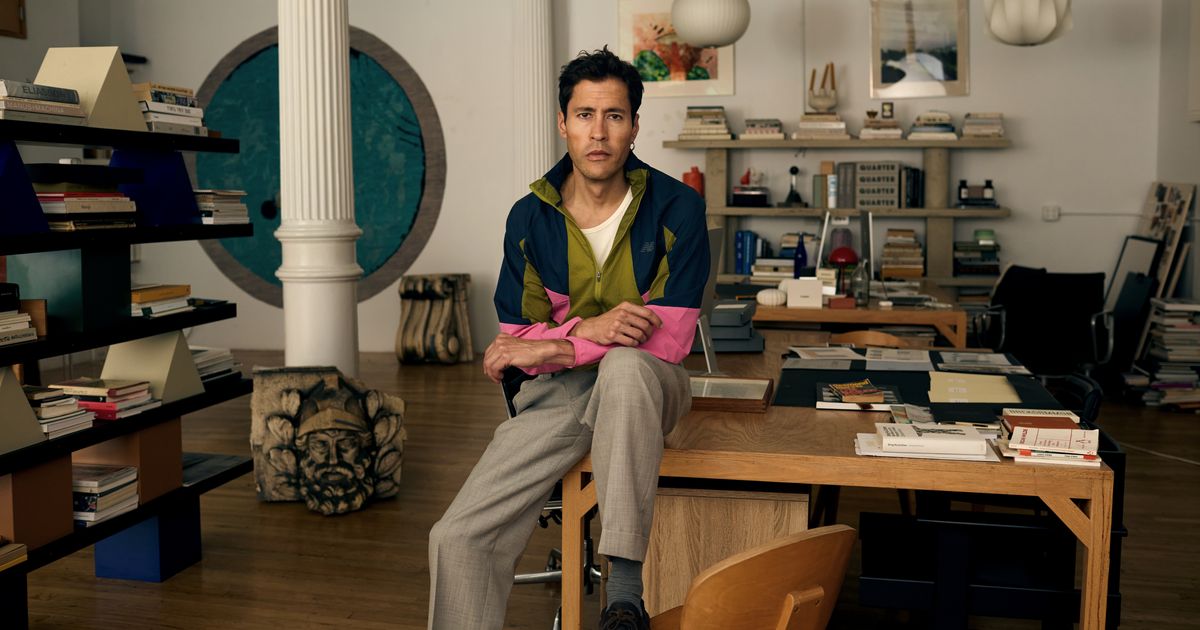
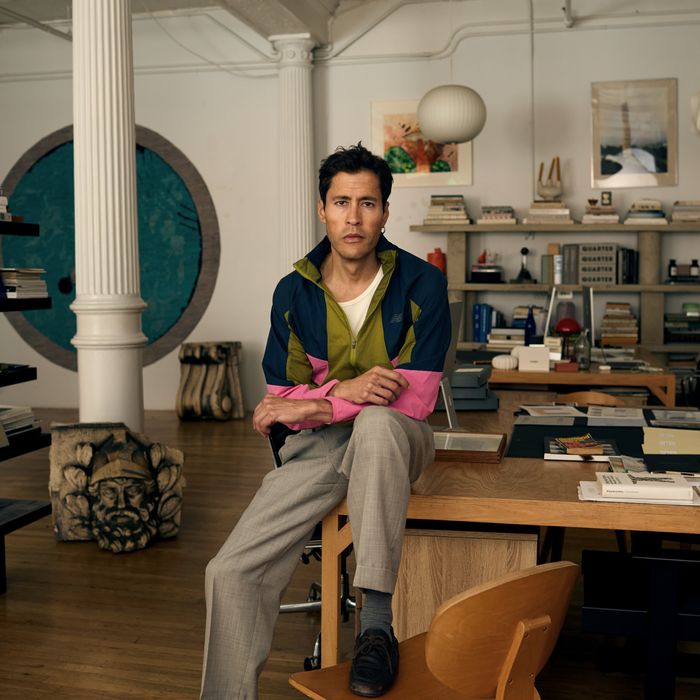
On a hot afternoon in August, I visited designer Rafael Prieto at the Tribeca studio where he lives and works, a high-ceilinged loft whose formality is punctured by the kind of industrial ’80s details we’ve deemed sexy in hindsight, like Venetian blinds and metal ceiling fans. Prieto answered the door dressed like a boy in luxurious pajamas — a loose striped Prada button-down over pale-blue boxers and gray crew socks tucked into a pair of barely there lace-up loafers. A single silver hoop dangled from one ear; a smattering of grays speckled his curly hair.
I was visiting the studio to look at the furniture Prieto is making for a show at Emma Scully Gallery that opens later this month, but I was quickly sidetracked. To enter Prieto’s studio, where he runs both his furniture office and the creative studio Savvy, is to encounter a densely realized version of the aesthetic universe he’s built over the last two decades with past, present, and future all speaking to each other under the same pressed-tin roof. Sprinkled throughout is a mix of found objects and Prieto’s own works, like the chairs and corseted-linen lights he made with his ex-boyfriend, Loup Sarion; the series of rugs he developed in collaboration with Christopher Farr earlier this year that conjure swimming pools from literature; and pieces from his 2023 exhibition with Scully, including a wooden side table embedded with a hunk of cast glass. A beeswax-and-urethane nose by Sarion hangs from one of the walls that section off Prieto’s living quarters.
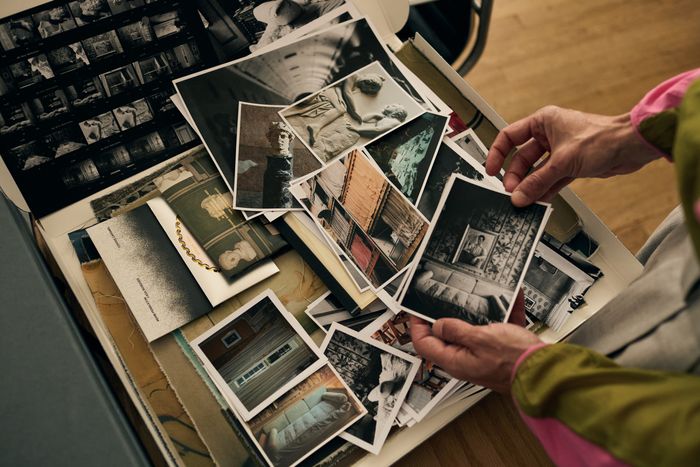
Photo: Frankie Alduino
Framing these pieces are historical works of art and design, conceptual in nature and startling in their familiarity: a signed and numbered Man Ray reedition of a household iron studded with tacks; a stamped Joseph Beuys multiple of a chalkboard eraser; two red-and-blue Rietvelds; a plywood Lawrence Weiner chair; and a piece made by John Cage in homage to Marcel Duchamp, which consists of eight sheets of plexiglass silk-screened with letters and numbers that Cage randomly selected using the I Ching, which features a numerical system with 64 possible outcomes. Taken together, these masterworks mirror Prieto’s own process, which often uses chance as a springboard for composition and which harnesses ephemera — memories, scents, poems, or even architectural fragments — to create new work.
The collection he’ll debut at “The Future of the Past,” opening September 30 at Emma Scully, borrows from a source close to home: the Beaux-Arts building being renovated across the street from his studio. Over the past year or so, Prieto has had a bird’s-eye view onto the scaffolding covering 366 Broadway, also known as Collect Pond House, an early-20th-century office-building turned apartment co-op that once was home to the Royal Typewriter Company and now counts several art galleries and one of the city’s remaining Gourmet Garages as its tenants. Looking out his window one day, Prieto noticed building fragments scattered across the roof of the scaffolding. These were not mundane chunks of rebar and concrete. 366 Broadway sports a fantastic array of architectural detail across its façade: copper cornices, marble columns, pregnant spirals, Greek keys slinking around corners, stern goddesses, and dozens of keystones carved into the likeness of bearded men.
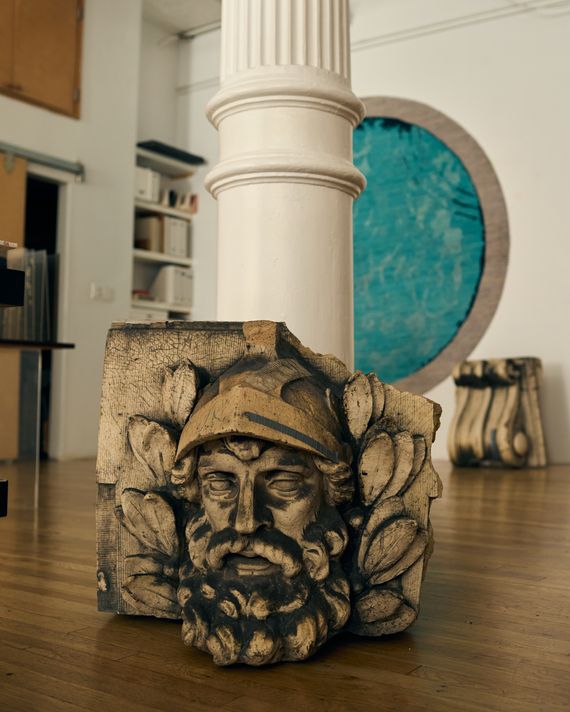
A bearded keystone from 366 Broadway sits on the floor of Prieto’s studio, awaiting a future commission.
Photo: Frankie Alduino
After months of watching the remnants go nowhere, Prieto worked up the nerve to ask if he could take some. “I almost got paid” to cart them away, he says with glee, which is how he ended up with the 16 fragments of Edwardian architecture that form the backbone of the show.
In the lead-up to the exhibition, Prieto photographed close-ups of the building’s other architectural details, abstracting them into a machined catalogue of lacquered wooden parts, which he could Frankenstein into different pieces of furniture. In one console table, a glossy-black L-shaped frame — its ladderlike leg inspired by the fluted piers that hug the corners of Collect Pond House — rests lightly on a scrolled stone support. Another stool from the collection slots a craggy stone carcass inside a black columnlike shell. The effect is one of a ghostly palimpsest. The new pieces carry the memory of the building from which they came, like the city itself being torn apart piecemeal to create something new. At the same time, cast into a new context, the fragments could have come from any city, anywhere in the world.
Prieto zooms out even further with some of the other pieces in the exhibition, which don’t incorporate original building fragments but are inspired by their architecture. In these pieces, which are coated in a palette of bright reds, dusky purples, black, and burl, their provenance becomes even murkier. And some fragments are still awaiting future transformation. The bearded keystone that Prieto rescued from 366 sits in the corner of his studio awaiting a custom commission. “I just assumed that not everyone wants a big piece of a building in their house,” he says. “Like, I’m aware that some of these pieces will be living in Connecticut.”
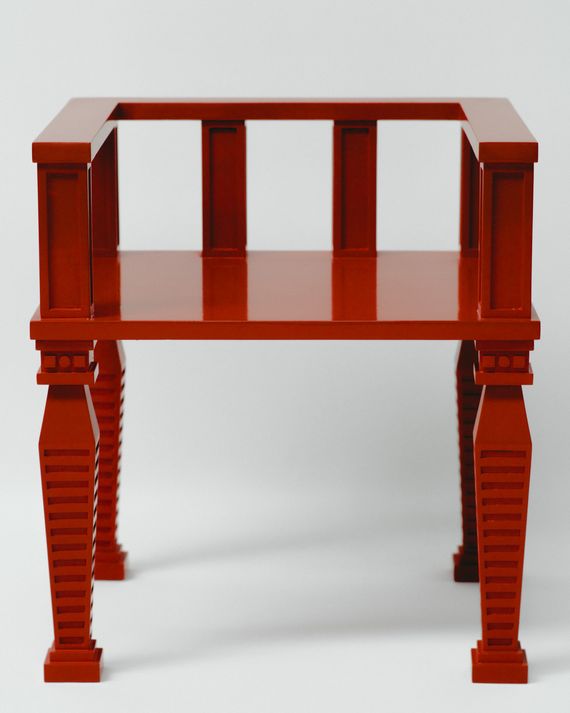
Photo: Mike Vera
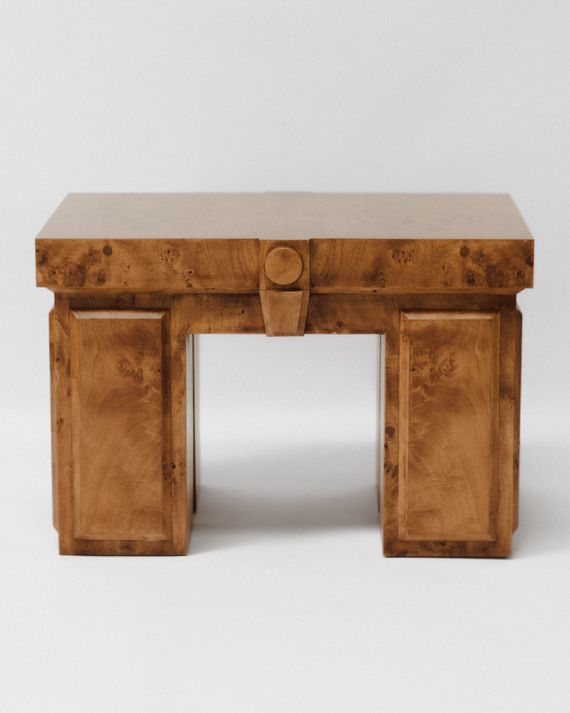
Photo: Mike Vera
In Prieto’s work, there is often a tension of opposites. Old vs. new, expectation vs. reality, ephemerality vs. permanence, the desire to shape-shift butting up against the inertia of staying static — a dissonance that can perhaps be attributed to a life spent moving from one region to another. Prieto grew up on a cattle ranch in the north of Mexico, and his work and studies have taken him from Mexico City — where he founded his third business, Casa Bosques, a chocolate company that recently turned into a hospitality empire — to Berlin, San Francisco, and New York.
He’s never been able to shake the idea that he’s a stranger in his own city. “I remember when I saw my first show with Lawrence Weiner, the way he was building sculptures with words,” says Prieto. “My English is always so choppy, and the way I phrase something … sometimes it’s not right. I felt like there was someone speaking my language.”
Perhaps that’s why the show at Scully’s feels so major; by incorporating scraps of New York into the work, Prieto is finally metabolizing a piece of the city. “At the beginning, the show at Emma’s was about a desire for preservation,” says Prieto. But in the end, it’s become a manifestation of how New York City mutates, to the way the old constantly jockeys for attention with the new. In a PDF he sent me about the project, there was a word cloud with phrases that Prieto had created for the collection. “Resist monumental grandeur,” read one bolded phrase. As if he — or New York — ever could.
Related