
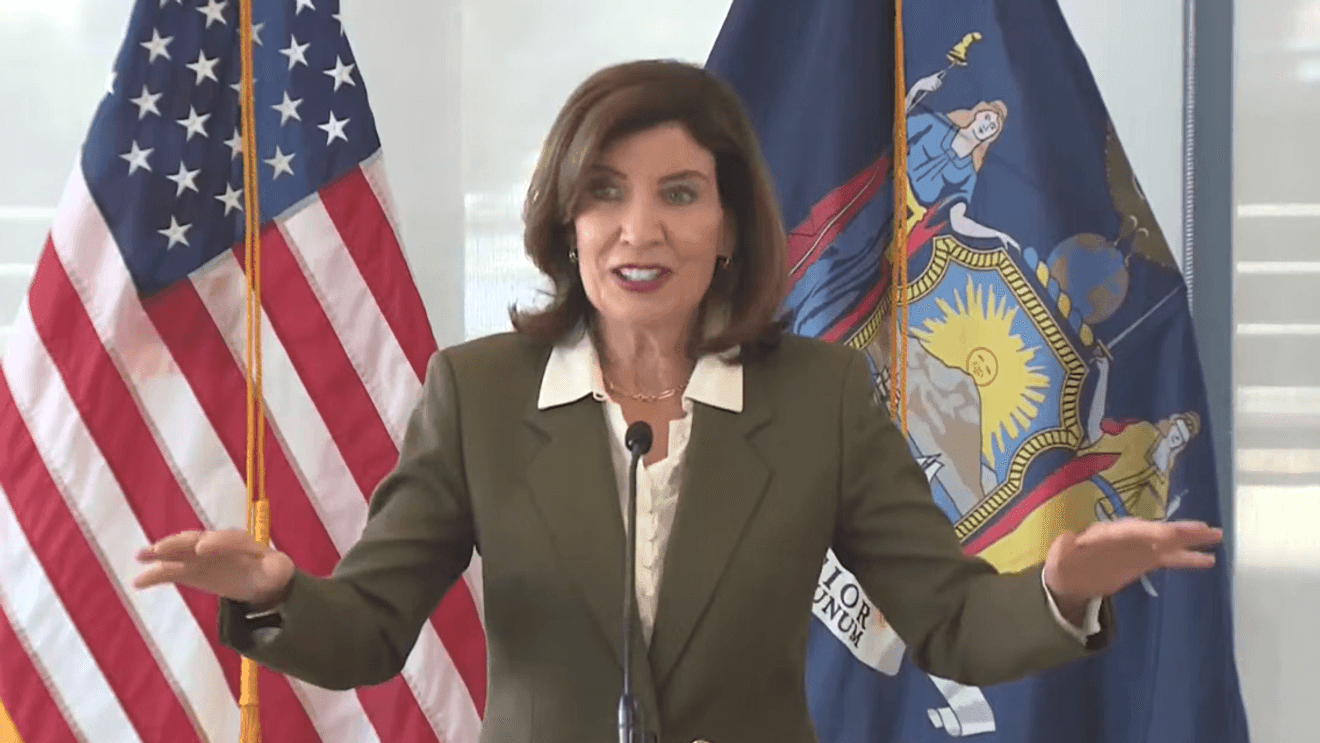
New York (WRGB) — Millions of New Yorkers could soon see their monthly utility bills drop, as Gov. Hochul launched a statewide push to enroll more households in the state’s Energy Affordability Program.
The state estimates about 2.5 million additional households are eligible for the Energy Affordability Program, or EAP, on top of nearly 1 million already enrolled. Depending on household income, the program can save households up to hundreds of dollars a year on utility costs, with discounts designed to make a typical utility bill less than 6 percent of household income. New Yorkers can check eligibility and apply here.
Gov. Hochul said,
As Washington Republicans keep driving up the cost of energy, gas and groceries, I’ll never stop working to help New Yorkers keep more money in their pockets. That’s why I expanded access to our Energy Affordability Program – a move that will save residents across the state up to $500 annually on their energy bills. Right now, 2.5 million eligible New Yorkers are leaving money on the table and I’m on a mission to help keep the lights on and costs down by launching an all-of-government push to get them enrolled in this money saving program. I encourage New Yorkers to take advantage of this opportunity by visiting NY.gov/EAP today.
State officials say up to half of all New York households are eligible for monthly utility discounts through EAP. Some households are automatically enrolled based on participation in other assistance programs, but many others must apply online.
Households are automatically enrolled if they are currently enrolled in the Home Energy Assistance Program or Public Assistance, including Temporary Assistance, which are administered by the Office of Temporary and Disability Assistance.
Other households may qualify through participation in programs including SNAP, Medicaid, Veterans’ Disability or Survivors Pension, Supplemental Security Income, Lifeline Telephone Service Program, federal public housing assistance, Utility Guarantee, Direct Vendor programs, Temporary Assistance for Needy Families, Safety Net Assistance, Bureau of Indian Affairs General Assistance, Head Start, Tribal TANF, and the Food Distribution Program on Indian Reservations. Those households are not automatically enrolled because of customer privacy restrictions and must self-enroll online.
Effective January 2026, Hochul’s administration expanded eligibility to include households below the state median income, or below area median income in New York City, Westchester and Nassau County. Under the expansion, income eligibility varies by household size and region, with separate thresholds listed for Con Edison and National Grid in New York City, National Grid on Long Island, and National Grid Upstate and other utilities statewide.
To boost enrollment, Hochul directed the Department of Public Service to begin a new outreach campaign in the coming weeks and months, including targeted digital advertising and coordination with other state agencies for direct mail, email and texts. The state also plans to cross-reference customers enrolling in other programs for potential EAP eligibility, partner with community organizations for in-person enrollment events, and have utilities directly inform customers about how to enroll. State agencies with public-facing offices will also promote the program on digital boards.
Assemblymember Grace Lee urged eligible residents to apply saying,
New York families are already stretched thin, and harmful federal policies are driving energy costs even higher. I thank Governor Hochul for making sure more households can access the relief they deserve. Half of all New York households may qualify, and I encourage every eligible New Yorker to visit ny.gov/eap and enroll.
The enrollment push comes as Hochul highlights broader efforts aimed at utility affordability. The governor announced that $1 billion in energy rebate checks will go out to 8.2 million eligible households beginning September 21. Hochul’s office also pointed to $1.17 billion in one-time post-COVID funding that helped nearly half a million residential customers and 56,000 small businesses pay off past-due utility bills.
Since taking office in 2021, Hochul has provided more than $6.6 billion in direct utility bill relief to participating households, not including the $1 billion in rebate checks planned for this fall, and another $1.4 billion to support residential weatherization, energy efficiency and renewable energy projects intended to reduce energy use and lower bills.
Hochul’s Energy Affordability Agenda also includes changes to how utilities are regulated, including tying profits to performance on affordability, prohibiting utilities from passing certain costs to ratepayers, benchmarking utility CEO salaries to affordability goals set by the Public Service Commission, and returning excess profits to ratepayers. The plan also calls for increased scrutiny of rate hike requests, a 14-month review period for rate requests, and a new energy affordability index that would track the impact of utility rates on households, with the potential for an independent Affordability Monitor if a rate case pushes the average household energy burden above 6 percent.
In addition, the FY27 enacted budget establishes a RATES Commission to examine rising utility bills, including how costs are passed to consumers, utility profits and energy market design.
OTHER: Gov. Hochul announces rebate checks up to $200 to 8.2 million New York households