
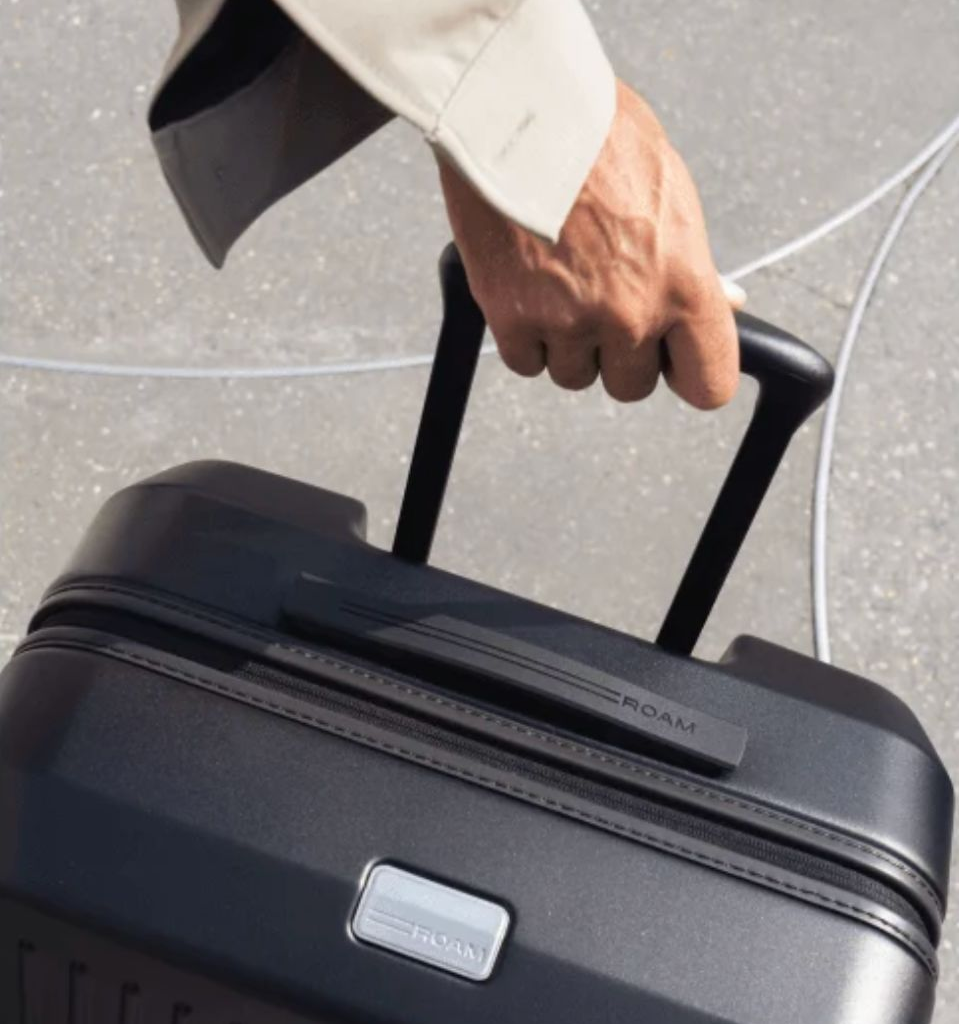
The newest suitcase from the American-made, and first choice of the jet-set crowd, ROAM Luggage does not look custom. That is the point. Manhattan is matte black on matte black: shell, trim, the whole silhouette. On the company’s site it sits inside a Designer Collection of destination palettes—Newport’s navy and slate, Monza’s racing red, Brooklyn’s stealth steel. Manhattan is the one that reads like the city it is named for. Bold from every angle, the brand says, and as confident as the place on the luggage tag.
It is also the cleanest way into what ROAM actually sells. The company is not a seasonal color house. It is a made-to-order workshop, designed in New York and hand-assembled in Vidalia, Georgia, that will let a customer pick the shell, the other shell, the binding, the wheels, the zipper, the handles, even the monogram plate. Manhattan is the ready-made answer for people who want the factory without the configurator. Carry-ons start at $595. A large check-in expandable runs $850. Shipping is free. There is a 100-day trial and an enviable lifetime warranty.
The duo who made everyone carry black is now selling black again.
ROAM was founded in 2018 by Charlie Clifford and Larry Lein, Tumi’s founder and former executive vice president. Tumi’s genius was the opposite of this: one travel uniform, usually black, for people who flew enough to treat a suitcase like a briefcase. Clifford has said the quiet part out loud. Why should you carry the same bag as everyone else? The bag should be an extension of the trip. ROAM’s answer was beautiful and unique customization at a price that sits between Away’s mass DTC and the Rimowa–Tumi shelf.
That is a crowded argument in 2026. Every premium case now promises quiet wheels, a polycarbonate shell, and a carousel that will not eat your bag. What ROAM can boldly claim is the assembly line. Cases are built one at a time in Georgia from U.S.-made virgin polycarbonate, with recycled antimicrobial lining and a compression system meant to keep a carry-on honest. Typical turnaround is a few days, not a season. The company once opened a small concession at Bloomingdale’s 59th Street. The business, then and now, is mostly direct.

ROAM LUGGAGE
What Manhattan is—and is not.
Manhattan is not the loud New York edition ROAM has also shown, the navy-and-orange nod to the city’s teams. It is tone-on-tone black, a look that will still disappear in a pile of Rimowas unless you know the racing stripe where zipper meets binding. The collection’s other cities do the talking: sea-and-sky Newport, Formula One Monza, quiet-steel Brooklyn. Destination naming is merchandising. The engineering does not change with the postcode.
Independent reviews have been consistent on the hardware and split on the ticket. Wheels get praised. Weight is competitive. Gloss shells sometimes scuff, as hard cases do, and some testers have said the price asks more than the materials strictly return. ROAM’s rebuttal: keep it twenty years, send it back in a hundred days if it is wrong, and do not pay a department-store markup for a bag built in the same country you fly from. That is a brand claim, not a depreciation schedule. The lifetime warranty certainly does make it more attractive than other luxury luggage brands with higher tickets, made from less professional quality materials.

Manhattan Matte Black Collection
The business of looking unlike the carousel.
Luggage after Away became a branding category. Color was the first hack. Then came USB ports, then the retreat from smart bags after airlines and batteries soured the pitch. What is left is identity. ROAM is definitively chic, and betting that a subset of travelers will pay Tumi-adjacent money for a case that does not look like Tumi, or will pay the same amount for a black case that was specified, not grabbed off a wall.
Manhattan is the Trojan horse for that second customer. It lets ROAM Luggage sell New York without selling a souvenir. The rest of the line is still the configurator: millions of combinations, a Georgia bench, a lifetime promise.
This article was originally published on Forbes.com