
Real journalists wrote and edited this (not AI)—independent, community-driven journalism survives because you back it. Donate to sustain Prism’s mission and the humans behind it.
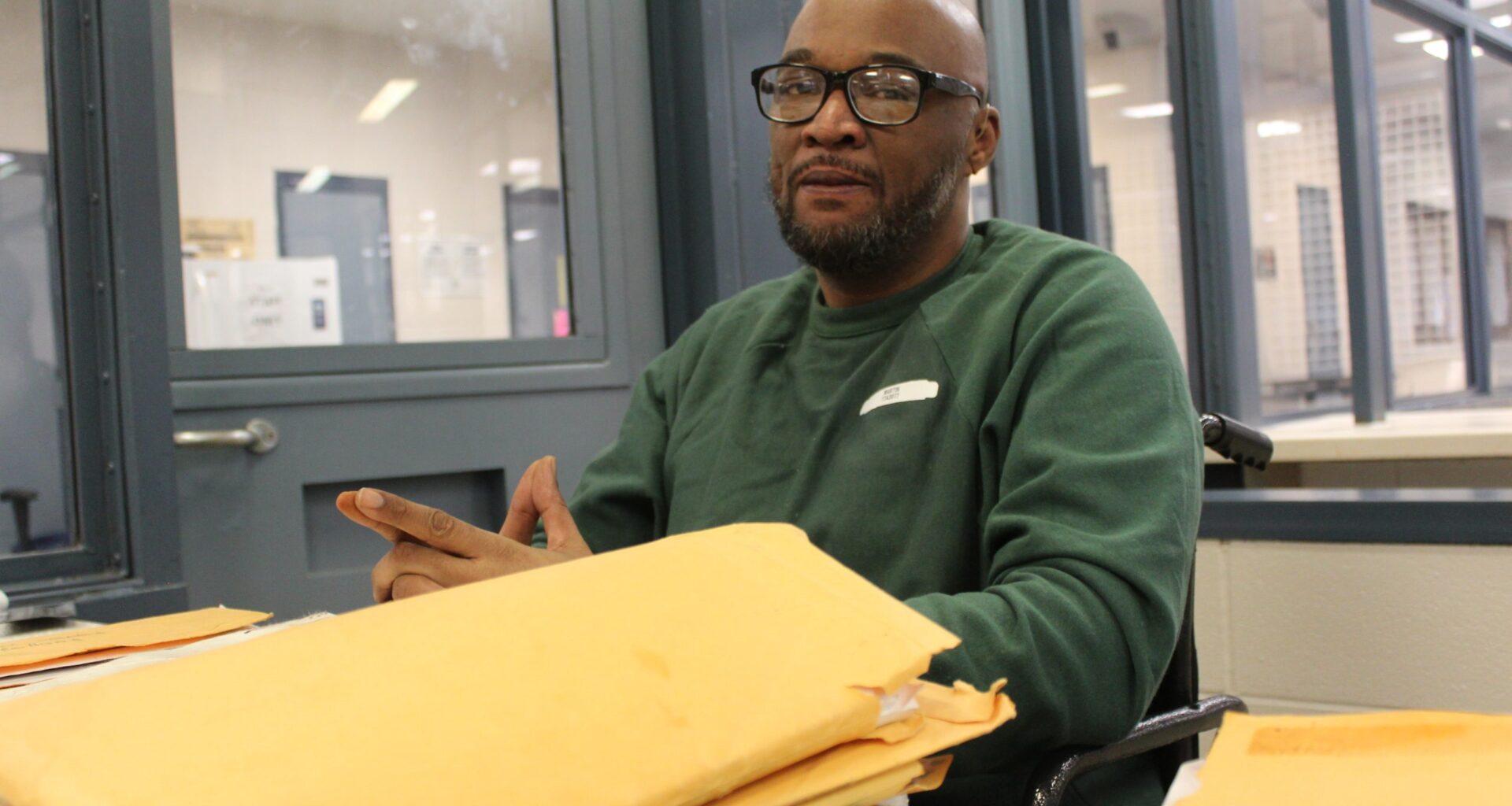
When Dante Martin first entered Five Points Correctional Facility, outside Ithaca, New York, in 2024, he was held in the medical unit rather than a cell. Martin, who has been incarcerated for nine years, has epilepsy, is legally blind and hard of hearing, and, as of 2025, cannot walk independently. Prison staff determined that only the medical unit was able to accommodate his needs until he could be transferred to a facility that could better support him.
Martin was transferred to another prison after a few months. But within a year, he found himself back at Five Points. This time, however, he struggled to get the care he needed there.
According to Martin, he has not received 16 of the 21 devices or services he requested more than 10 months ago from the Department of Corrections and Community Supervision (DOCCS)—despite prison officials agreeing that he’s entitled to them under the Americans with Disabilities Act (ADA). Without accommodations like large-print documents, an aid to help him move around prison, and a wheelchair-accessible cell, everyday activities like reading, socializing, and bathing have been difficult.
“As humans, we are social creatures. When I don’t have these accommodations, I’m isolated,” Martin told Prism. “It feels like I’m lost, I’m alone, and there’s no hope.”
More than 34,000 people are held in 41 DOCCS facilities. Of those, DOCCS has designated 11 prisons to provide tools, staff support, and other accommodations for people with vision, hearing, and mobility disabilities. However, no single facility is designated to accommodate every category of disability described in DOCCS’ internal policies. As a result, incarcerated people like Martin who have multiple disabilities can find it nearly impossible to get the supports they need to function—even when DOCCS agrees that such accommodations are necessary and meet the legal standard of being “reasonable.”
Several legal and ADA compliance experts told Prism that DOCCS’ failure to consistently provide reasonable accommodations to disabled people held in its facilities is likely a violation of federal law.
“Where a person with a qualifying disability requires a reasonable accommodation to access a prison program or service that non-disabled people enjoy, the ADA requires the prison to provide the accommodation,” Lauren Nakamura, an attorney for Legal Aid Society’s Prisoners’ Rights Project, wrote in an email. “If the prison fails to provide the accommodation, it’s violating the ADA, unless it can show that providing the accommodation would be an undue burden or would fundamentally alter the available program.”
Prism spoke with 19 incarcerated people with disabilities in prisons across New York who, without access to all of their requested accommodations, have experienced uncomfortable and dangerous conditions inside DOCCS facilities. Many of the tools and services they had fell through the cracks when they were moved to a new prison. After a transfer, some said they waited weeks or months to receive accommodations, and, in some cases, accommodations were denied even though DOCCS staff at a previous facility had approved them.
Several people Prism spoke with have found DOCCS’ official grievance process, which is often used to report missing accommodations, to be ineffectual, and some said they faced retaliation after making complaints.
Their accounts are supported by previously unpublished data, interviews with disability rights lawyers and medical experts, and hundreds of documents obtained by Prism, including medical records, administrative paperwork, and internal DOCCS directives.
“The health and safety of incarcerated individuals and staff is a top priority. DOCCS strongly adheres to the standards of care and accommodation for all incarcerated individuals with diverse needs in alignment with the Americans with Disabilities Act (ADA), which is outlined in our Department Directives,” DOCCS spokesperson Nicole March said in an emailed response to a detailed list of questions based on Prism’s findings. “The Department continuously reviews and updates its practices to ensure we are meeting these standards of accessibility and care.”
Life in prison without accommodations
Martin, 46, recalled having his first seizure about 15 years ago. In 2015, he was diagnosed with epilepsy.
Epilepsy, along with hearing loss, legal blindness, and severe back problems, has necessitated several supports and services for Martin to live safely and comfortably in prison.
“I need my accommodations in order to survive and in order to function,” he said.
Since he pleaded guilty to assaulting a police officer in 2017, he’s been held in eight different DOCCS prisons. The facility where he has had the most trouble receiving accommodations is Five Points.
In November 2025, after the condition of Martin’s back deteriorated to the point of needing a wheelchair, DOCCS returned him to Five Points—the only New York state prison designated as wheelchair accessible by DOCCS’ internal disability directive. DOCCS told Prism that eight other prisons are “fully wheelchair accessible,” and some others can partially accommodate wheelchair use, but those are not listed in the agency’s disability policy.
Within his first week back at Five Points, Martin asked for almost every accommodation listed on DOCCS’ Request for Reasonable Accommodations for Incarcerated Individuals with Sensorial Disabilities form. Per DOCCS’ internal directives, disabled people can request certain tools and services, and a high-ranking staff member at the facility and a medical professional review the applicant’s medical records to decide if the request is reasonable. Under the ADA, prisons generally must provide reasonable accommodations to qualified disabled people, so long as they don’t fundamentally alter a program, compromise safety, or create an “undue burden” for DOCCS. If approved, the applicant should either be given the accommodations or transferred to a facility that can provide them.
A Five Points medical staffer and the deputy superintendent for programs (DSP), the officer responsible for signing off on disability accommodations, approved every one of Martin’s requests, his application form shows.
However, as of this month, Martin told Prism that he only has five of the 21 accommodations he asked for: a hearing aid, sunglasses, a “shake awake” alarm, a plastic magnifying glass, and a telephone amplifier that isn’t compatible with the tablet he uses to make calls. He said he was allowed to bring the hearing aid he had at his previous facility, but it took months for him to receive the other items.
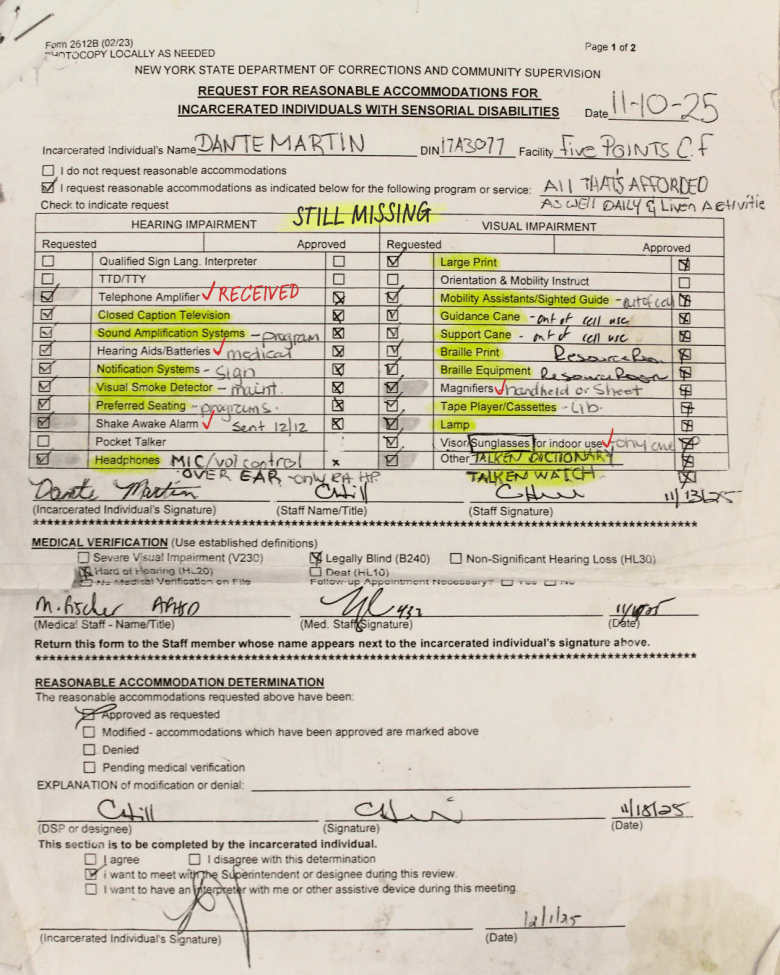 Dante Martin’s accommodation request form, overlaid with a graphic of which accommodations he has received and which are still missing. Courtesy of Dante Martin; designed by Kyubin Kim
Though Martin has access to a wheelchair outside of his cell and takes epilepsy medication, he has yet to receive braille or large-print documents, a tape player for audiobooks, and a mobility assistant—an incarcerated person paid to help blind people move around prison—among several other accommodations. He said he’s also waiting on a lamp to help him manage his epilepsy, which is aggravated by flickering light and heat. Martin estimated that he’s had about one seizure a month at Five Points, where it gets very hot in the summer.
Without these supports, Martin’s daily life in prison has been isolated, frustrating, and dreary. Without the large-print forms, Martin said he’s missed commissary orders at least five times, leaving him without hygiene products. Without the tape player, he hasn’t been able to listen to novels, like the James Patterson books he likes to binge-read. And without a mobility assistant, he can’t participate in communal meals, programming, or recreational time.
“I’m stuck in a cell alone by myself,” said Martin. He worried that without adequate medical monitoring, his life could be in danger.
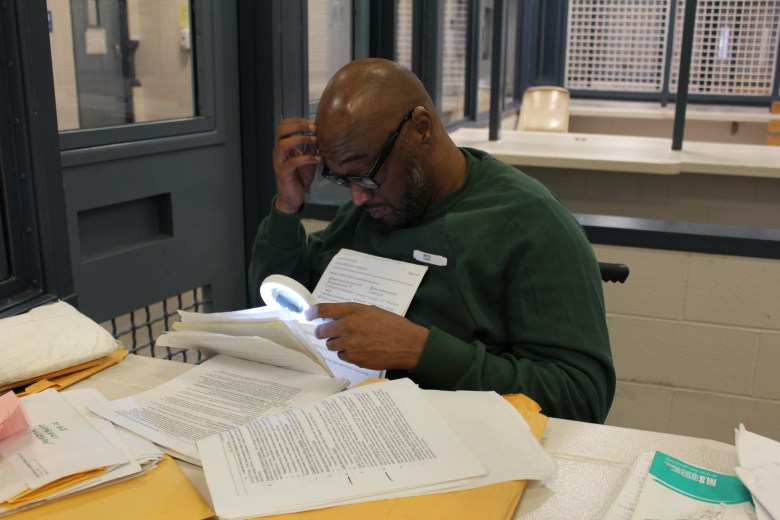 Dante Martin looks at his documents in the Five Points visiting room using a plastic magnifying glass, one of the tools he has received as part of his accommodations request, on March 20, 2026. Credit: Curtis Brodner
In an ongoing class-action lawsuit against DOCCS for placing disabled people in solitary confinement despite a state law forbidding the practice, DOCCS has failed to provide the number of disabled people in its custody, what disabilities they have, and where they are held. Victoria Pilger, a lawyer representing the incarcerated plaintiffs, said she believes DOCCS’ failure to share that information during discovery meant the department has not been tracking it.
DOCCS has also repeatedly delayed fulfilling Prism’s freedom of information request for similar information. However, a document obtained by Prism from February lists the disabilities of 53 people incarcerated at Eastern New York Correctional Facility, an hour’s drive west of Poughkeepsie. The document indicates that, at least at this facility, DOCCS does internally record information about disabled people it incarcerates.
DOCCS did not directly comment on the lawsuit, the agency’s failure to share data in court, or the document that indicates the agency tracks that data.
According to intake data shared with Prism by Prisoners’ Legal Services of New York (PLS), between March 2023 and January 2026, 123 people in DOCCS facilities wrote to the civil rights group that they were missing accommodations or otherwise faced disability discrimination. PLS received at least one complaint from 92% of state prisons, and five or more complaints from about a quarter of all facilities.
Five Points—where Martin is held—had the highest number of complaints, more than twice as many as the second highest on the list, Eastern.
A new era for disability in prison
For most of the 20th century, many disabled people convicted of crimes were confined in asylums rife with abuse or prisons that provided little accommodation or support.
That started to change in 1990, when Congress passed the ADA, the landmark civil rights law that mandated government institutions accommodate people with disabilities. Eight years later, a Supreme Court case, Pennsylvania Department of Corrections v. Yeskey, clarified that the ADA applies to prisons and jails.
Prisons in New York initially failed to comply with the ADA, leading a group of hearing-impaired incarcerated people to file a lawsuit against the state in 1991. A judge ruled that by failing to provide accommodations like sign-language interpreters and hearing amplification devices, the prisons were violating the law.
The lawsuit led to DOCCS’ policy for requesting reasonable accommodations, initially just for visual and hearing impairments. While the directives have expanded over the years to be more thorough and include mobility disabilities, the process remains inefficient and inconsistent across facilities.
Some prison systems have a designated staff person at each facility who ensures compliance with the ADA. DOCCS, however, has only one ADA coordinator for the entire state. Instead of one ADA coordinator per prison, each facility’s DSP oversees the entire accommodations process, from reviewing requests to investigating complaints, documents show. That’s in addition to managing education, rehabilitation, other grievances, and more.
“The state-wide ADA Coordinator and the Office of Diversity and Inclusion reviews and oversees incarcerated individuals’ reasonable accommodation requests, determinations made by the DSP, and all complaints received related to reasonable accommodations,” DOCCS said in an email.
Other problems can arise from the inability of any one prison to accommodate all types of disabilities, leaving gaps in coverage for some people with multiple disabilities. Finding the right facility is further complicated by the security level mandated for an incarcerated person and by complex medical needs that require specific treatment and can cause disabilities, according to Dr. Homer Venters, a former chief medical officer of New York City’s prison system who now investigates prisons as a federal monitor.
According to PLS’ intake data, between March 2023 and January 2026, there were 150 instances when a person was placed in a facility not designated to accommodate their disability, including when this happened more than once to the same person. Julian Martinez, a consultant who monitors ADA compliance, said many states use this system of “clustering,” in which a prison system designates different facilities to accommodate different disabilities, as a cost-saving measure. Martinez said other prison systems put the onus on the facility to provide accommodations as soon as staff verifies a disability instead of requiring incarcerated people to request their own.
As New York’s prison population ages, disability accommodations requests from elderly people with long sentences have also become more common, according to Venters.
Some of the incarcerated people Prism spoke with were able to get the tools and services they needed at prisons that were not designated to accommodate them. But for others, DOCCS’ piecemeal approach undermines the systemwide reforms mandated in the ’90s.
“They put me through hell”
During his 45 years in New York’s prison system, Jose Medina has experienced firsthand the challenges of navigating DOCCS’ disability accommodations process after a transfer. Medina, 72, has been incarcerated all over the state—eight facilities total since he was convicted of murder in 1981.
Twenty years ago, he was diagnosed with prostate cancer, he said, and has glaucoma and cataracts that visually impair him in one eye and have made him legally blind in the other.
In 2022, Medina was held in Sullivan Correctional Facility, where officials had approved accommodations like a magnifying tool, a tape cassette player for audiobooks, and large-print documents, records show. But when Sullivan closed in 2024, his accommodations were thrown into disarray.
“They put me through hell,” Medina said.
He was moved to Green Haven Correctional Facility, where DOCCS required him to reapply for accommodations. But, for the five weeks he was held there, he said he didn’t receive adequate supports.
“Life was a battle and hard for me to get around on my own,” Medina said in a message sent through Securus, DOCCS’ digital communications provider.
After weeks struggling to function, he was moved again—this time to Eastern. Again, Medina had to reapply for accommodations. Under DOCCS policy, staff should have used the same criteria to judge his application, so Medina assumed getting reapproved would be simple. He was wrong.
On his form to request vision accommodations from Jan. 3, 2025, staff indicated “no medical verification to support visual defect”—without it, they would not approve Medina’s request. However, medical records from six days after Medina received the response reference eye surgeries he underwent years prior, as well as a vision test he took the same day he filed the form. After his request was rejected, Medina was examined during a medical consultation that found what he already knew: Even with glasses, his vision was severely impaired.
It’s unclear why Eastern staff didn’t refer to the same medical records that Sullivan staff appeared to have when they approved Medina’s accommodations in 2022, let alone the vision test that took place at Eastern itself. Cassandra Rohme, a civil rights attorney who represents incarcerated people with disabilities, along with other legal and medical experts, said that by forcing incarcerated people to reapply every time they change facilities, DOCCS exacerbates the risk that needs go unmet.
You’re not spontaneously recovering from being blind just because you went to a different facility.
Cassandra Rohme, civil rights attorney
“It doesn’t make any sense,” Rohme told Prism. “Obviously you’re not spontaneously recovering from being blind just because you went to a different facility.”
DOCCS’ use of paper medical records can add to the confusion, she added. DOCCS told Prism that the agency’s 2027 budget includes funds to develop a digital system for medical record keeping.
Medina would not accept Eastern’s decision. With the help of friends, over the following weeks, he submitted another application, filed complaints through DOCCS’ grievance system, and attempted to track down his medical records. After four and a half months with no respite, Medina got a letter from an Eastern staff member that he would receive his accommodations in a few days. He got access to a guidance cane, magnifiers, a tape player, and some other vision tools, but Eastern refused to provide him a mobility assistant.
Medina escalated his efforts. He wrote to high-ranking DOCCS staff, nonprofit legal advocates, and the U.S. Department of Justice about his situation. He even wrote to New York Gov. Kathy Hochul, whose office attempted to intervene, a letter from a DOCCS official shows.
It wasn’t until this past February—over a year after he first submitted his request at Eastern—that Medina said he finally received a mobility assistant. Martinez, the prison ADA consultant, said that in his experience, a reasonable wait time for accommodations that don’t require specialized equipment is four to six hours.
In May, Medina learned his prostate cancer, which had been in remission, had returned. But he remains a relentless optimist, signing every message “the fighter and survivor.”
“I have learned to turn this prison pain into purpose,” he wrote, “and I am not at the finish line yet.”
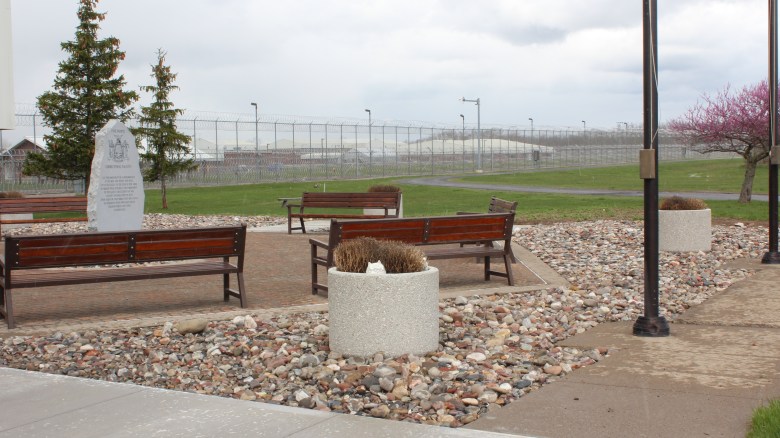 Outside of Five Points Correctional Facility, on March 20, 2026. Intake data from Prisoners’ Legal Services of New York (PLS) shows that 20% of all disability discrimination reports PLS received came from Five Points, the most of any prison in the state. Credit: Curtis Brodner
Nowhere else to turn
Between his arrival at Five Points in November 2025 and late April, Martin filed at least 14 grievances—double the number he made at every other facility he’s been in combined. Half of the grievances dealt with inadequate medical care, or missing or denied accommodations. Eleven people Prism spoke to said they had also filed grievances related to disability accommodations.
On Jan. 15, Martin filed a grievance after Five Points staff moved him from the medical unit to a general-population cell that is not wheelchair accessible. About a month before the move, the DSP had sent Martin a letter that read, “Upon further investigation with medical, you are not wheelchair bound, you are wheelchair for long distances.”
Martin wrote in his complaint that he had not been seen by a doctor before being moved, and that a nurse had told him the decision was made by “administration and medical.”
He maintains that he needs a wheelchair to maneuver in his cell. The cell he was moved to was a small room that he lived in alone. It had a shower elevated more than a foot off the ground, by Martin’s estimate, so instead of trying to crawl inside, he said he bathed in the sink.
Without a mobility assistant, Martin was rarely allowed to leave his cell, except for medical and administrative appointments once or twice a week.
Because his cell was so cramped, Martin said he struggled to use his chair to enter and exit. Without a mobility assistant—which Five Points approved but Martin said has still not provided—he was rarely allowed to leave his cell, except for medical and administrative appointments once or twice a week.
“We’re humans, we’re supposed to at least socialize,” Martin said during an interview on April 20. “You have me in a cell since at least Jan. 5. You don’t think that’s fucking with my mental?”
Since July, Martin said Five Points has moved him to four different cells, including both medical and general-population cells, without explanation. He is currently in a medical cell, which is equipped with support rails and an accessible shower. Despite his cell placement and his barrage of grievances, Martin told Prism that he remains without most of his accommodations.
Grievances are reviewed by a panel of incarcerated people and staff, according to a DOCCS internal directive. The panel can issue a decision on how to resolve the complaint, but cases that require a change in staff behavior or policy are ultimately referred to DOCCS administrators. While DOCCS closely monitors grievances, the agency does not track ADA-related complaints in its semiannual report on grievances.
In March, the panel denied that Martin was missing accommodations, claiming that he had been provided with sunglasses, a cane, a magnifier, the lamp to manage epilepsy, and a talking watch on Dec. 1, 2025. The decision does not mention the 12 other approved accommodations that he said he has not yet received. In another decision, issued in April, the panel wrote that he had been provided with all of the accommodations.
When prison systems fail to provide accommodations, grievances increase, said Venters, the prison medical monitor.
“It creates a very contentious environment,” Venters said. “And it may keep the patient from doing other things they need to do, like they may not be able to get down the stairs or get to meals or get to places they need to go without that accommodation.”
“It’s not acceptable at all to wait until there’s been a failure in accommodation, and then they file a grievance,” Venters added. “That’s not an acceptable or ethical approach to disability accommodation.”
Martin believes he invited retaliation by complaining. He sees his previous placements in inaccessible general-population cells as punishment, and in early May, Martin said staff confiscated his wheelchair for in-cell use and replaced it with a walker.
“How am I supposed to get in and out myself now or move around my cell if you took my wheelchair?” said Martin.
He said his access to a wheelchair continues to be inconsistent. Several others incarcerated at Five Points and other facilities told Prism that they believed staff had taken away their wheelchairs or filed reports of misbehavior as retaliation for speaking out.
“I NEED MEDICAL HELP. MY LIFE IS IN DANGER”
In April, Martin’s worst fears of what could happen if he did not get his accommodations materialized.
It was a week before I planned to visit Five Points to meet Martin, whom I’d been communicating with over the phone and Securus for months. On the morning of April 12, Martin sent me a message: “I NEED HELP .I’VE HAD ANOTHER SEIZURE and I’VE BEEN LAYEN ON THE FLOOR SINCE 6:30am.THE OFFICER’S AND THE NURSE ARE AWARE OF THIS AND LLEFT ME ON THE FLOOR,I NEED MEDICAL HELP. MY LIFE IS IN DANGER .”
After trying to reach Martin’s mother and sister, I called Five Points to ask staff to check on him. On my first attempt, a medical staff member said she was dealing with an emergency and hung up. When I called back, an officer repeatedly said he wouldn’t answer any questions.
“This is urgent,” I said.
“It’s not urgent to me,” he responded, and hung up.
After about an hour, Martin’s mother called me to confirm that staff eventually checked on him, after his cousin called the facility four times. Martin said he spent hours incapacitated.
A day after Martin’s seizure, March, the DOCCS spokesperson, told me that staff conducted a wellness check, and Martin had seen medical staff twice. “The Department takes reports of potential medical concerns seriously. We are reviewing the circumstances surrounding these calls,” she said.
While Martin waited for help, he said he thought he would die.
“At one point I was saying, ‘Man, this is it,’” he said. “‘This is my final destination.’”
About two months later, Martin found himself in the same position after another seizure. He worries the next seizure will be his last.
“It’s fear for my life, because once you lose that, you can’t get that back,” said Martin. “I came here to do a bid, not to be treated like an animal.”
Editorial Team:
Rashmee Kumar, Lead Editor
Carolyn Copeland, Top Editor
Stephanie Harris, Copy Editor
Related