
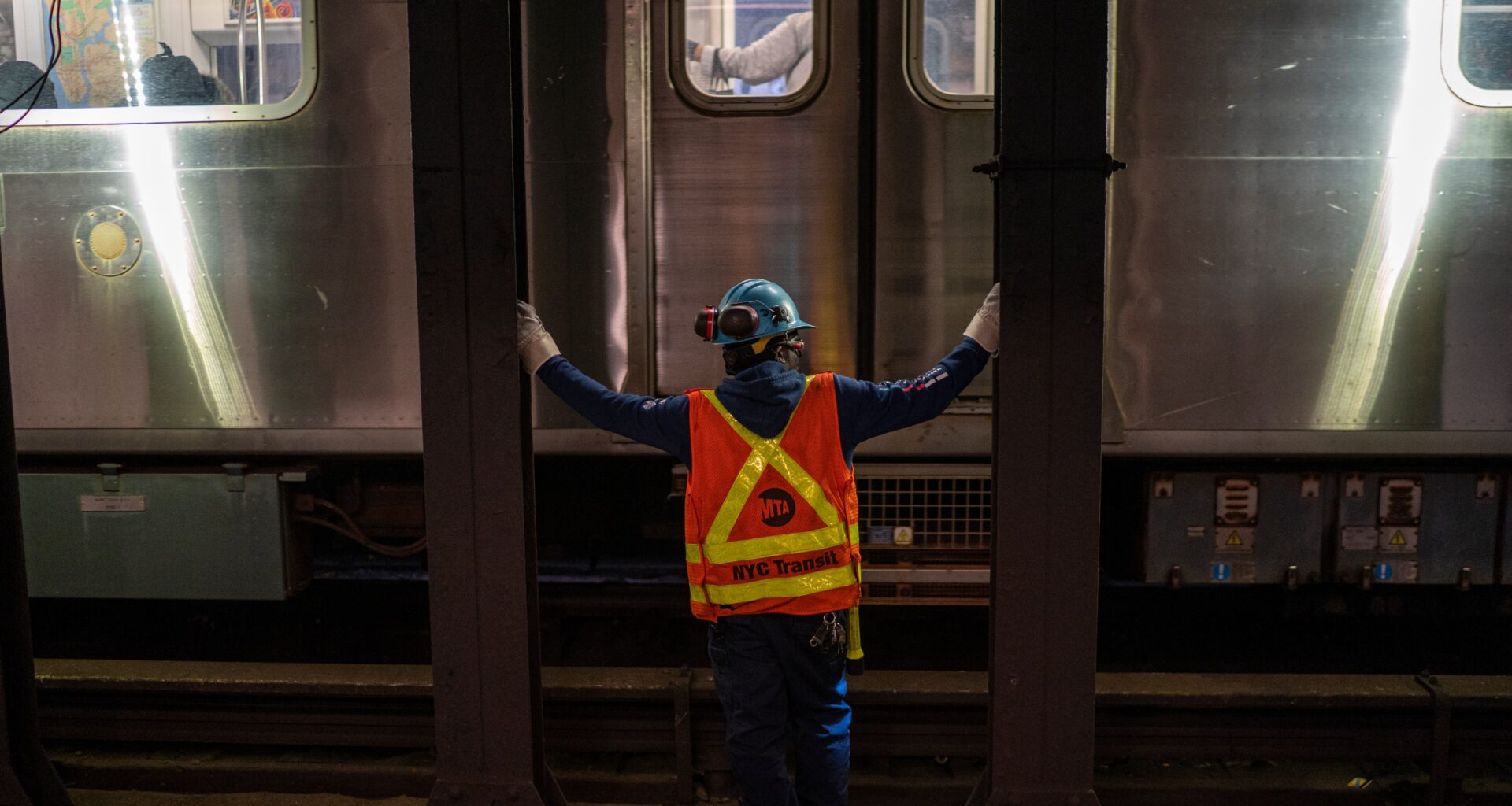
Weeks after a track worker was killed on the job, the MTA is trying to change how work crews get to their job site, the Daily News has learned.
Going forward, work crews heading to sections of track where a curve or a change in elevation will take them out of sight of nearby stations will be required to hitch a ride on a subway, according to an internal memo reviewed by The News.
Currently, track workers walk to their worksite from the nearest station, moving along the tracks in reflective vests while carrying flashlights.
Once at the worksite, a designated “flagger” sets up a series of yellow lights to warn oncoming trains that a crew is on the tracks. The flagger then stays in position beside a red light and a device called a “portable stop,” which trips the emergency brake on any train that blows through the flagger’s position.
Before those lights are set up, however, an “advance flagger” is tasked with standing on the platform at the station immediately behind the work crew and notifying incoming trains that there are workers ahead.
Moet McCullum, a 41-year-old mother of three, was working as a flagger in the Bronx on the night of Sept. 3, preparing to set out yellow lights on the tracks between 167th and 161st Sts. along the D line in Highbridge, when she was hit and killed by an oncoming train.

Courtesy of family
MTA worker Moet McCullum was killed by a D train in the Bronx. (Courtesy of family)
As first reported by the Daily News, the operator at the controls of the D train told supervisors that he had been warned by an “advance flagger” on the 167th St. platform that a work crew was on the tracks — but when he then didn’t see any flagging lights, he set his train to normal speed.
The advance flagger was not within visual contact of the crew up ahead on the tracks — and despite NYC Transit policy, no call was made to the MTA’s rail control center to temporarily stop train traffic until flagging could be established.
While McCullum’s death remains under investigation by the MTA and the National Transportation Safety Board, NYC Transit President Demetrius Crichlow told employees earlier this week that, going forward, work crews headed to such worksites will now be dropped off by an in-service subway train.
“We cannot wait to take reasonable steps to strengthen our safety practices,” Crichlow wrote. “We have an opportunity — and a responsibility — to examine how we work, reinforce our existing protections, listen to our employees, and identify additional safeguards that can help protect one another.”
The new rule, which seeks to minimize the amount of time a work crew spends on the tracks before flagging, has been established by requiring crews working on tricky sections of track to get there by train, according to the memo.
Rather than walking, the crew will “taxi” via subway, and get out mid-tunnel “to set up the first set of lights in any location where a train does not have clear line of sight between a station and the point where flags or lights must be established.”
NYC Transit is also in the process of identifying all of the sections of track where that requirement will apply, and marking them for track crews, the memo says.
It’s unclear when the new rule will go into effect. An MTA spokesman did not immediately respond when asked about the timeline for implementing the new rule or how the relevant track sections will be identified.
John Chiarello, president of the Transport Workers Union Local 100, which represents NYC Transit’s track and subway workers, called Crichlow’s memo “a step in the right direction.”
He added that a “more comprehensive reform” of flagging procedures would come after the ongoing investigation into McCullum’s death by the union’s safety team, the MTA and the NTSB.
Flagging is regarded as one of the most dangerous jobs in track work.
NYC Transit worker Hilarion Joseph was working as a flagger in November 2023 when he was struck and killed by a D train in Manhattan.
Another flagger, not publicly identified, suffered severe head trauma in 2024 after he was hit by an out-of-service F train in Brooklyn.
Both incidents were cited in a 2024 Federal Transit Administration assessment that demanded the MTA improve its safety procedures.
The MTA appealed that report, saying the findings mischaracterized the agency’s safety record.