
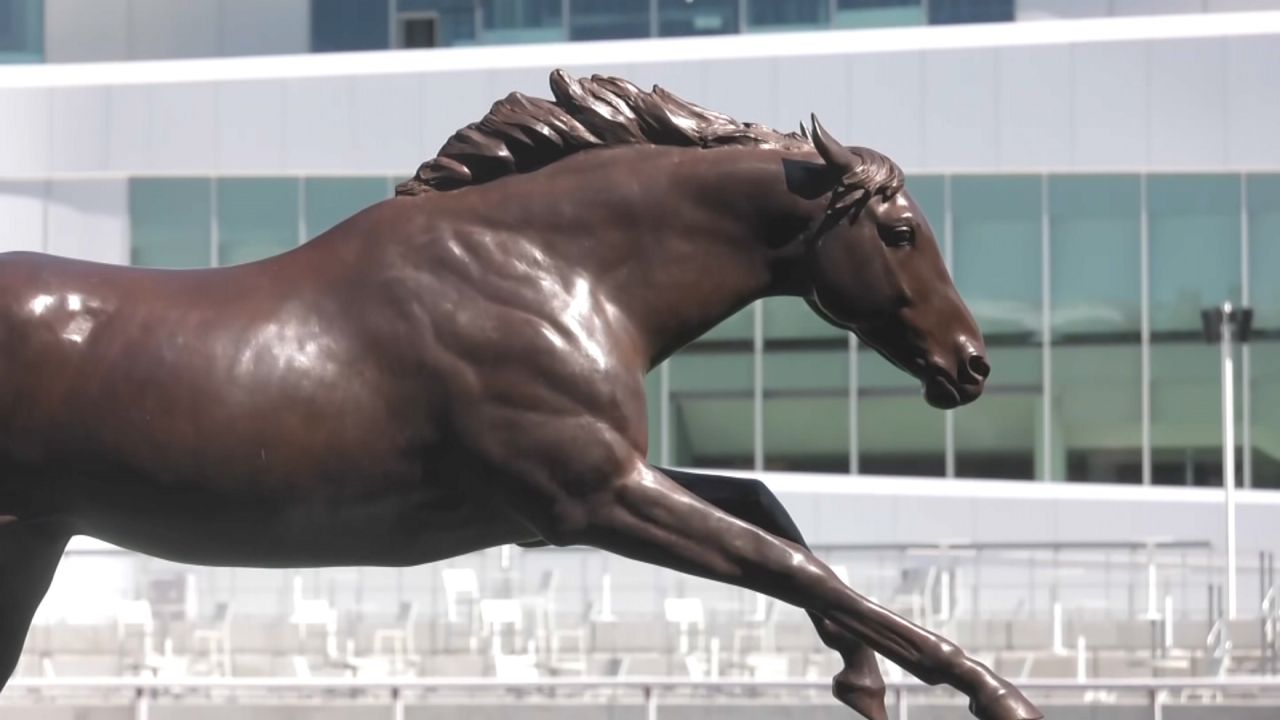
For the first time in three years, the Sport of Kings will return to New York’s historic Belmont Park.
The historic track on the Queens border is set to reopen on Friday after a massive renovation that will allow races to run through the winter.
Sponsors of the move, including Gov. Kathy Hochul, are calling it a big win — despite waning interest in the sport.
“It’s really important that we have a world-class racing facility here,” Jackie Bray, NYS director of state operations, said in an interview with NY1.
It’s part of a deal funded by a $455 million state loan to the nonprofit New York Racing Association, plus another $100 million from the NYRA in a plan that closes another historic site in Queens — Aqueduct Racetrack.
“We’re going to see about $155 million in economic output annually for this community, and $10 million in tax revenue,” Bray said.
Longtime racing fans who recall Belmont’s early 1900s-era feel may be in for a shock.
“The old building was dated from ‘68. This is as modern a facility as you’re gonna see in racing,” Glen Kozak, NYRA’s executive vice president of Operations and Capital Projects, said.
“Awesome views of the track of the back of the paddock, restaurants, seating, dining, everything is upgraded. But there’s something for everybody. New backyard here,” he added.
Replaced by a largely glass-enclosed seating, some of the nearly one dozen bars and restaurants pay homage to past Belmont Stakes champions, like Secretariat — the 1973 winner of the Triple Crown.
Fans will now be able to watch races from the infield during big meets. Although, capacity won’t hit past highs of 90,000 — last seen in 2018 when Justify clinched the 11th Triple Crown at Belmont.
Officials say they’re hoping to cap the crowd at 50,000 max during the Belmont Stakes, mirroring upstate’s Saratoga Springs, but on regular race days, it’ll be far lower.
“Having 10,000 seated here in the main facility is a right size, as well as an upgraded backyard that will be completed for next spring,” Kozak said. “Like 27,000 seating in the old building. So you know, again, different size, different time.”
It’s sold out on Friday to a limited crowd of 6,000 due to construction expected to finish this spring, critics are questioning whether the investment is worth it, citing years of declining attendance.
In 2019, a daily average of 3,000 people came to the races.
Plus, the industry’s reliance on state subsidies and potential tension with the opening of three downstate commercial casinos.
“As long as racing brings the level of economic output for New Yorkers, as long as it employs so many New Yorkers, we’re going to continue to support racing,” said Bray, when asked if the state will continue to financially support the industry.
State officials downplayed the casino competition.
“People who go there are not necessarily looking for a sporting experience; they’re looking for family experience, and so I think to the extent that there is going to be any sort of crossover, I think it’s going to be minimal,” NYS Gaming Commission Chair Brian O’Dwyer said.
They’re hoping for fresh faces and new fans.
“Whatever type of experience they want. From being able to walk in and sit in the general admissions crowds, all the way up to going onto the fifth floor and being able to see Manhattan through the roof up here and everything in between,” Robert Williams, executive director at the New York State Gaming Commission, said.
In an attempt to limit horse fatalities on the track, designers focused on safety conditions like new footing to protect both the jockeys and horses.
“They spent millions of dollars on the surface, particularly the new artificial surface…which proved to be extremely safety efficient,” O’Dwyer explained.
“Everybody hates it when a horse breaks down and it has to be destroyed. But we’re going to make sure that, to the extent possible, that’s not going to happen in New York,” he added.
Next year, the internationally famous Breeders Cup Stakes race will return to Belmont for the first time since 2005 — as will the Belmont Stakes — and its punishing mile-and-a half length.