
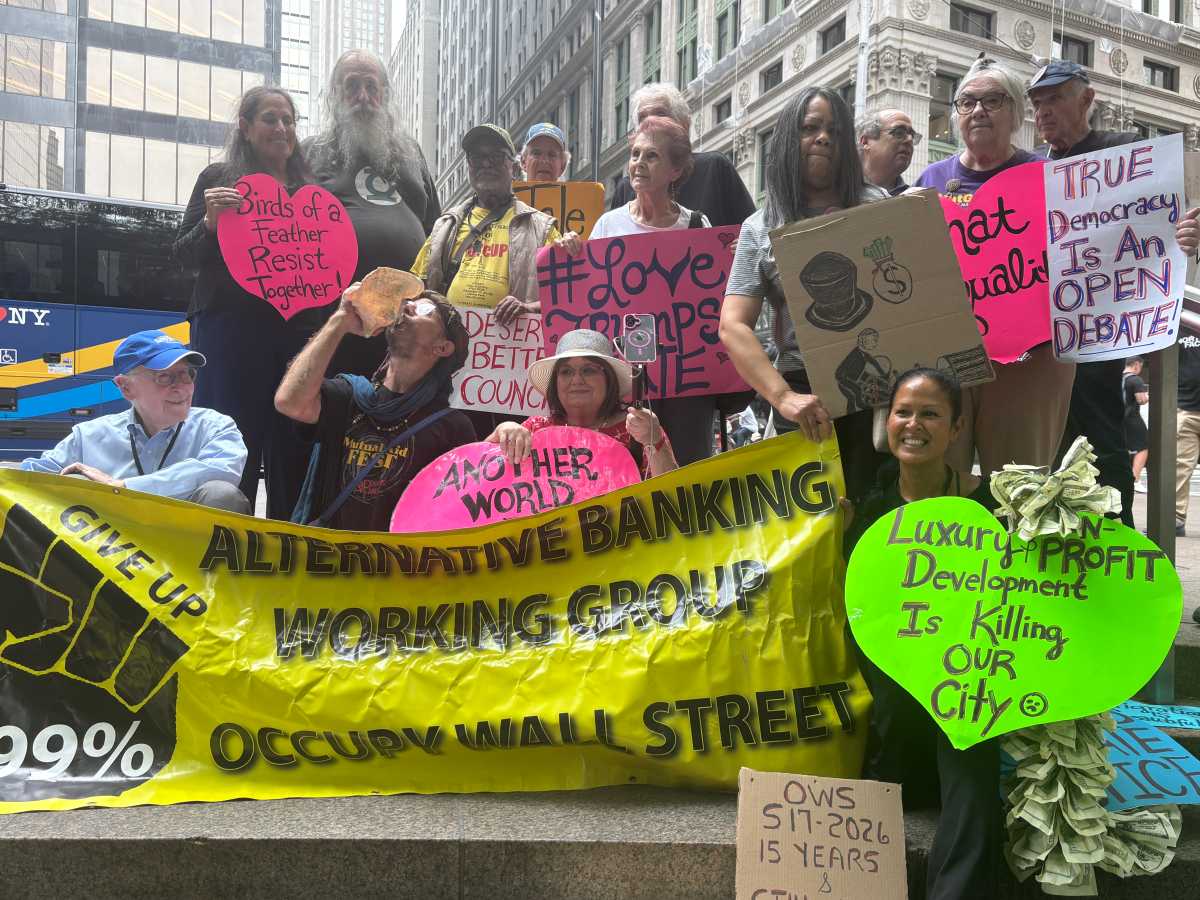
Protestors on Thursday united in Lower Manhattan’s Zuccotti Park, the site where Occupy Wall Street was born, gave speeches, held signs and argued that their movement was not over and the problems remained.
They spoke as part of Occupy2026, the 15th anniversary of a march that turned into a movement, near colorful signs saying “Another world is possible,” “This is the revolution,” “Birds of a feather resist together” and “What Inequality?”
Occupy Wall Street veterans, former occupants, and supporters sought to rekindle the passion for protest that led to nearly 60 days in Zuccotti Park.
Since protestors now, as back then, had no amplification permit, they used a “human microphone” with crowds in unison repeating every few words speakers said.
“What began with people camping on a small patch of public space in Lower Manhattan became a laboratory for new forms of organizing, mutual aid, political education, and collective action,” organizers said in a written statement.
Joshua Douglass, an attorney and one of the founders of Occupy2026, said OWS was “a movement whose main success was changing the dialogue.”
“OWS is a way of life, a vibe inside of your soul that says this isn’t right, what’s going on,” Douglass said. “And pretty much everyone is feeling that today.”
Many at this mini marathon, with events scheduled through Saturday, Sept. 20, touted the transformation, not elimination of the movement, famous for its focus on “income equality” and phrases such as the “99%” and the “1%.”
It also spawned many other groups, changing conversations about change, while many said most of the same challenges remain in a world, if anything, more unequal and particularly perilous.
“I’m really, really glad to see all of you here today,” Alejandrina Murphy, a Manhattan resident who said only five showed up last year in the rain. “The issues remain the same and they’re worse than ever.”
Some of the crowd of nearly 50 held signs saying S17, for Sept. 17, the moment that gave birth to a movement. “People from all ages were here,” said Ken Gale, co-producer and co-host of Eco-logic. “They weren’t only hanging out with people of their own age. Here everybody hung out with everybody.”
Bennett Weiss, who came to the rally from Newburgh with bags full of buttons, such as “Let’s do it again: Occupy 2026 15th Anniversary,” said the world came to Wall Street.
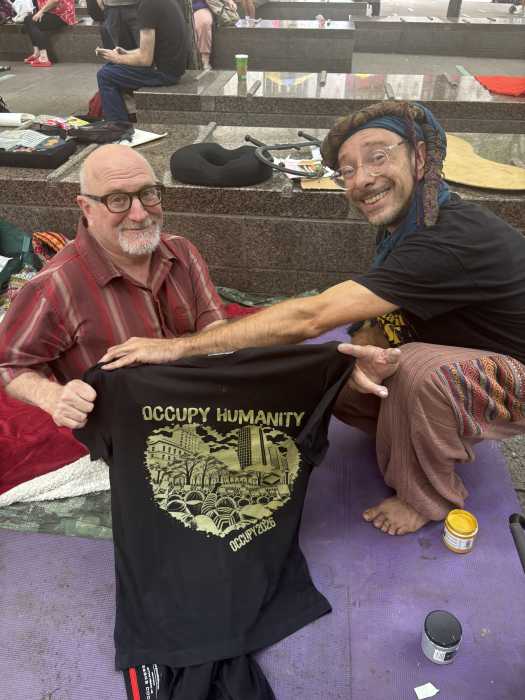 Occupy Wall Street protestorsPhoto by Claude Solnik
“People from all around the world would come and talk with us,” Weiss said. “Occupy reached out to the public.”
After running a button machine then, collecting thousands of dollars in contributions for buttons, Weiss was back handing out buttons 15 years later.
“An important part of the Occupy movement was the button table,” Weiss said. “It generated conversations. People agreed with some and not with others.”
When police 11 years later prevented protestors from marching to and occupying One Chase Manhattan Plaza and Bowling Green Park, protestors headed for Zuccotti Park, which soon was crawling with cameras.
“It was accidental,” Jerry Ashton, at the time a 19th St. and Second Street Manhattan resident and now author of “The Unintended Activist, said of this location, left open for the protestors. “It was electric.”
Others said OWS acted like a petri dish for protest and an innovation incubator, bringing together individuals who founded organizations targeting specific issues.
“So many wonderful things came from Occupied, such as other organizations,” said Donna Stein, president of New York City Friends of Clearwater and co-host of Eco-logic on WBAI. “People became activists who had never been activists before. Other people who were activists were re-energized.”
Jerry Ashton, now author of “The Unintended Activist,” had just retired as a debt collector and begun doing journalism, covering Occupy Wall Street for the Huffington Post, 11 years ago.
“I came down to write a story and take pictures, but I made a terrible mistake. I started listening,” Ashton said. “What I listened to resonated. They were complaining about income inequality, talking about how the system was putting us into debt.”
After working 30 years as a debt collector, Ashton believed something was wrong and wanted to “right the wrong of unpayable medical debt.” He co-founded RIP/Undue Medical Debt, initially with offices overlooking Zucotti Park.
They use donations to buy debt on the debt market, where medical debt is often sold for pennies and then forgive it. “You could buy $100 worth of debt for a penny,” he said. “$10,000 would buy a million dollars.”
He said RIP/Undue Medical Debt has managed to forgive $46.9 billion in debt, affecting over 35 million Americans.
“That came out of Occupy Wall Street,” Ashton added. “I retired from the board a few years ago to go into veteran debt abolition.”
While Occupy was born out of an effort to change the world, many said it changed people one at a time.
“Occupy was a movement that developed organically. It started in New York, but it went global,” Stein said. “Occupy made people better people. Occupy was all about creating a better world. One of the themes is ‘Another world is possible.’”
It also created a community who felt connected by a cause, going on to be part of Fight for $15, Black Lives Matter, Sunrise Movement, March for Our Lives, the Bernie Sanders campaign and others.
“It was a wonderful community of people covering many ages,” Stein, who had been part of the environmental solidarity working group, added. “Not everybody agreed on every issue. It was interracial, inter-generational.”
Douglass said “OWS urges humans to come together, to create a better world together,” a timeless message.
Some, however, pointed to shortcomings in the movement that never developed clear goals or demands.
“We’ve got to be in parks like this every week with music and songs and dance. We got to get the dance going,” said Staten Island resident Bill Johnston. “We’re losing the fight from 2011. We’ve got to do better.
While there was diversity, others said there wasn’t enough in a movement that, while it went global, still fell short on inspiring large numbers across racial lines.
“Occupy Wall Street was generally a Caucasian movement,” said one protester. “When Black Lives Matter happened later, that’s what this movement should have been. It didn’t resonate with the Black community.”