
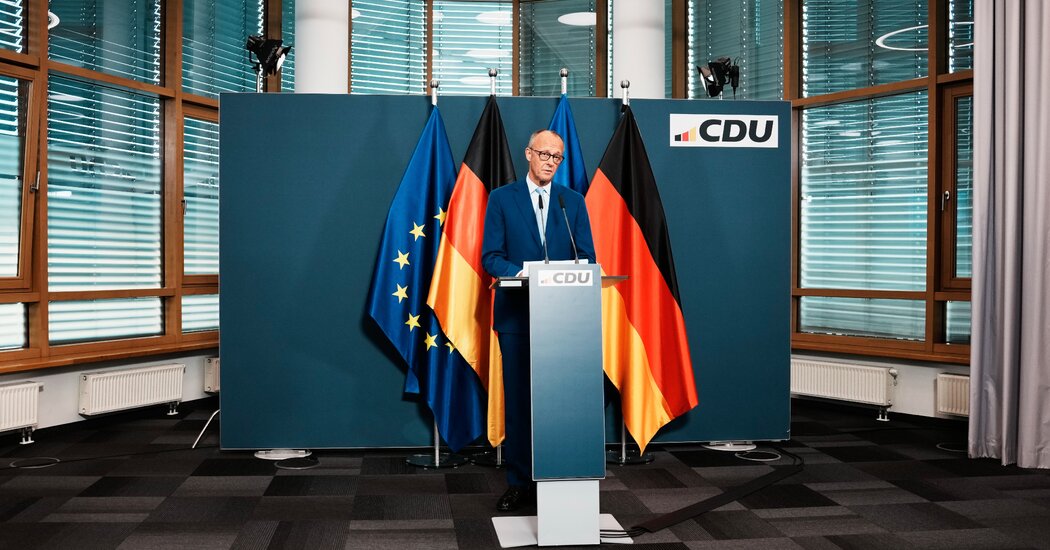
Friedrich Merz, the unpopular and increasingly embattled German chancellor, vowed on Sunday evening that he would remain in the job, after his party performed poorly in two state elections in eastern Germany.
Mr. Merz’s center-right Christian Democrats, long the nation’s dominant conservative party, limped to their worst postwar showing in a state election, in the lightly populated coastal state of Mecklenburg-West Pomerania. In Berlin, the capital, they appeared on the brink of losing power after a surprisingly large loss to the far-left Die Linke party.
“It is a disaster,” Mr. Merz told reporters shortly after polls closed.
The chancellor’s approval rating is falling toward single digits. He has faced mounting pressure to resign since his party was trounced in another eastern state earlier this month by the far-right Alternative for Germany party, or AfD. But he pledged on Sunday to stay and shepherd legislation meant to revive the German economy.
“What needs to be done now requires backbone, steadfastness and patience,” Mr. Merz said. “I will provide that.”
The timing and content of Mr. Merz’s speech were “an attempt to choke off the speculation about his possible resignation,” Carsten Brzeski, a senior analyst at the financial firm ING, wrote on Sunday evening.
The election showed a continuing polarization of the German electorate.
In Mecklenburg-West Pomerania, the AfD more than doubled its vote share from the previous election and finished first. It campaigned on economic renewal and on deporting refugees from the Middle East and elsewhere. With most of the vote counted, the Christian Democrats had fallen below 5 percent of the vote, the threshold for winning seats in the state parliament, a potentially devastating development for Mr. Merz’s party if it held through the final tally.
“We have the mandate to govern,” the AfD’s candidate for state premier, Leif-Erik Holm, told jubilant supporters.
The AfD probably won’t govern the state now, though. It was projected to fail to win a majority of seats and no other major parties will work with it in a coalition. That is partly because it has been classified as suspected right-wing extremist by German intelligence.
In Berlin, Die Linke outperformed its polls with a relentless focus on bringing down the high cost of housing. Its victory was large enough that it could lead the next Berlin government, replacing the Christian Democrats, who finished second in the race.
Pollsters’ interviews with voters on Sunday showed that Mr. Merz was again a drag on his party, but he was not the only reason the Christian Democrats struggled.
In Berlin, the party was also hurt by unpopularity of its incumbent mayor, Kai Wegner, who infuriated residents by playing a tennis match during a widespread power outage last winter. He chose not to seek re-election.
In Mecklenburg-West Pomerania, the incumbent premier, Manuela Schwesig, a Social Democrat, has built a strong brand with voters. It is largely driven, voters told pollsters on Sunday, by her willingness to stand up to her own national party, which is Mr. Merz’s junior partner in the federal coalition government. She appeared in line to hold power, with the help of other left-leaning parties.
“We quite clearly ran on concrete policy issues: economy, jobs, social affairs, and social cohesion, as well as on me as a person,” Ms. Schwesig told a public broadcaster, A.R.D.
She was helped by strategic center-right voters, analysts said, who deserted the Christian Democrats in a bid to unite around the party likeliest to block the far right from power.
The bigger danger for Mr. Merz, in particular, may be the growing number of voters in both regions who seem to embrace the idea that centrist parties can no longer deliver the fundamental change they desire.
Goldie Nickel, a young voter in the Mecklenburg-West Pomeranian city of Neubrandenburg, said last week that she supported the AfD because she felt the government wasn’t tough enough on immigrants. “Migrants and refugees that either break the law or misbehave should be sent back to their home countries,” she said.
In a Berlin campaign dominated by the issue of affordable housing, a quarter of voters flocked to Die Linke and its promise to take public ownership of 270,000 apartments now held by private real estate giants. Die Linke supporters see parallels between their lead mayoral candidate, Elif Eralp, born in Munich to two left-wing activists from Turkey, and Zohran Mamdani, the mayor of New York.
The results left Mr. Merz and his party reeling. Last week, the chancellor had been buoyed by a letter of support from eight state premiers from his party. On Sunday, the party’s general secretary, Franziska Hoppermann, also gave Mr. Merz a vote of confidence in an interview with a public broadcaster, Z.D.F.
Mr. Merz, in his speech, said that “trust in our country’s institutions is falling and is being actively undermined by radical parties on the left and right.”
Leaders in Germany and Europe, he said, need to speak more “about freedom, about security in everyday life, about peace and about our own strengths as well as our weaknesses.”
Tatiana Firsova contributed reporting from Berlin, and Philip Kaleta from Neubrandenburg, Germany.