
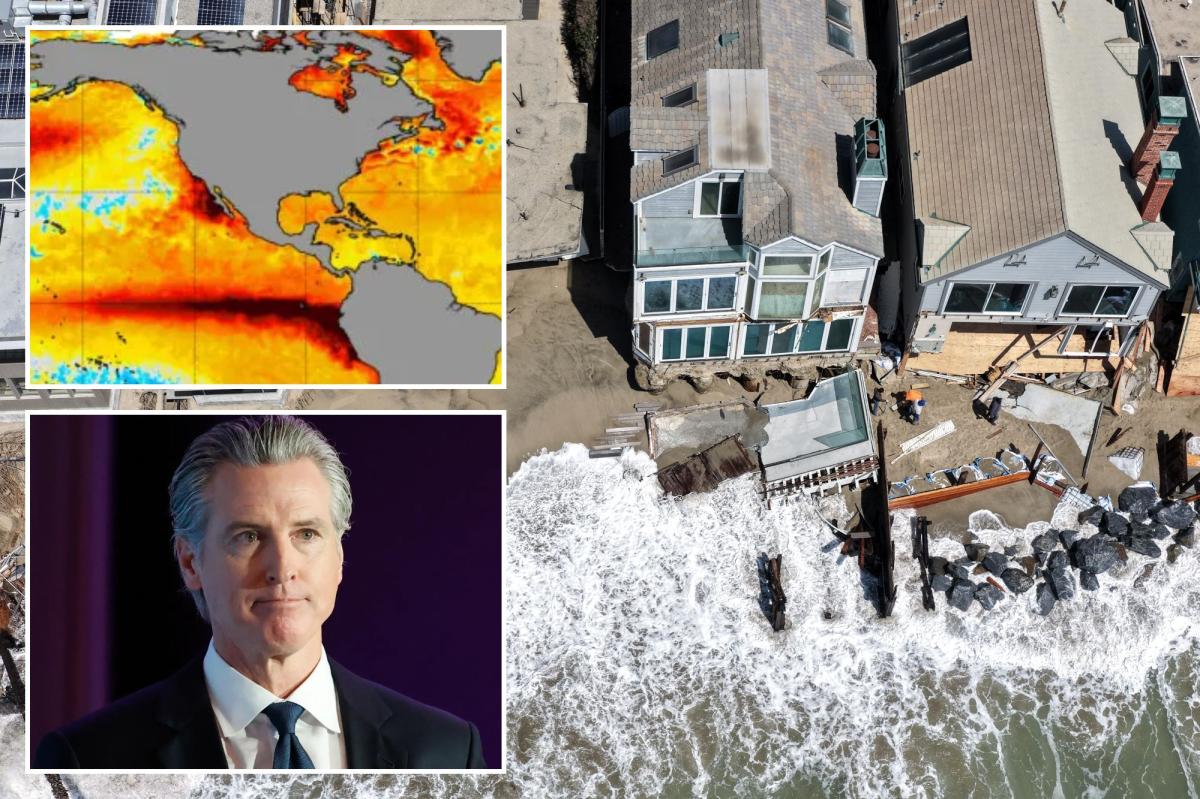
California Gov. Gavin Newsom declared a statewide emergency Monday as the Golden State braces for what officials warn could become the strongest El Niño on record.
The emergency proclamation allows California to mobilize resources ahead of potentially destructive winter storms, including flooding, landslides and coastal erosion, according to KTLA.
El Niño is a natural climate pattern caused by unusually warm waters in the eastern Pacific Ocean that can shift storm tracks and bring wetter, more intense winters to California.
Sign up for the California Morning Report newsletter
The biggest news, opinion and culture shaping California right now.
Thanks for signing up!
Record-breaking ocean heat and an emerging El Niño caused minor coastal flooding along the Long Beach Peninsula. Getty Images
California Gov. Gavin Newsom has announced a state of emergency ahead of a forecast El Niño event Monday. NOAA
Newsom’s office confirmed state resources are being mobilized before potential winter storms and associated impacts. Getty Images
Heavy surf generated amid a record-breaking ocean heatwave and an emerging El Niño. Getty Images
The pattern is already strengthening and is expected to continue intensifying through the end of the year, with the most significant impacts expected during the fall and winter months.
“The emerging El Niño event is already breaking records, and forecasters expect it to continue to strengthen, potentially becoming the strongest in recorded history,” Newsom’s office said.
The US National Oceanic and Atmospheric Administration (NOAA) Climate Prediction Center says there is now a greater than 90% chance of a “very strong” El Niño during fall and winter, along with a 75% chance the event reaches historic strength between October and December, exceeding previous events dating back to 1950.
The designation does not mean California is guaranteed to be battered by storms. But stronger El Niño events increase the chances of weather typically associated with the phenomenon, including heavy rain, flooding, powerful waves and coastal erosion.
Gov. Newsom said Monday’s declaration is intended to give communities more resources before severe weather arrives. Carlin Stiehl for CA Post
During El Niño, the Pacific’s usual trade winds weaken, allowing warm water to shift east toward the US West Coast. The warmer waters can push the Pacific jet stream south and alter weather patterns across the country.
El Niño events are not new and typically occur every two to seven years, according to NOAA. They generally last between nine and 12 months, although some can persist longer.
State agencies have been directed to stage sandbags, pumps and other flood-fighting equipment, while Caltrans will prepare road-closure and snow-removal equipment along vulnerable highways.
Damaged houses in Orange County’s Capistrano Beach in the aftermath of Hurricane Marie. Pedro Colo for CA Post
The California National Guard is also being prepared to assist with flood response, search-and-rescue operations and logistics if needed.
Officials are also moving to protect critical infrastructure and vulnerable communities, while environmental and natural resources agencies have been told to help local governments prepare for flooding, landslides and debris flows.
“We are not waiting for this season’s storms to be on our doorstep,” California Office of Emergency Services Director Caroline Thomas Jacobs said.
“By planning early and coordinating resources ahead of El Niño, we are working to ensure communities and first responders have the personnel, equipment, and support they need to prepare for severe weather, respond quickly when conditions change, and protect lives and property across California.”
Outside actor Nicholas Cage’s lavish Malibu mansion, a massive sinkhole continues to grow, likely the effects of El Niño. Clint Brewer Photography / BACKGRID
Hurricane Marie wreaked havoc on Cage’s beachfront property, where a failed seawall collapsed his driveway. BACKGRID
The preparations come after parts of Southern California have already suffered severe coastal damage this month.
Nearly a dozen luxury beachfront properties in Orange County were red-tagged after powerful swells from Hurricane Marie battered the coastline and stripped away sand around homes.
At least 14 homes along Beach Road in Dana Point’s Capistrano Beach were damaged over Labor Day weekend, while Laguna Beach declared a local emergency after erosion threatened oceanfront properties and forced several beach closures.
Laguna Beach officials said swells beginning Sept. 2 caused “significant sand movement and erosion” that continued more than a week later.
Meanwhile, outside actor Nicholas Cage’s lavish Malibu mansion, a massive sinkhole continues to grow.
A huge black pit has opened directly beside the mansion as crews work from a boom lift over the wreckage.
Just beyond the homes, waves continue to slam into the coastline.
It is a nightmare view for residents of the gated Sea Level Drive community, where the collapse swallowed the soil beneath the private road and wiped out the only route in and out.
Malibu officials declared a local emergency at 6 p.m. that day, red tagging seven homes over structural danger and another 24 because emergency vehicles could not safely reach them.
Newsom said Monday’s statewide declaration is intended to give communities and first responders more resources before potentially severe weather arrives.
“We are preparing for this El Niño early because every Californian deserves to be safe in their home, connected to their community and protected when severe weather comes,” he said.
Download The California Post App, follow us on social, and subscribe to our newsletters
California Post News: Facebook, Instagram, TikTok, X, YouTube, WhatsApp, LinkedIn
California Post Sports Facebook, Instagram, TikTok, YouTube, X
California Post Opinion
California Post Newsletters: Sign up here!
California Post App: Download here!
Home delivery: Sign up here!
Page Six Hollywood: Sign up here!