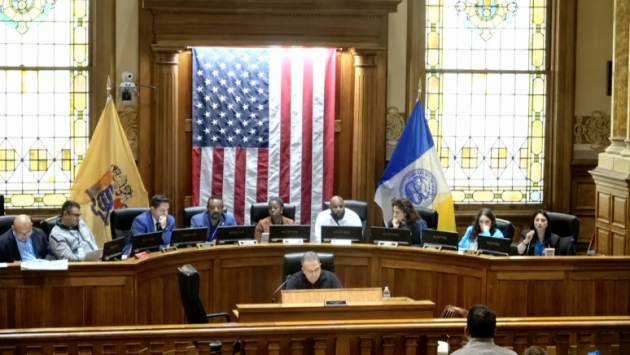
Several Jersey City Council members pressed for answers related to the potential federal funding used to acquire 128 Glenwood Ave. for a community garden and pocket park.
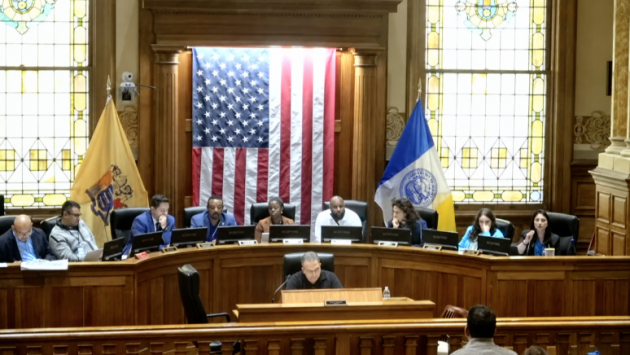 Screenshot via Microsoft Teams.
By John Heinis/Hudson County View
The council approved the first reading of an ordinance to acquire the property for $1.2 million on September 9th, though an accompanying resolution to utilize $1 from Community Development Block Grant-Public Facilities (CDBD-PF) funds was withdrawn, as HCV first reported.
“If this resolution is voted down, what are the options to fund this, 128 Glenwood?” Councilman at-Large Michael Griffin asked Acting Community Development Director Saulo Diaz.
“The ordinance provides that the funding would come from this grant. If the one million dollars was voted down by the council and the resolution, then the administration would have to find alternate funding,” explained First Assistant Corporation Counsel Lisa Scorsalini.
Griffin asked if alternatives might include the Hudson County Open Space Trust Fund “or something like that,” to which Business Administrator Ruby Choi broadly said other sources of capital funding would need to be identified.
Deputy Mayor for Housing and Economic Development Keshav Poddar sought to provide more clarity on the matter.
“Councilman, if the resolution would be voted down, as the corp. counsel and the business administrator said, the only alternative would be to find other sources of funding. I can say from my conversations from the developer and their team, is that it’s unlikely they would proceed with the sale with further delay,” he expressed.
Ward C Councilman Tom Zuppa, who has spoken in favor of the project previously, asked for the timeline of uses for CDBG funding in general and how they got to the current point to where $1 million is being proposed to go towards the purchase of 128 Glenwood Ave.
He specified that he wanted to know generally what the funds are used for, how they got to the use of these funds, and why they could not be used for anything else.
“This is the public facilities part of CDBG funding, these can pretty much be used for community improvements, that includes acquisition, street paving – anything that is considered an improvement along our LMI Census Tract,” noted Diaz.
Zuppa than noted that it was suggested to the governing body that the funds are set to expire, therefore it’s important they are utilized now.
“At the end of January, HUD [U.S. Department of Housing and Urban Development] conducts what’s called a timeliness test to ensure that municipalities aren’t holding on 1.5 times their annual award, if we are holding more than that, then we fail timeliness,” Diaz stated.
“For the past three years, Jersey City has failed timeliness, we’re on our way to fail it a fourth time at the end of this January unless we include in this one million dollars because the rest has already been awarded out. If that happens, if we fail timeliness at the end of January, what they do then is going forward, they cut us down 50 percent of our annual award.”
From there, Zuppa wanted to be clear that a project has to be ready to go before the council assigns any funding to it.
“After we assign a project with money, we have to do environmental reviews, there’s procurement laws and bids we have to go through at the end of January at this point – an environmental review takes at least 60 days – that already puts us in December, that’s no time for any procurement or bidding,” replied Diaz.
Zuppa continued by asking if the city was in a position to use those CDBG funds if they weren’t used on 128 Glenwood Ave.
“Correct, so those funds haven’t been awarded out, they’re what we call ‘unallocated.’ When it comes time, and if we do fail timeliness, they’ll see those unallocated funds and there’s a pretty good chance they’re gonna recapture it because it’s just sitting there,” Diaz answered.
When Zuppa inquired if there was additional CDBG funding earmarked for projects starting in January, Diaz noted that there is another resolution on the agenda to accept additional CDBG monies to the tune of $4,321,335.
Zuppa dialed in by asking if the project at 128 Glenwood was theoretically not on the table right now, could the $1 million in federal grant money be spent elsewhere.
“If it doesn’t go to Glenwood, I would have to find some kind of acquisition to spend it on here before the end of January,” Diaz said.
Ward E Councilwoman Eleana Little followed up by asking if the funds could also be used for street paving, as had been mentioned earlier, or if they were strictly for public facilities.
“To use your example, like street paving, it would take time: We would have to conduct studies, an environmental review, we would have to get the improvements approved by the federal authorities to make sure they count it as an improvement, there has to be a whole new bidding process, a new contractor – it takes steps,” Diaz outlined.
He added than when utilizing CDBG funds, the federal government wants it spent on new projects over old projects, though street improvements could occur under certain circumstances.
“And there’s no other new project on the docket that realistically can be approved now?” inquired Ward D Councilman Jake Ephros.
“For this one million dollars? I would have to go back and check. We spoke to every department in the city so that they could all submit applications,” responded Diaz.
Once again, Zuppa asked if the $1 million could possibly be allocated elsewhere.
“I think I can confirm that I’ve had several planning conversations around other projects, this is the one that is ready to go. The other ones, we are still in the early stages, it’s not clear if we could meet the timelines the director was talking about,” Choi explained.
Griffin interjected that he felt there was “an unfair, inequitable process to this,” noting that he was in support of the project when the costs were covered by a Hudson County Open Space Trust Fund grant, but not now.
“It just feels like, in my opinion, a line was skipped, all of a sudden everything changed and now we’re here debating over … if it can get alternate funding,” he added, noting that most organizations who apply for CDBG funds, that’s their only resource.
” … I understand that this park qualifies, but it also qualifies under other funding sources. Whereas, if your making an application for Andrew Washington Mental Health Resource Center, it only qualifies under once sources, which is CDBG. That’s why I asked the question. I support the park, but the funding, I have a problem with it.”
That caused Zuppa to again ask if the city would lose the CDBG funding if it was not spent on 128 Glenwood.
“Is the administration prepared to make that statement?” he pressed.
“Yeah, it’s hard to tell if we’ll lose it, it could be recaptured, but we do have to hit timeliness by the end of January,” Diaz responded.
When Zuppa asked for additional information, Poddar said the proposal had already passed environmental review and the vote before the council is the last action before the city can get to work on what is planned there.
“As Director Diaz said, we are right up against the line here. And unfortunately this is a situation that we in part all walked into and nobody believes that it’s a good situation for the city to be making decisions this way, as Councilman Griffin said, but that’s unfortunately where we are as a city,” Poddar also said.
“So any other uses of the funds, for projects that are not as far along, would run the risk that Director Diaz [has outlined] … I can’t say definitively say that there’s no other project that, in theory, could utilize the funds, but again, we are the furthest along.”
Zuppa then asked for Choi to provide a list to the council of other projects that are eligible.
Ward F Councilman Frank “Educational” Gilmore suggested that there shouldn’t be a rush in September to meet a January deadline, indicating he would be hard pressed to support 128 Glenwood as is.
“People get paid good salaries to figure things out. We’re in the business of serving the best interests of the public. So we have to do everything, use everything at our disposal to ensure we are making the most financially responsible move for these funds,” he asserted.
” … I think we have the capacity to, at the very least, to put this on hold to see what other projects would be able to come to fruition. This may be the best project, or the one that most ready to go, but let time tell us that. You waited this long! Not you per se, but the monies been the there, we waited this long.”
Choi indicated that she had been in meetings for the last two months trying to identify projects to use CBDG funds for, reiterating that it was very unlikely that any other project could be ready on the same timeline.
Before concluding discussion on this topic, Diaz pointed out that the CDBG award has been slashed by $1 million by HUD for not meeting timeliness.
The Jersey City Council will convene for their regular meeting on Wednesday at City Hall, 280 Grove St., at 6 p.m., which will also stream live on Microsoft Teams.