
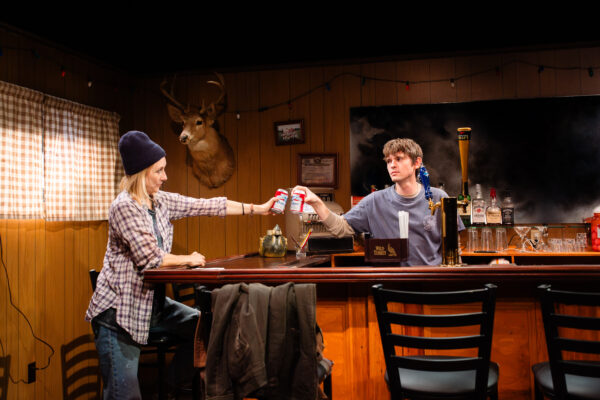
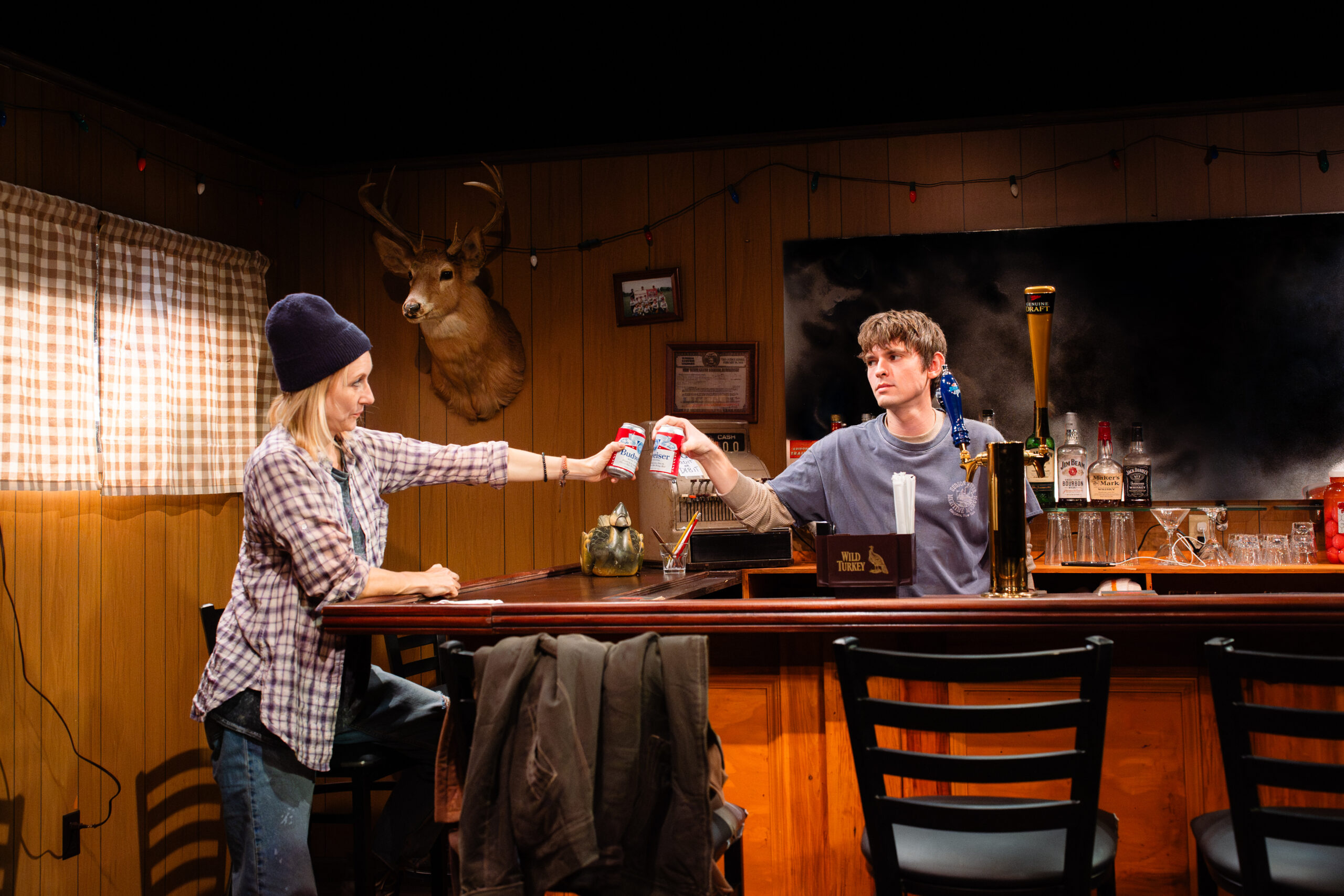
Tina Benko and Bubba Weiler in The Holes. Photo: HanJie Chow
In an interview about his previous viral smash of a play, Job, playwright Max David Friedlich said, “If the industry is going to survive, we need thirty-year-old bros to get onboard thinking this is a cool thing.” His new play, The Holes (technically an older play; it’s a reworking of the first play he ever wrote, in junior high), also directed by Michael Herwitz, feels like it’s proceeding down that path, with the goal of catching Job’s lightning in a bottle one more time–but I was very aware of its roots in an adolescent’s idea of transgression and masculinity. I couldn’t help feeling the snigger breaking through even when it’s got serious things to say.
No one would come to the Hudson Valley to go to this dive bar, expertly imagined by Anna Grigo with all the key physical details, from ratty taxidermy to out-of-season Christmas lights. The bar used to be a hub for a white working-class community, but Kingston, New York, after a wave of Covid-spurred migration, is gentrifying despite itself, and Phil, the bar’s second-generation proprietor, is terminally ill. His late-twenties son, Joey (Bubba Weiler), who’s just restarted college ten years after washing out in his first semester, has come home to run the place and take care of his father. Formerly a bullied, too-smart-for-his-own-good gay teenager in this economically depressed area, he wanted nothing more than to leave the bar and the town, but here we are. The bar is spiraling the drain; Phil’s “asshole cancer” is slowly and painfully killing him. It’s 2022, but Phil refuses to bend to the times or even let Joey do so in his absence. Most days, even the regulars have moved on to a place with better beer or better food. There’s barely a customer beyond Martha (Tina Benko), a cheerful barfly who hero-worships Phil as “the heartbeat of our community”–despite or perhaps because of her drinking problem, whose contours become more and more evident as the play progresses.
Then, late one night, an urbane Black stranger, Wesley (Grantham Coleman), appears out of a snowstorm, drawn by a mysterious Reddit post to drive up from New York City in a blizzard to hand an envelope of cash to Joey as the price of access to the bar’s back room. The scene ends with an aura of mystery (augmented by Brandon Bulls’s sound design) but it’s not long before we learn about the bar’s open secret: in that back room, a man can experience a handjob that will change his life. It all has to do with the holes: not glory holes, but the far stranger and more spiritual holes in the hands of the mysterious One Guy who provides the service. (Spoiler alert, your first assumption about what that implies about the guy’s identity is probably correct.)
Martha calls it “a shared experience: something that connects all the men around here.” She thinks Joey has no right to start making money off this–it’s not like the Man who performs the act is getting paid, even–and the play’s fourth character, Carson (Jack Mulhern), agrees. He’s a high school classmate and onetime friend of Joey’s, also kind of pissed that Joey’s charging admission to what Phil gave away for free–but he can’t stop spending money he doesn’t have in order to partake. (Joey, on the other hand, thinks the Man is a “true pervert” who’s doing this for his own gratification.)
Phil and his father extended invites with their own unspoken logic; Joey, desperately seeking to save the family business, has started charging for the privilege, even as he continues to follow his father’s admonition to never enter the room himself.
Wesley, in his allotted time slot, has a transformative revelation—one that will lead him to walk away from his cushy life (his pregnant wife, his job in venture capital) and start bringing men up by the busload to share the peace and joy that he experienced.
Friedlich refers to the play as a fairytale, and he and Herwitz keep a number of tonal and narrative options in the air for a long time: Is this an allegory or a satire? Real or surreal? Black comedy or body horror? Is the backroom experience just a transcendent orgasm, or something more? Joey thinks it’s a way for men to evade the realization that they enjoy being touched by another man. Martha thinks the Man is “sculpting better men with his bare hands.” Wesley prefers “an escape from the trap of Western masculinity.”
But as the momentum shifts from trying to understand what the men are experiencing to trying to commodify and scale it, The Holes gets darker in both its horror and its satire. And while Friedlich and Herwitz want to take us on both a spiritual and a satirical journey, I can’t get past a visceral discomfort at the idea of a man–be he a pervert or Jesus–cheerfully giving sexual gratification to 80+ men a night in the backroom of a bar for free as an act of spiritual and community largesse. That person feels like a sex slave, in all the possible permutations: whether the patrons are finding true salvation, whether Wesley is a corrupted capitalist huckster, whether Wesley has gone off the deep end. And if the play is a fairytale, it remains a fairy tale that’s only interested in the transformative enlightenment of men.
It feels like a series of missed opportunities to let go of a gimmick, because the other questions the play asks about community and gentrification and economic survival are vivid and vicious. All four of these people are desperately lost souls, even if Joey’s the only one who really knows it. Benko’s utterly unearned optimism, Coleman’s frenetic charm, Mulhern’s barely contained rage: all facets of the fight they’re having with the world to stay sane. Weiler’s Joey feels perhaps one step more in touch with own emotions, but that only makes him more aware of his own despair and his own bad choices; you can sense how trapped he feels in every line of his body. I’m interested in the play about how Martha and Carson continue to survive in a town once the Wesleys show up and try to take over; in the play about how Joey got out but never got away. But in The Holes as it is, the Beavis and Butthead of it all never left me.