
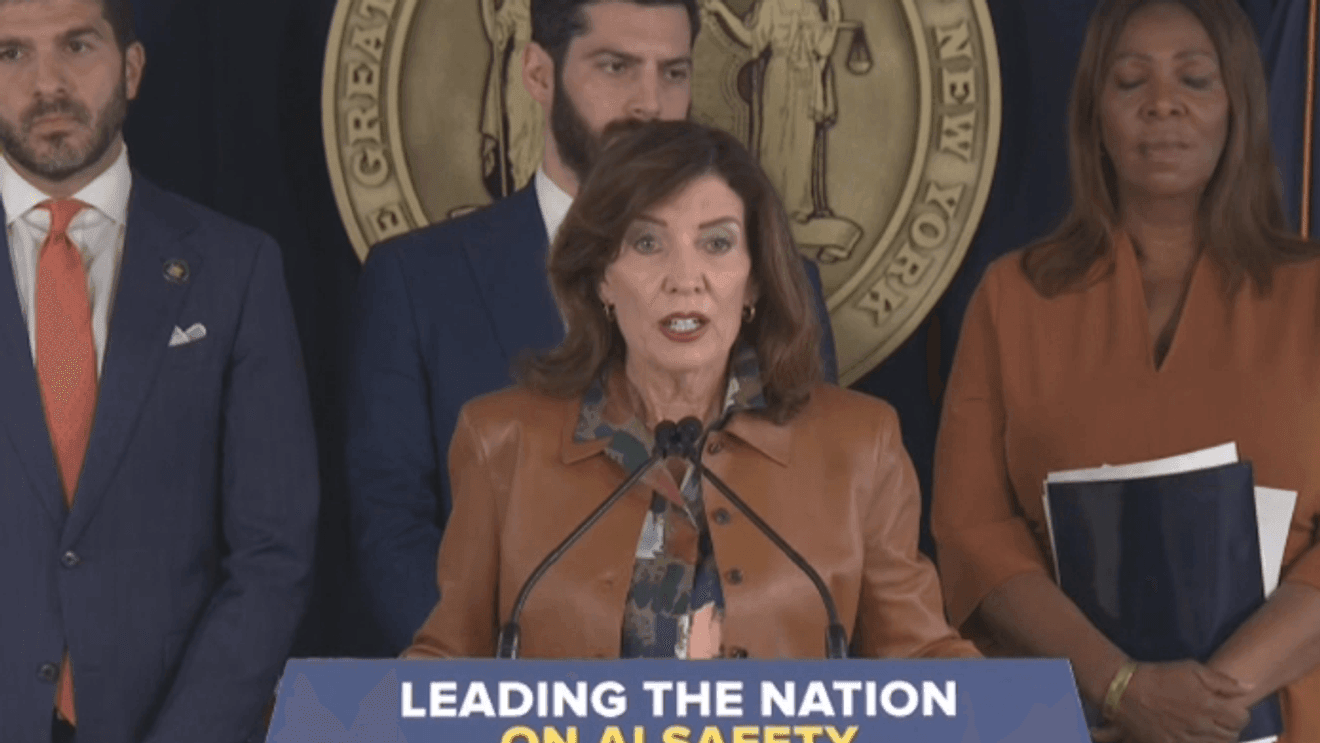
New York is moving ahead with new rules aimed at regulating some of the most powerful artificial intelligence systems, as state leaders weigh safeguards that could include an emergency “kill switch” to shut down an AI system in a crisis.
Gov. Kathy Hochul said the state is considering whether a kill switch could be part of its oversight as it builds out guardrails for the rapidly advancing technology. “We may even explore safeguards like AI kill switches,” Hochul said.
New York’s new AI safety law is now being put into action. Starting in November, covered frontier AI developers will have to register with the state ahead of the law taking effect next year. The law is designed to require AI developers to take steps to identify and address potential safety risks.
State Sen. Andrew Gounardes said lawmakers are approaching the issue with urgency. “Everything should be on the table right now because we’re hearing some pretty staggering and sobering, you know, warnings about how if left unchecked, AI developing at this at these frontiers can be catastrophic for the future of humanity, and that’s an outcome that nobody wants,” Gounardes said.
At the same time, some AI experts and industry voices are warning that a patchwork of state-by-state regulations could create problems for the industry, raising concerns about how much regulation is too much and whether differing rules could make it harder for AI companies to grow.
Tush Nikollaj, president and CEO of LogicalNet, said AI should be viewed as a tool that can take over routine tasks. “AI will enable us to do all the things that used to be mundane, if you will. Think of the you know the horse and buggy, and the automobile comes along. I think AI is just another tool,” Nikollaj said.
Nikollaj said his biggest concern is inconsistent regulation across the country. “What concerns me the most is having a fragmented regulation across different states is going to be I think it’ll put it could put the U.S. behind in terms of investments,” he said.
New York is moving forward without waiting for a federal framework, as officials try to balance the risks of AI with its potential benefits.