
Con Ed forecasts that electric buses, trucks, and other commercial vehicles will add over 100 megawatts of electricity demand by 2030. Being able to tap their spare battery capacity could be particularly valuable during summer — especially as residents crank up their air conditioners amid the increasingly hot and humid weather. (Meanwhile, larger stand-alone battery projects are struggling to advance in New York, owing to what critics say are Con Ed’s onerous and costly regulations.)
The utility is part of another electric school-bus project in the South Bronx, which now includes 23 dual-port chargers to power 45 new vehicles. In both the South Bronx and East New York, residents have disproportionately high rates of asthma and other respiratory conditions, in large part because of elevated tailpipe pollution in their communities.
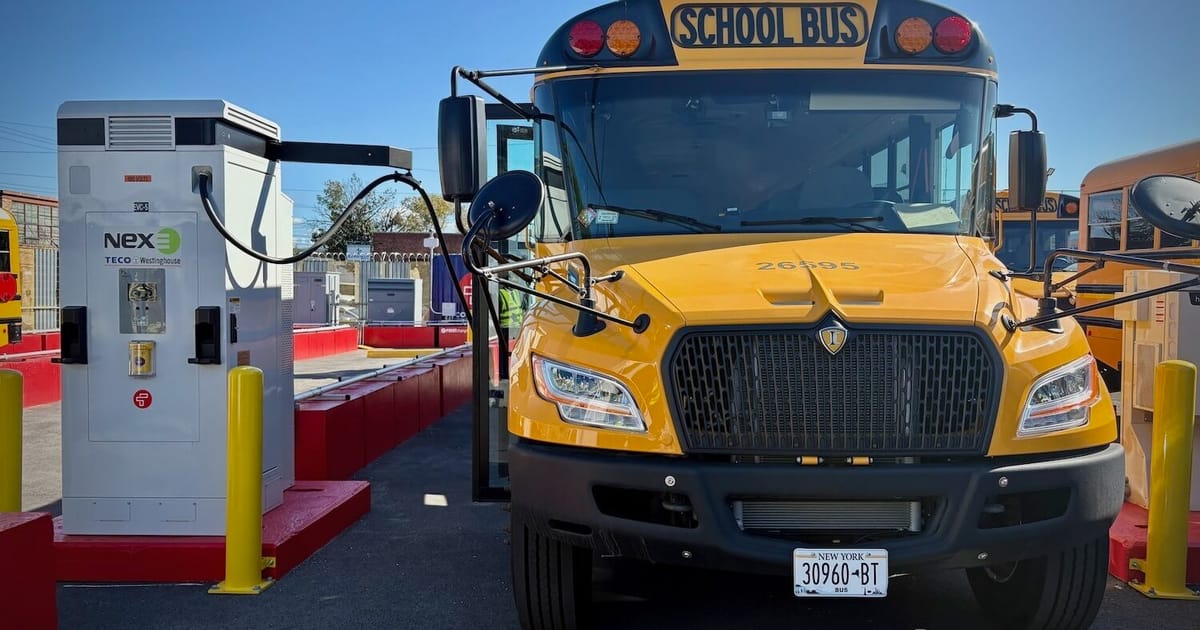
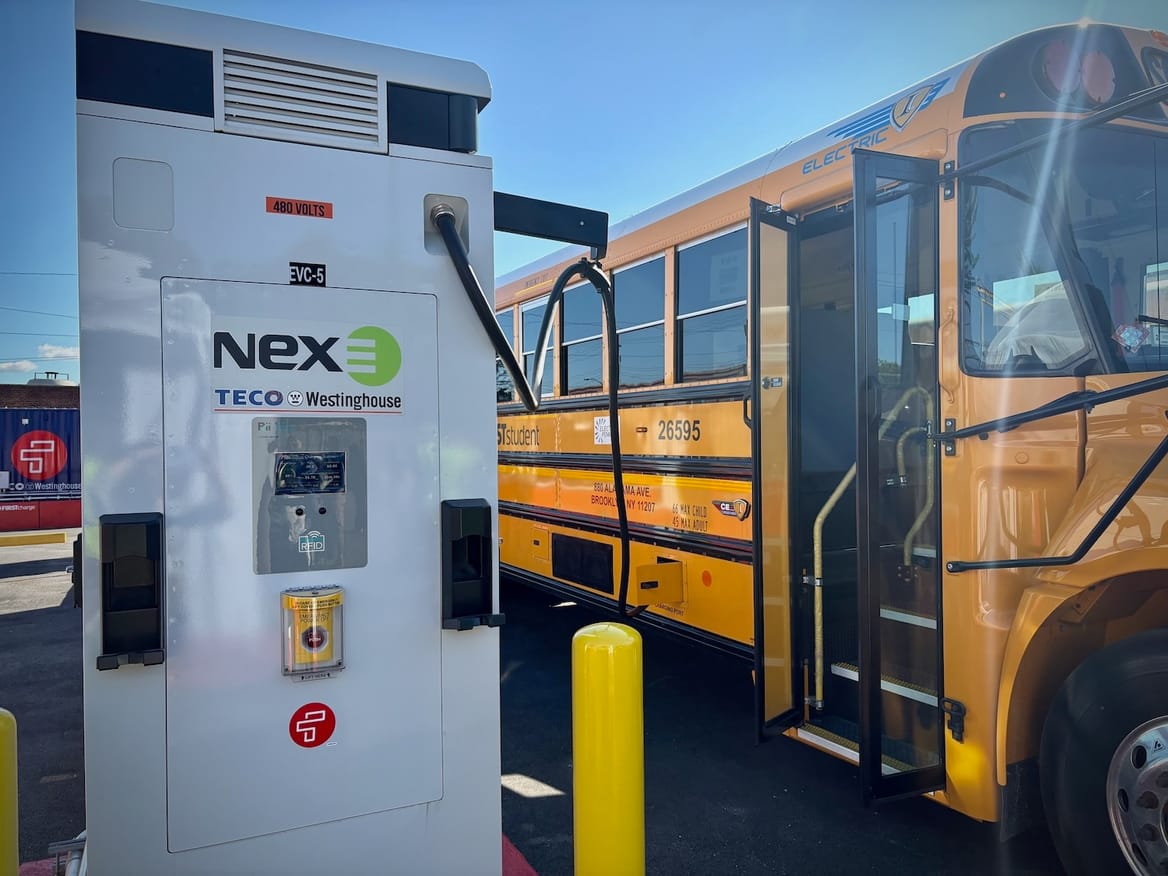
At the East New York depot, two of the buses have 3-kilowatt solar arrays on their roofs that can supply power to the bus batteries and the depot’s larger battery unit. First Student is considering outfitting more buses with panels, as well as installing a 500-kW rooftop solar system and a 2-MW battery at the site. The bus chargers are already equipped with hardware and software that allow the company to discharge extra power to Con Ed’s system.
“Our goal is to create additional vehicle-to-grid capability, facility-to-grid capability, up to 10 megawatts over the next couple years,” said John Kenning, CEO and president of Cincinnati-based First Student.
First Student’s electric buses run for a full school day on a single charge. As buses age and batteries degrade, the company may need to add a midday charging session, Kevin Matthews said. (Maria Gallucci/Canary Media)
Across the United States, more than 8,500 electric school buses were operating as of June 2026, up 66% from the same time last year, according to the World Resources Institute. The organization attributed the growth to schools’ persistent concerns about the effects of harmful diesel exhaust on vulnerable students, as well as the availability of state and federal funding programs.
Statewide zero-emission vehicle mandates are also a key driver for the nascent electric-bus market, though New York lawmakers recently pushed back deadlines by five years. Local school districts and bus companies now have until 2040 to comply with New York’s all-electric school bus mandate, and until 2032 to ensure that all new school bus purchases are zero-emission.
Lawmakers were responding to concerns from the state’s school transportation associations, which argued that districts needed more time to overcome several major hurdles, including how to pay for electric buses — which still cost more up front than diesel buses, even if battery-powered models are cheaper to operate and maintain in the long run.
First Student, for its part, received about $2 million in funding from the New York State Energy Research and Development Authority’s incentive programs to help pay for six new buses and to retrofit four diesel buses to run on battery power in East New York.
“Purchasing an electric vehicle is only one piece of the puzzle, albeit a very large piece,” Joy Gardner, executive director of the nonprofit Empire Clean Cities, said from the depot. But schools “also have to navigate charging, utility coordination, routes and operations, limited available space, infrastructure costs, and funding applications — all without interrupting the essential services they provide.”
“That’s what makes real-world deployments like this so valuable,” she added. “They create examples that help inform other fleets and projects.”