
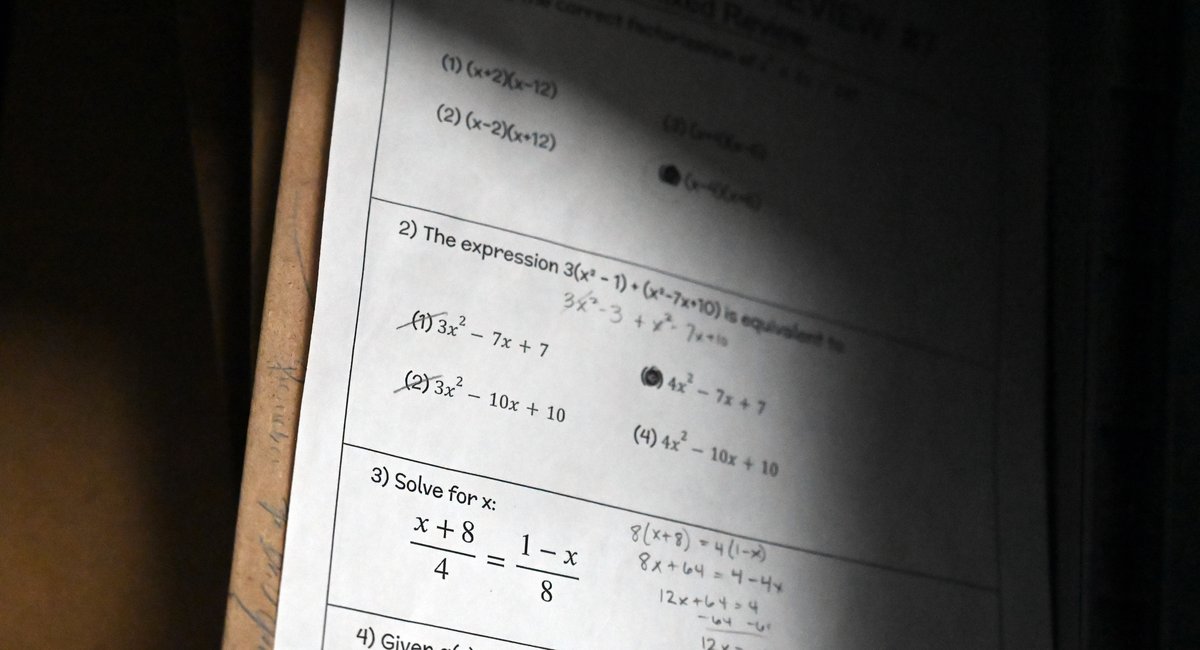
The Regents exam will no longer be a mandatory rite of passage for high school seniors in New York starting next fall. But what will replace the test remains a mystery, leaving parents and educators anxious about how students’ mastery in core subjects will be measured.
The unease about a post-Regents education system was laid bare at a City Council hearing on Tuesday.
“Schools still do not know how they will measure proficiency for students … who will be affected in less than a year,” said Councilmember Eric Dinowitz, who chairs the education committee and is a former public school special education teacher.
The New York Board of Regents voted last week to move forward with plans to drop the tests as a diploma requirement starting next school year.
The move marks a massive shift in education policy for the state, which has required the Regents tests for three decades as markers of students’ skills in English, math, social studies and science.
But state officials said the tests are an unfair obstacle for students with disabilities, diverse learning styles, or limited English proficiency.
Board of Regents Chancellor Lester Young Jr. said in a statement last week that the plan is to offer a range of opportunities for students to demonstrate mastery of a subject, rather than through high-stakes tests. “Advancing this work moves us closer to a more equitable system, one that upholds high expectations for all while ensuring that a student’s ZIP code, background, or circumstance never determines their opportunities for success,” he said.
But exactly how that will work is unclear.
State officials have presented a broad “Portrait of a Graduate,” highlighting six characteristics all students should demonstrate. Those include being academically prepared, a creative innovator, a critical thinker, an effective communicator, a global citizen, reflective and future focused.
David Bloomfield, education professor emeritus at Brooklyn College and The CUNY Graduate Center, has argued that the Regents exams are deeply flawed, but said the state’s Profile of a Graduate is simply too vague. He called for a pause as state officials work out new requirements “beyond blurry outlines.”
Danyela Souza Egorov, a fellow at the conservative Manhattan Institute and public school parent, warned that the end of Regents testing will “lower the value of a New York state diploma.”
“Why do the people setting educational policy for the state have no confidence in our kids’ ability to learn?” she asked.
New York’s shift away from Regents tests reflects broader trends. Across the country, states have been moving away from exit-exam requirements for graduation.
But at Tuesday’s hearing, councilmembers, families and advocates worried that the state is failing to offer a clear replacement, leading to confusion and a lack of accountability.
Some city council members warned schools may find themselves in an educational “purgatory” without clearer guidance.
“ I’m already hearing from my office, from parents, and students who don’t know what’s required of them anymore. They sound like they’re confused,” said Councilmember Mercedes Narcisse.
New York City Public Schools First Deputy Chancellor Danielle Giunta said students who complete required coursework amounting to 44 credits will be able to graduate. But Giunta acknowledged that the city school system does not have a consistent methodology for tallying those credits. She said the city is working with school leaders to review the metrics they currently use.
As a model for the future, city officials pointed to a consortium of schools that have for years used a range of capstone projects, oral and written reports, and science experiments to assess student learning.
For example, Superintendent Michael Prayor, who oversees high schools in South Brooklyn, talked about economics students who partner with economists at the Federal Reserve Bank of New York and conduct research. The partnership culminates with students giving an oral presentation of their work. He said students studying the history of the Holocaust interview survivors and examine survivor testimonies to create documentaries on the subject.
Giunta said city officials are working with school leaders to “create curriculum and work that we can share across schools” as part of a move toward new graduation requirements.