
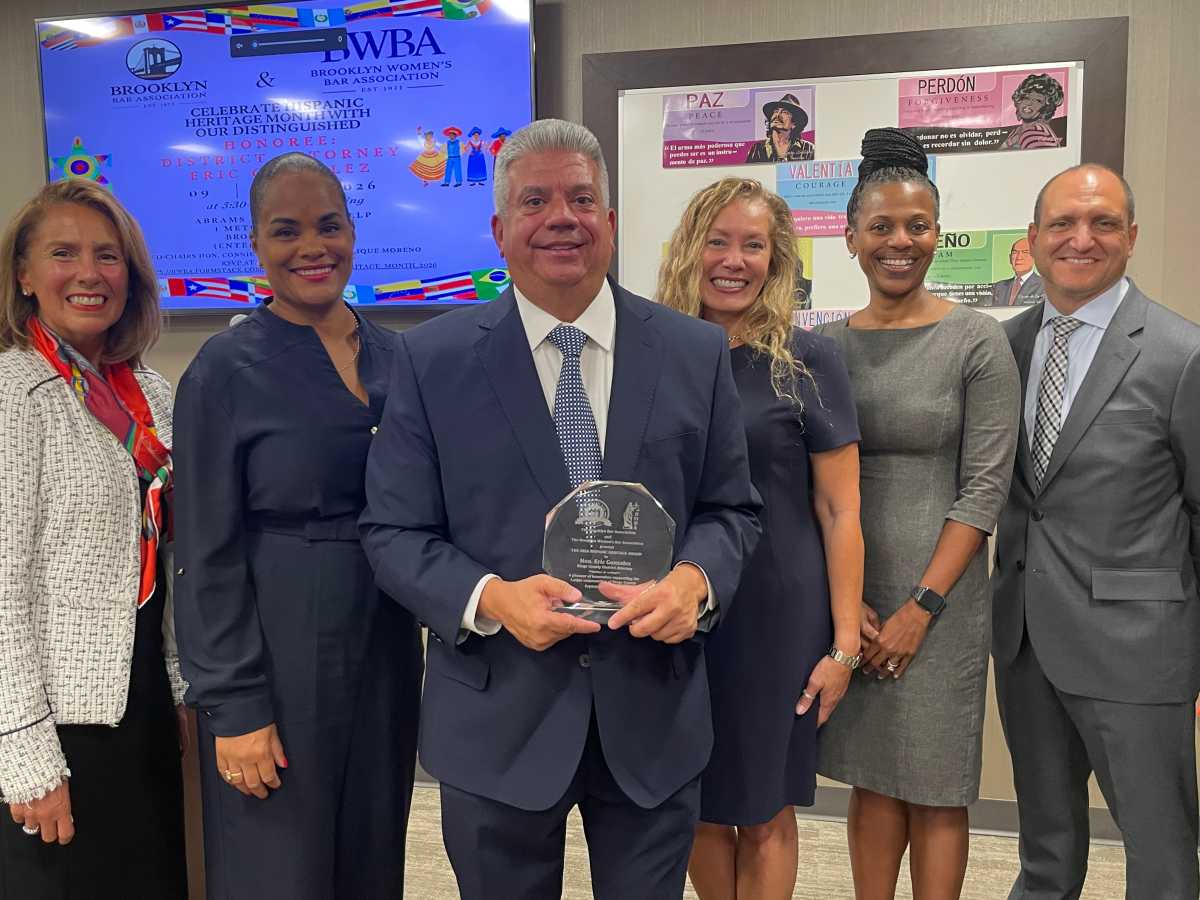
Brooklyn District Attorney Eric Gonzalez teared up Tuesday while accepting an award from the Brooklyn Bar Association in recognition of his trailblazing work as Brooklyn’s – and the state’s – first Latino top prosecutor.
“Our real responsibility is to make sure that we’re not the last to hold these positions,” Gonzalez said. “My only request is that all of you use your collective voices to continue the fight to provide more opportunities.”
Gonzalez’s remarks came at the legal organization’s annual Hispanic Heritage Month celebration, an event he noted was meaningful to him because of how many people in the room were also the first from their community to hold their positions – referencing judges on different benches across the city and attorneys in certain leadership roles – and how many of those people had a continued commitment to reaching a hand back to helping the next person through the door.
“You’re all people who have broken barriers in your career in this room, and to be honored and to be considered to be worthy of being a keynote speaker in this matter means a lot to me because of you,” Gonzalez said. “These rooms did not always look like this.”
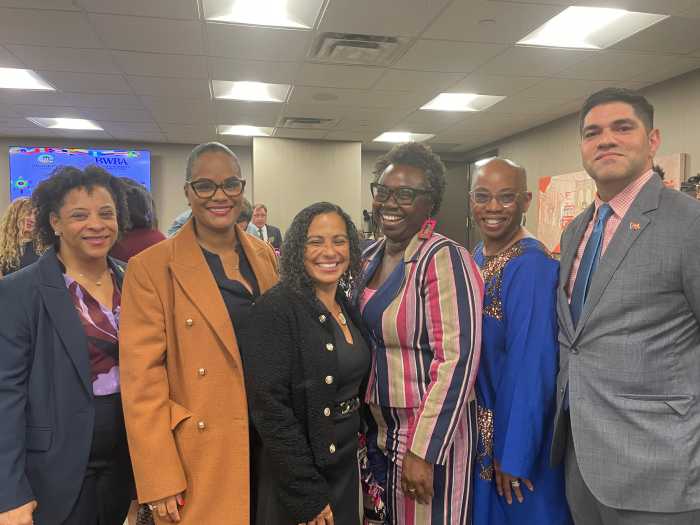 Brooklyn attorneys and judges, including Hon. Joanne Quinones, Hon. Dagmar Plaza-Gonzalez and Hon. Abayomi Ajaiyeoba stand together at the Brooklyn Bar Association’s event.Photo by Isabella Gallo
Gonzalez knows firsthand that those doors to lofty legal positions aren’t easy to open. A Latino boy from Brooklyn – first Williamsburg, then East New York – whose parents held jobs in what he described as Lower East Side sweatshops, going to college, let alone law school, weren’t things he saw as remote possibilities. Until, that is, he was approached by a graduate student in her 20s while skipping out of school as a high-school sophomore.
“She said, ‘Why aren’t you in school?’ And I said, ‘Because I’m playing handball,’” Gonzalez said, laughing. “She said, ‘Listen, you should be in school.’ Then she pulled me aside and said, ‘What do you want to do with your life?’ I told her, ‘I don’t know.’”
The woman told him she was starting a chapter of the club ASPIRA, which supports Latino youth, at his high school, and that she’d pay him and other students to come study and prepare for college at her office on Downtown Brooklyn’s Jay Street.
So, though he was skeptical, Gonzalez said he trekked from East New York to Downtown Brooklyn – two of the city’s roughest neighborhoods when he was growing up in the 1980s – to receive $20 after studying from SAT prep books with a few other Latino kids from his school for four hours every Saturday.
 Brooklyn Bar Association’s Dan Antonelli and Angélicque Moreno stand on either side of Hon. Connie Mallafre and attorney Karlyne Fequiere.
Gonzalez said he credits that experience with the rest of his life: He earned a high enough score to be admitted to Cornell, then earned admission to the University of Michigan’s Law School, then set his sights on becoming a prosecutor. He won election to head his borough’s district attorney’s office in 2017 and has led it ever since.
“She changed my life,” Gonzalez said. “Having that history coming from East New York, I just wanted to serve. I believed in paying it forward, and so that’s what I tried to do … I had a vision of what a fair criminal justice system could look like, and what I’ve tried to do with my time that I’ve been the shepherd of that office is to do two things: make our community safer, and try to create fundamental fairness in how we do the work here.”
Growing up in East New York drove his desire to lead a career in law enforcement, he said. One of the city’s deadliest neighborhoods in the city’s deadliest borough when he lived in it – one year, 128 people were killed in just his precinct and roughly 900 people were killed in Brooklyn – he wanted to both improve public safety and ensure people on both sides of the courtroom – the crime victim and the accused – got a fair shake.
“East New York was called the murder capital of this state in this city. It was a tough time, and I saw a lot of bad things,” Gonzalez said. “I knew that those who were killed were hardworking families who lived there and wanted nothing more than safety and fairness.”
“But growing up in that precinct, I also saw that there was distrust of law enforcement,” he continued. “It’s tough to explain because everyone wants to be safe, but if people don’t feel they’re treated with respect and dignity, they don’t have faith in the system, and they feel less safe. That was why I wanted to be a prosecutor in Brooklyn … I always cared about having a sense of public safety and believed that people could not live their lives if they didn’t feel safe in their community.”
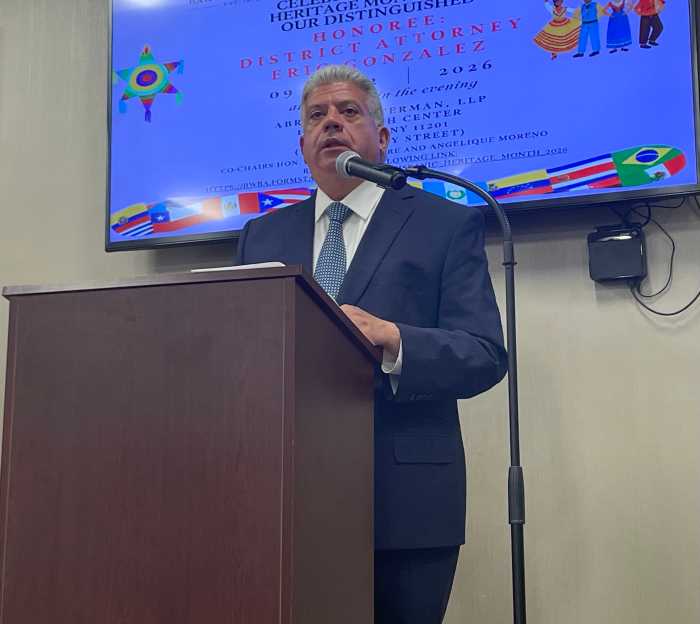 Gonzalez speaks at the Brooklyn Bar Association’s event.
Gun violence in Brooklyn has decreased under Gonzalez – It hit its lowest point ever last year. That’s a mission that’s deeply personal to him – his younger brother was shot and killed in the Bronx – and ongoing – his voice tightened while noting that a man had been shot in Downtown Brooklyn a few streets over just earlier that afternoon.
“I don’t feel like the work is complete. I don’t feel like I deserve to get all the recognition, because there’s still much more work for us to do,” the district attorney said. “I made a commitment to the people of Brooklyn that I would drive down gun violence. I’m proud that Brooklyn is safer than ever before. But, there was a shooting up the block earlier today and a young man, 24 years old, lost his life.”
“The mission is never really done, which is why I say I don’t like getting recognition because I have much more to do, but I am proud that many people feel represented because I exist in this space,” he continued, tearing up.
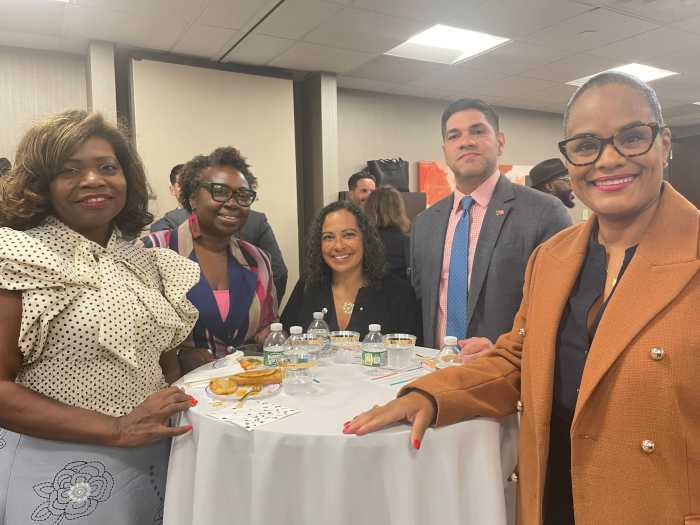 Brooklyn judges and attorneys stand together, including Brooklyn Supreme Civil Administrative Judge Genine Edwards, Brooklyn Supreme Court Judge Joanne Quinones and Brooklyn Supreme Court Judge Dagmar Plaza-Gonzalez.
Under Gonzalez, the Brooklyn District Attorney’s Office has pushed forward programs to overturn wrongful convictions. He’s been involved in 42 such cases, something he sees as important in ensuring people trust law enforcement.
“When we started this work in the Brooklyn DA’s office, people thought it would undermine the confidence in the DA’s work,” Gonzalez said. “My experiences taught me just the opposite-that when you come forward with the humility to acknowledge when things haven’t gone right, and you make the effort to correct those miscarriages of justice, and you explain why it’s happened and you train on it, the opposite impact occurs: People have confidence that the office will be seeking to do the right thing moving forward.”
He’s also helped diversify the office during his tenure, something he said is critical, both to wedging the door to the legal world open further and to the office’s proper function.
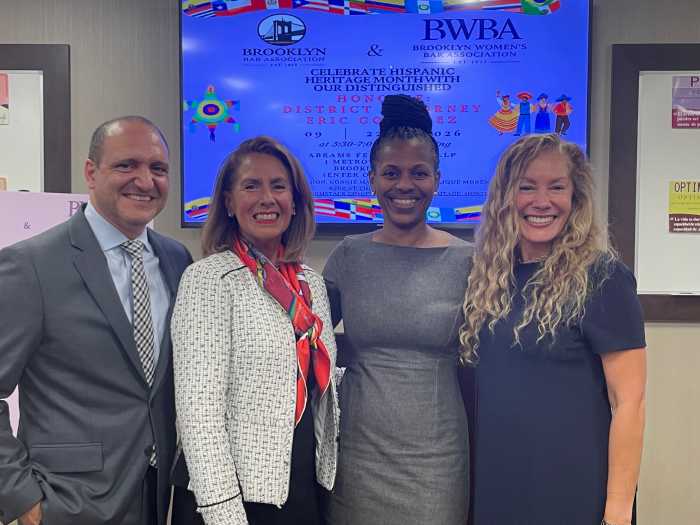
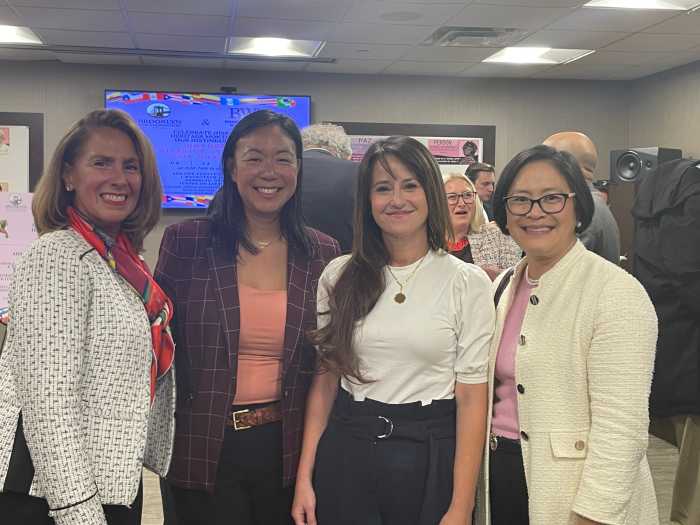 Brooklyn Supreme Court Judge Connie Mallafre, Brooklyn Women’s Bar Association President Elect Ruth Chung, Columbian Lawyers Association President Grace Borrino and Appellate Division, Second Department Justice Lillian Wan stand at the Brooklyn Bar Association’s event.
“I entered a district attorney’s office that was very large – the largest district attorney’s office in the state, but was not as diverse as it is today,” Gonzalez said. “People who looked like a lot of the people in this room weren’t really seen in leadership roles in a lot of the institutions and our courthouses.”
“It’s not representation for the sake of representation,” the district attorney continued. “It’s representation because when we represent, we’re better. And when people are coming behind you, our young students and young people see you in these rooms and in your positions, they know that they can get there too.”
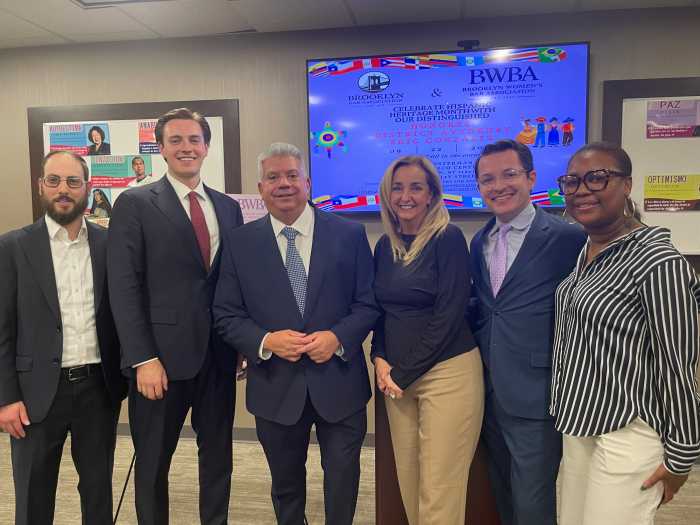 Members of the Abrams and Fensterman firm, which hosted the Brooklyn Bar Association’s event, stand with Brooklyn District Attorney Eric Gonzalez. (From right to left: Octavia Brown-Lyde, Peter McNally, Eric Gonzalez, Frances Ciorciari, Brendan Romano and Efrain Lipshutz.