
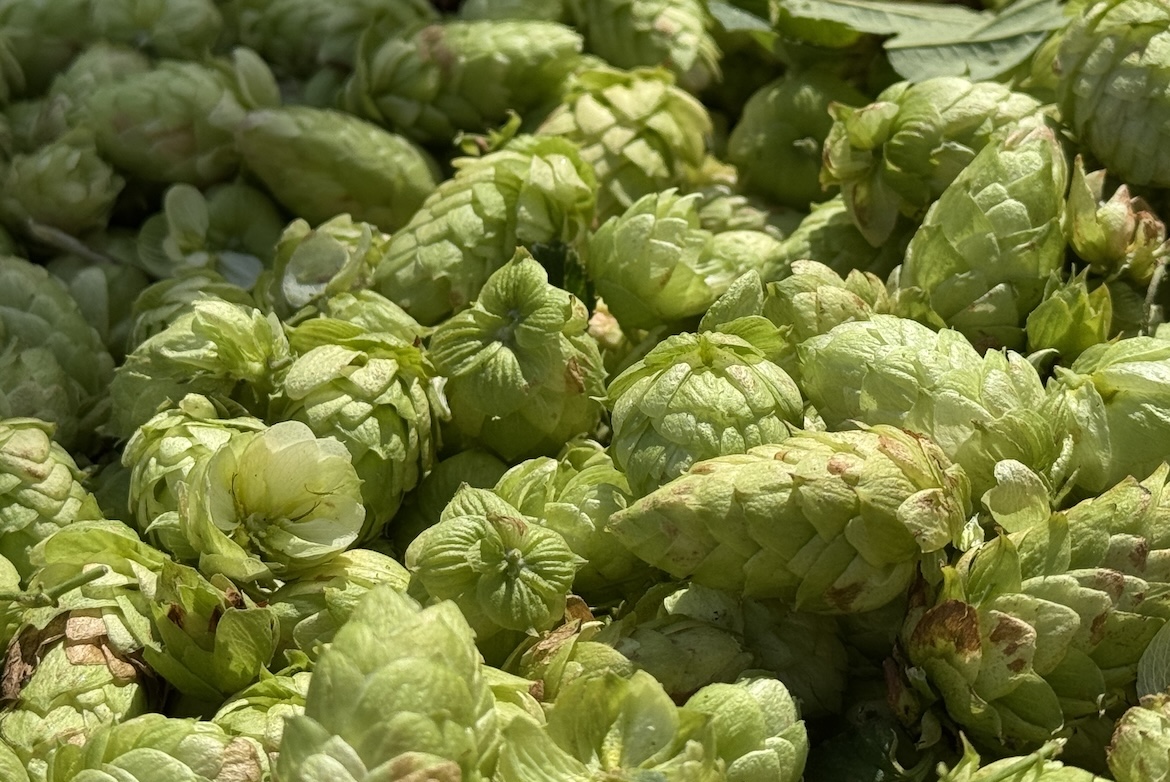
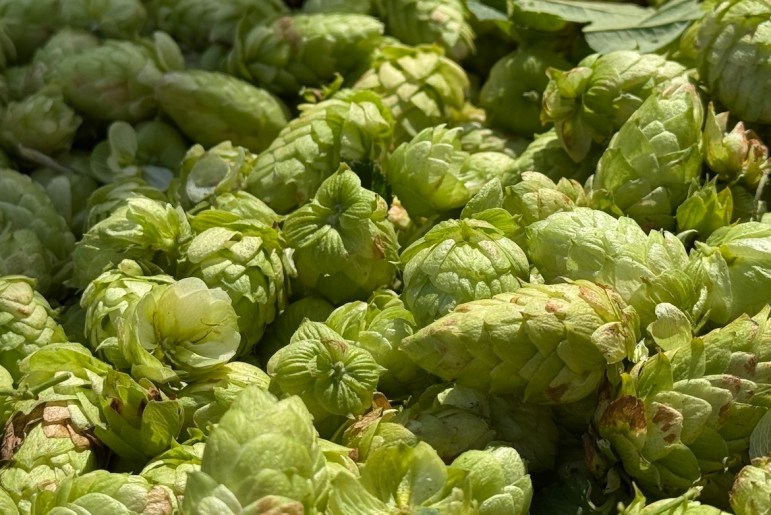
 Photos by Will Cleveland
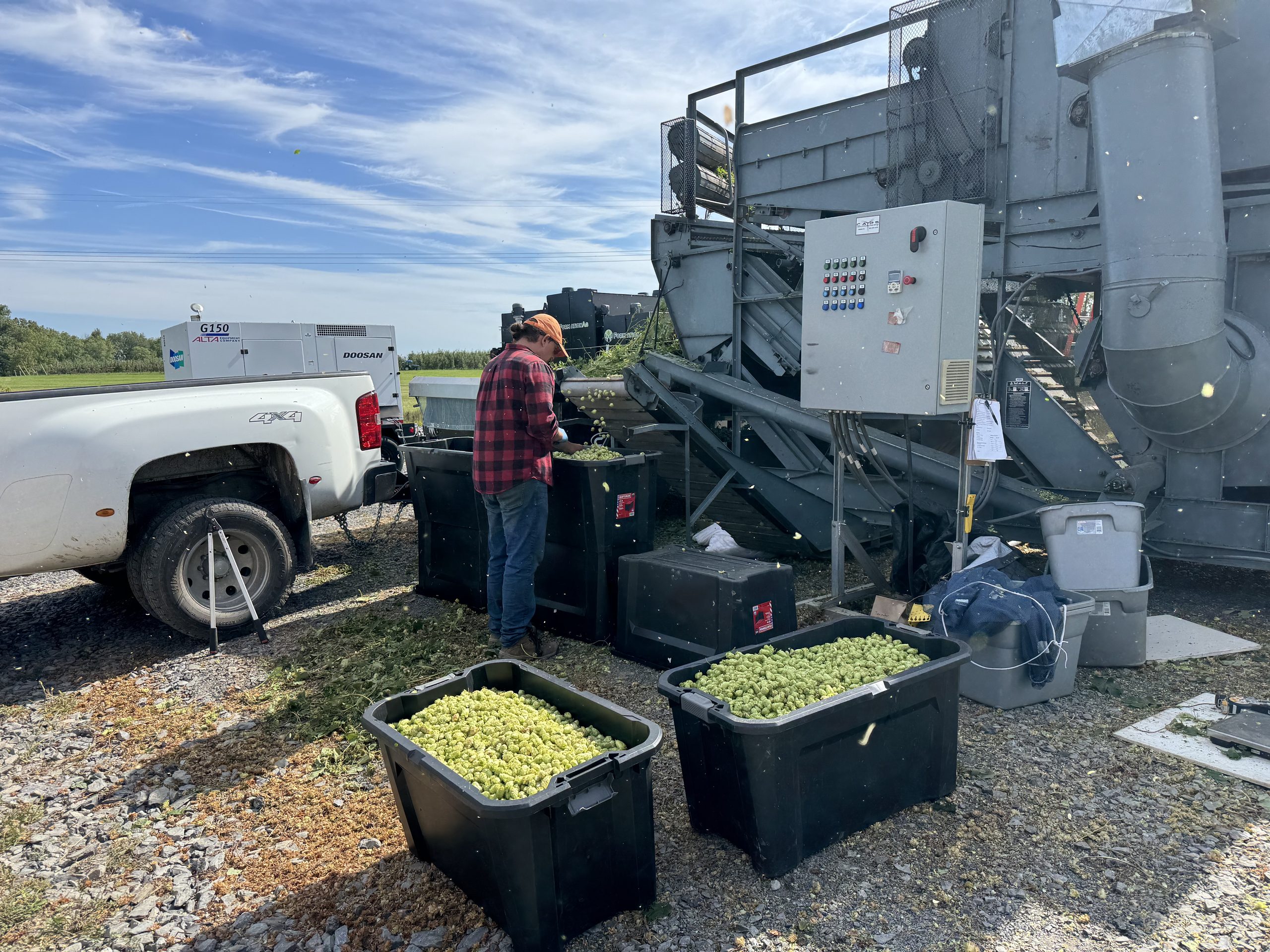
The Wolf hop picker is loud enough that Nathan Lewis and I have to lean in and half-shout to hear each other over it. The machine itself is a relic, German-built in the 1980s, standing some 15 feet tall in an open field on Gates East Farm, part of Cornell AgriTech’s sprawling campus just outside Geneva. The picker is whirring and rumbling in a spot across Sutton Road from the hop yard where the bines had been cut off the trellis just minutes before.
Six rollers strip the cones off in seconds, a sound somewhere between a wood chipper and a washing machine. And the whole time it runs, shredded plant matter drifts down out of the machine, floating and settling onto my clothes, into my shirt pocket, over everything nearby. It smells incredible. It also gets on everything. Four people are doing this work today, and I’m just watching, an interloper getting a look at a part of the brewing process most beer drinkers will never see.
This is the first harvest I’ve watched in person, on a crew led by Larry Smart, the Cornell AgriTech horticulture professor who runs the university’s hop breeding program. Lewis, a doctoral student, and Jacob Bish, a farm technician, do the daily work of keeping this yard running. I first wrote about this program in 2021, when it was a brand-new $300,000 experiment with no track record and a lot riding on it. Five years later, hops that started in this yard are showing up in cans and pints at breweries across the state, so I drove back to Geneva to see what five years and a meaningful chunk of state money have actually bought.
Cornell AgriTech is the applied-research campus tucked into more than 900 acres just outside Geneva. As a land-grant university, Cornell has spent more than a century breeding crops for New York growers—grapes, apples, vegetables, grains. Hops are one of its newest experiments, and the yard sits a short drive from Pedersen Farms in Seneca Castle, the farm that helped prove New York could grow commercial hops again after Prohibition.
Five years and $1.8 million in state appropriations is a real bet for a crop this niche, and breeding a good hop was never really the hard part. The harder question is whether a New York farmer can afford to grow one. A variety that tastes incredible and dies to mildew is worthless here. One that survives the climate but costs $20,000 an acre to plant is worthless too, if nobody can justify planting it. Nearly everything I saw this Saturday was an answer to one half of that question or the other.
Over a century ago, New York was the top producer of hops in the country, with more than 60,000 acres in production. Disease, Prohibition and then competition from West Coast growers took a heavy toll. By 2022, the number had fallen to 153 acres spread over 85 farms.
New York’s farm-brewery law passed in 2012 and took effect in 2013. It was designed to set off a boom in the state’s craft beer scene. But it also came with a catch. To keep that farm-brewery license, a brewery had to source a rising share of its ingredients in-state—20 percent through 2018, 60 percent from 2019 through 2028, and 90 percent beginning in 2029. The trouble was that the hops everybody wanted, the Citras and Mosaics and Galaxys behind the entire hazy IPA boom, were proprietary varieties bred largely in the Pacific Northwest and Australia. They aren’t licensed for commercial production in New York, and many of the Pacific Northwest varieties weren’t particularly well adapted to the state’s climate. What did grow here—Cascade, Chinook, Willamette—tended toward more traditional earthy, spicy or resinous profiles than the tropical character brewers were chasing.
Jan Nyrop, who was Cornell AgriTech’s director at the time and has since retired to become a professor emeritus of entomology, drew a comparison back then that stuck with me: wine. New York’s wine industry had built an identity around terroir, an actual sense of place, and he thought beer could do the same thing, but only if there was something to grow here that tasted like here.
Rick Pedersen had already shown the appetite was real. In 1999, his family’s farm became the first in New York to plant hops commercially since Prohibition, and by 2021 he said “quirky hop varieties are all the rage” with the modern craft drinker. Paul Leone, who runs the New York State Brewers Association, called a dedicated Cornell breeding program a potential game-changer: produce something distinctive, he said, and breweries everywhere would want it.
Cornell took its $300,000 in state money and set out to do for hops what it had already done for grapes, apples and barley: figure out what would actually thrive here, then hand growers something worth planting. Smart, who ended up running the program, wasn’t even a hops guy by trade. His specialty is breeding hemp, and he inherited the hop program as another breeding challenge, since hops and hemp are members of the same plant family. Five years in, does he ever ever second-guess the assignment? He laughs off the question.
“I like squash, but I like beer better,” he says.
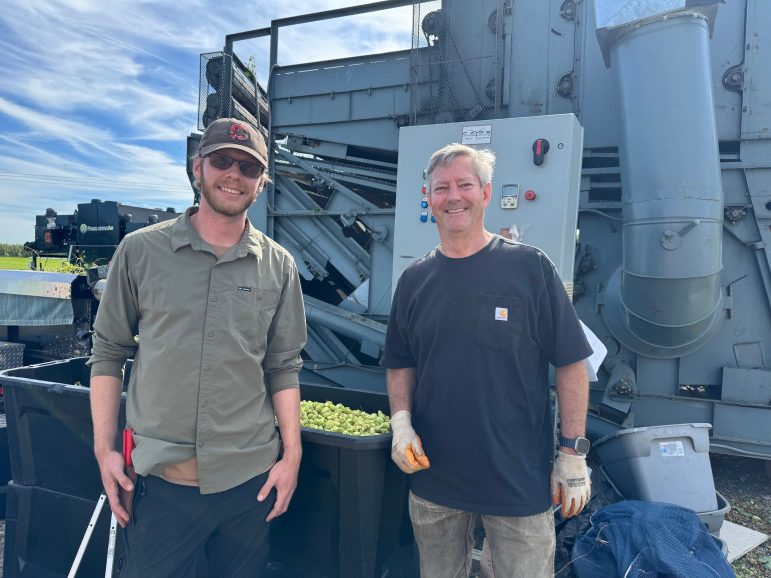 Nathan Lewis, left, and Larry Smart
Cornell wasn’t inventing this particular experiment from scratch. Public hop breeding has been around in the United States for decades: a university or government program breeds hops for the conditions of a specific region, then works with growers and brewers to see what’s actually worth commercializing. Cornell is just the newest entry in a field that stretches from the Pacific Northwest to the Southeast and Midwest.
Oregon State University started its modern aroma-hop breeding program in early 2010 after a gift from Indie Hops, an Oregon hop merchant: $807,000 for the breeding work itself, on top of $200,000 the company had already given for hop chemistry research—more than $1 million total, aimed at new aroma hops adapted to the state’s own growing conditions. North Carolina State started its own program in 2016 for almost the same reason: the Pacific Northwest varieties weren’t well adapted to the local climate. NC State eventually developed NC1601, a selection with estimated yields of 1,600 to 2,000 dried pounds per acre—roughly four times what standard varieties manage there—that’s since gone into test batches at a handful of North Carolina breweries.
Minnesota tried a similar approach, funding University of Minnesota work beginning in 2018 to develop hop-breeding resources and cultivars adapted to the state’s conditions. The project ran through 2021, and Minnesota researchers have continued work on disease-resistant genetic material. It’s a useful contrast with Cornell’s approach; breeding programs can produce valuable breeding stock and research even when they don’t immediately produce a commercial variety.
There’s a larger public program sitting behind all of them, too. The federal government has long bred hops for American growers, and the USDA’s current program, based in Oregon and Washington, recently proved the model can still work. In 2025, USDA researchers released Vera, a public aroma hop with tropical, stone-fruit and citrus characteristics and resistance to the dominant strains of powdery mildew troubling Pacific Northwest growers. Vera grew out of a collaboration involving Washington State University and USDA researchers and was tested with growers and brewers before release, proof that a public hop program can eventually get all the way to a finished beer.
That history matters because Cornell’s basic blueprint isn’t novel: breed for the climate you have, select for what brewers want, test with growers, keep going until something survives both the field and the glass. What’s different is the problem New York is solving. This isn’t Oregon staying ahead of a global market, or North Carolina forcing a crop to work somewhere it barely wants to grow. It’s a state trying to rebuild an industry that once mattered enormously here, before disease and Prohibition wiped it out, and unlike Minnesota, actually staying funded long enough to find out if that’s possible.
That first $300,000 appropriation didn’t stop after one year. The Legislature has continued providing $300,000 for the Cornell Hops Breeding Research and Extension Program through the state Department of Agriculture and Markets in every budget cycle from the program’s 2021-22 launch through the newly adopted 2026-27 budget. That’s $1.8 million in appropriations over six budget years, though some of that money has been reappropriated rather than spent immediately, so the figure describes what the state has authorized, not necessarily what Cornell has already spent.
The money has gone toward the unglamorous stuff required to make a breeding program work: trellises, equipment, a fungicide program, field work, a doctoral student’s stipend. And it’s still handed out one year at a time.
Smart is candid about what that means in practice. “Technically it is a short-term project,” he says. “My money only comes one year at a time. So, every year it’s a new one-year project.”
His hope, a modest one, is that the state looks at what’s already been invested and doesn’t walk away now that the program is producing results. Or as I’d put it: Please don’t screw this up, Albany.
If Cornell does eventually get a hop across the finish line commercially, the plan is to license it the way the university handled its apple breeding successes, Snapdragon and Ruby Frost, through a grower consortium that scaled the varieties up at New York nurseries. The nightmare scenario, as Smart describes it, is releasing something and watching growers out west pick it up instead, thousands of acres suddenly planted in Yakima, with New York’s own farmers competing against the variety Cornell bred to help them. Royalty money would be nice for Smart personally, he admits, but that’s not why the state is funding this.
A hop is the cone-shaped flower of a fast-growing perennial, and inside each cone sits a cluster of sticky, yellow glands called lupulin, nearly all of a hop’s value to a brewer—the acids that give beer its bitterness and the oils that give it aroma.
This year’s harvest kicked off Aug. 10 and runs through roughly Sept. 25. Cornell’s yard is up to 61 varieties in active trials now, a mix of commercial lines, experimental USDA breeds and heritage hops rescued off old New York farms; nine of those have made it far enough to get handed off to real breweries for real brewing trials. That’s the part that matters to you and me: hops that started as a maybe in a research plot are ending up in glasses.
Getting a plant from that maybe to a finished pint takes years. Lewis, starting the third year of a doctorate he hopes to finish by the end of 2028, walked me through the timeline: year one is just about getting the plant established; year two gives you a decent read on yield; and years three through five are where you learn what a variety can actually do. That stretch matters here because New York’s disease pressure swings wildly from one summer to the next. Last year ran clean and warm, mostly just some powdery mildew to manage; this year brought heavy rain and a bad flareup of downy mildew that gave the whole yard a rougher test.
Powdery mildew thrives in humid conditions. Downy mildew thrives in wet conditions, and New York’s rainy summers hand it exactly what it needs. Disease resistance, more than flavor, is the real test any hop has to pass here before it graduates out of the trial yard, and Smart doesn’t dress that up.
“In New York, it’s all about disease resistance,” he says. “We cannot release a variety that’s susceptible to disease. We’ve got to lower the cost for growers spraying fungicides.”
He’s got a scar-tissue story on hand. A few years back his lab imported two promising varieties bred in North Carolina, developed in partnership with a major West Coast brewery. Planted in Geneva, both got hammered by powdery mildew even under a full spray program. When Smart’s team asked the North Carolina breeders what was going on, the answer came back simple: They don’t get powdery mildew in Asheville. Smart’s response was dry—make sure, he said, that whenever you promote that hop, its susceptibility goes right in the description. Cornell shelved both varieties.
Lewis’s own research lives inside that same problem, and it’s gotten more technical than I expected. Beyond yield, he’s tracking branch length and plant shape, and something he calls shattering: what happens when the Wolf harvester’s rollers are too rough on a delicate cone and it explodes on the way through instead of coming out intact. To sort through 61 varieties faster than a trained eye ever could, he’s started using machine learning to identify hop varieties and classify cone shapes from photos, and his lab is developing a rapid test for alpha and beta acid content, the compounds that determine a hop’s bitterness, instead of waiting on slower wet-chemistry lab work for a rough read on a new variety.
None of that solves the other half of the problem, though.
“The cost to establish a hopyard, you’re looking at $15,000 to $20,000 an acre in trellis systems,” Lewis says. “Forty grand, at least, for a hop-picking machine. Somewhere in that ballpark to dry the hops. Several tractors that are all specialized. You’ve got to figure out how to spray fungicide 18 feet into the air all throughout the season.”
That estimate isn’t far off published figures. Cornell’s own small-farms program puts total per-acre startup costs—plants, trellis, irrigation—at $12,000 to $15,000, with harvesters running $30,000 to $35,000. Lewis says small independent acreage is a tough way in, and the more realistic path runs through apple growers or vineyard operators who already own the specialized tractors and just need to add hops to an existing operation.
Bish is blunter: “You don’t get a good harvest that first year. And that second year isn’t much better. You’re looking at three years before you start to make any money. It is just a labor-intensive crop.”
Cornell has figured out how to breed the thing; somebody still has to figure out how to afford it.
The experiment on the ground
Bish drives his tractor across the road to where a tall row of Dwyer 2, one of the program’s heritage varieties, was ready to come down, and I follow as closely as I can manage without losing the trail. The farm covers enough ground that it’s easy to fall behind. As we cross, I keep hearing something that sounds unmistakably like a very angry, very distressed cat somewhere in the trees, and I say something to that effect, assuming an actual animal is in distress nearby. Lewis and Bish both crack up.
“Don’t worry, those aren’t real cats,” one of them tells me. “The recordings are played to scare the birds away.”
It apparently works on birds. It briefly worked on me, too.
Dwyer 2 has its own small origin story. It turned up on a property north of Albany, climbing the side of a barn with no one tending it. That area and the neighboring Schoharie Valley were once one of the country’s most important hop-growing regions before disease (and later Prohibition) wiped it out. Hops are perennial and can survive for decades once established, even completely untended, so old hop country in New York is still dotted with feral plants that outlasted the farms they were originally planted on.
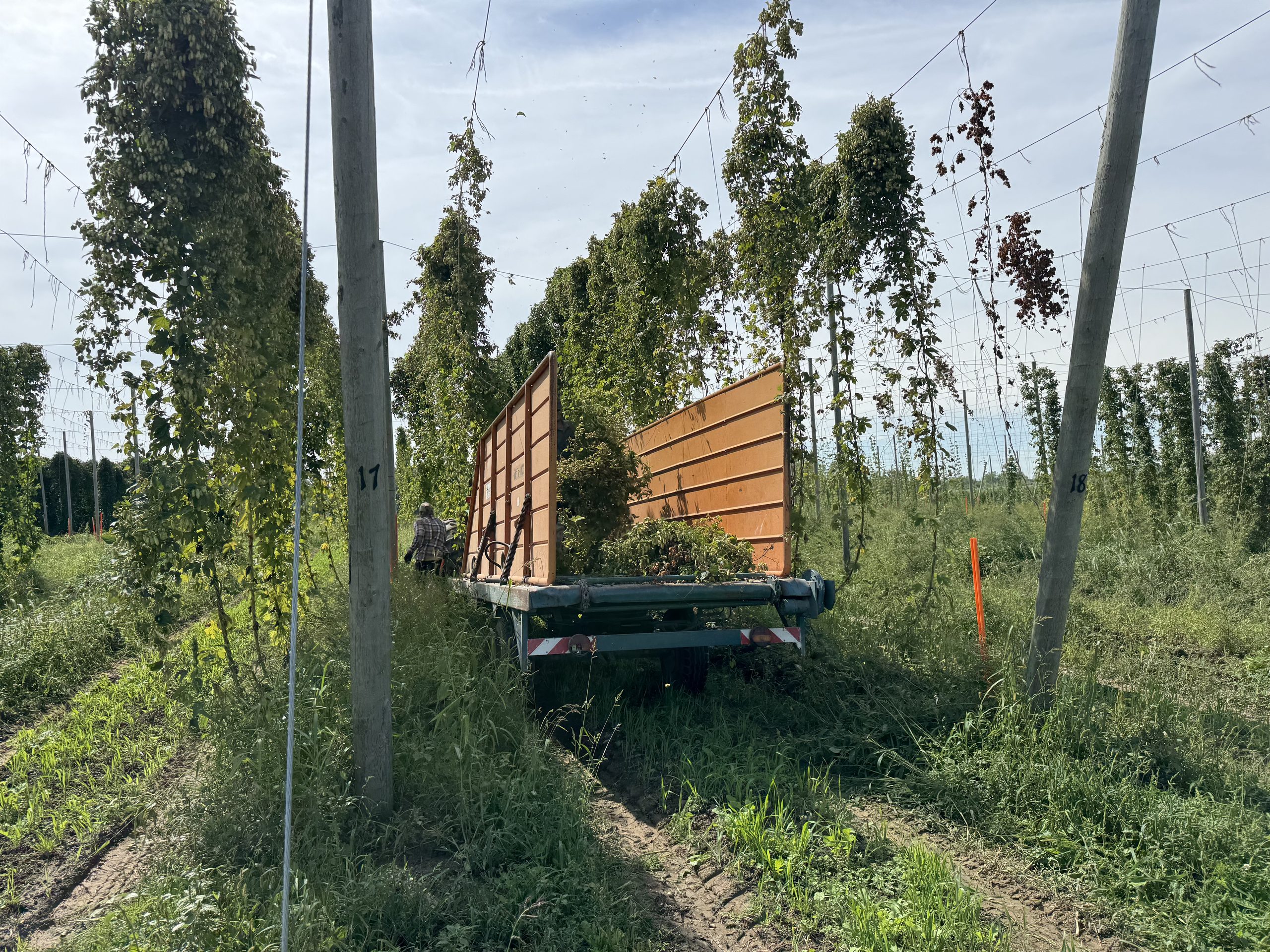
The crew is also expanding the trellis system: new rows are going in at 21 feet instead of the standard 18, because some varieties outgrow an 18-foot wire before the season ends and lose a chunk of their top growth, where a good share of the cones form, to the waste pile instead of the harvest. Jensen Precast, a local business, donated the concrete posts needed to build the taller rows, saving the lab something like $18,000, though the crew is now hunting for string long enough for the extra height and isn’t sure the fungicide sprayer can reach that far up either.
Running the actual harvest is an antique, a Wolf hop picker built in Germany in the 1980s and pulled out of a defunct hop operation in Nebraska about four years ago. Bish got it assembled and running, and has kept it going for three seasons since. He clearly finds the operation more charming than exhausting. “These are a bunch of big toys,” he says. “We come into work and play every day. Sometimes it’s more of a challenge than others.”
Right before I arrived, the machine had jammed, and the crew had pulled material out by hand to get things moving again.
The search for New York’s beer
These days, Smart talks less about chasing the next Citra and more about nailing a hop that fits a beer style New York can genuinely call its own: the cream ale. One candidate getting real buzz is an experimental USDA line, bred in 2000 by USDA researcher John Henning in Corvallis, Ore., as a sister variety to Triumph, already grown commercially in New York and sold through the state’s Hop Guild. Its profile splits the difference between classic German noble hops, herbal and floral notes running into stone fruit and tangerine, and Cornell is pushing hard to get the USDA to formally release it. A material transfer agreement currently caps how many plants the lab can grow and blocks it from handing cuttings to a commercial nursery. Smart is hoping for release within the next few months, under a name the lab has coined jointly with the Hop Growers of New York, pending that release: Quest.
Running alongside Quest is Reality, a revived heritage strain of Cluster hops that likely dates to before Prohibition, when Cluster was among the most widely planted hops in the country. Genetic testing on the wild plant that became Reality confirmed it didn’t match any existing commercial variety, exactly what you’re hoping for in Smart’s world.
Both have already made it into finished beer. Big aLICe used hops grown right in this yard in its Pure Pils, and Smart still talks about the first time he saw that can on a store shelf with something close to disbelief. Steuben and Druthers have both put Cornell hops into cream ales as well, aiming at that same New York-specific style Smart keeps circling back to.
Then there are the finds that read like local legend, my favorite part of this whole story. One heritage variety turned up growing wild near the Sullivan County hamlet of Barryville, and DNA fingerprinting traced it to a likely seedling relative of Saaz, the noble Czech hop. Swiftwater and Genesee Brew House teamed up on a Pilsner using it earlier this year.
Tips like that still come in cold. Smart got an email just days before we spoke from someone who’d bought a property in Millbrook and found hops climbing an ash tree, with no sign the property had ever been an actual hop yard. That’s next on his list: get down there and run DNA fingerprinting to see if it’s worth anything.
Chinook grown out west tends to lean piney; Chinook grown in New York, by Lewis’s account, leans noticeably more tropical, more toward stone fruit than pine resin, which is promising for the cream ale project even if the long-term goal on the breeding side is still finding something with the bright citrus and tropical character that could compete in a hazy IPA, the kind of hop the whole program was originally dreamed up to produce.
What’s kept Lewis and Smart out in that yard on a Saturday—because Saturday, not some more convenient weekday, was when this particular hop was actually ready—comes down to something simpler than any of the science. New York’s craft beer scene has held up better than the national industry lately, and Smart puts it in land-grant terms: Cornell exists to serve industries like this one; not just the farmers growing the raw ingredient, but the whole local food and beverage economy that depends on it. He counts a long list of breweries as partners, among them Indian Ladder, Strong Rope, Steuben, Brewery Ardennes, the loosely organized Seneca Lake Order of Brewers and Big aLICe.
Lewis landed here almost by accident, having reached out to Smart about graduate work on hemp before Smart mentioned the hop project as an aside. His own tastes run toward cream ale, and he gravitates toward Steuben, Prison City and Big aLICe on his own time. Smart’s current favorite is Big aLICe’s Queensbridge IPA.
The program started as a $300,000 experiment with nothing to show for it and no guarantee it would ever produce anything a farmer could plant or a brewer could use. Five years and $1.8 million in state appropriations later, it runs an annual open house so local brewers can walk the trial rows themselves, and on harvest day it hands out fresh wet hops first-come, first-served, no formal allocation system beyond who shows up. Several breweries tied to the Seneca Lake Order of Brewers are already lining up wet hops for a competition next month.
Whether the economics ever catch up to the science is still an open question. Cornell has spent five years and $1.8 million on the science. The other half is still somebody else’s problem.
Will Cleveland is a Rochester Beacon contributing writer. A former Democrat and Chronicle reporter, he writes about beer in the Finger Lakes region and Western New York on Substack.
The Beacon welcomes comments and letters from readers who adhere to our comment policy including use of their full, real name. See “Leave a Reply” below to discuss on this post. Comments of a general nature may be submitted to the Letters page by emailing [email protected].
Related