
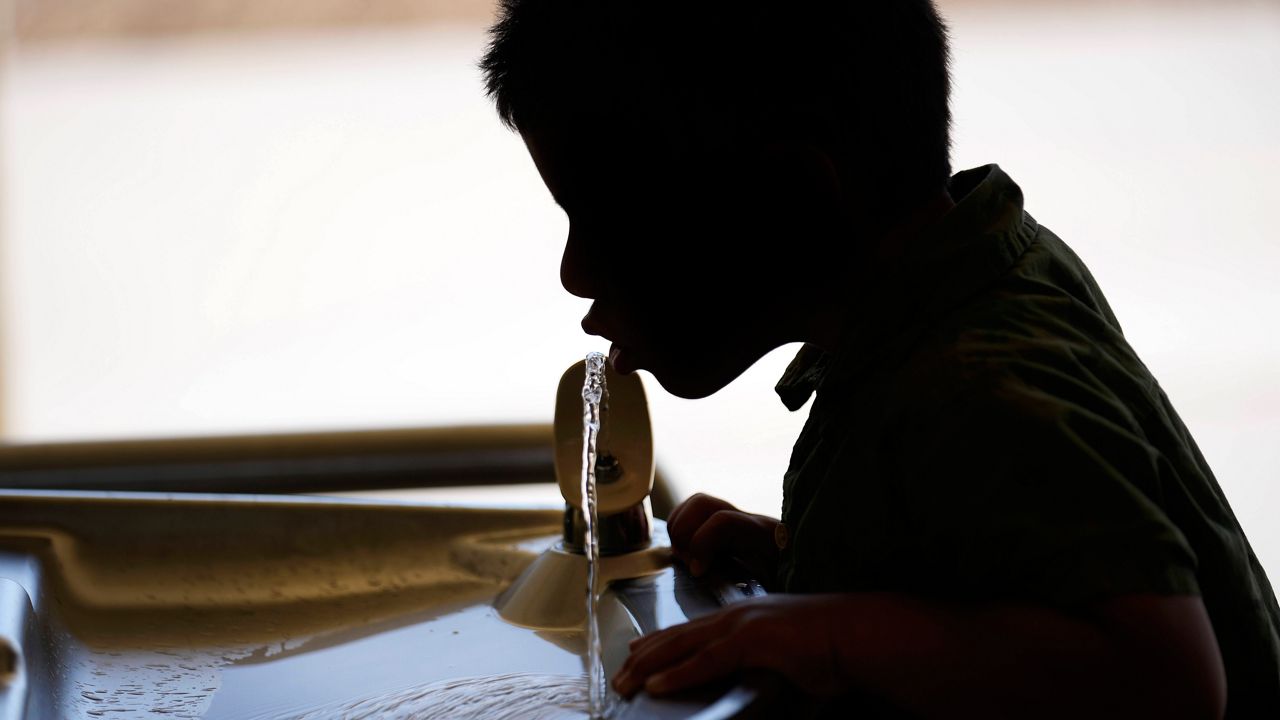
Nearly half of New York schools have lead in their drinking water, according to a new report — and Jefferson County has it worse than almost anywhere else in the state.
The report, “Get the Lead Out New York,” was released last week by Environment America Research & Policy Center and the New York Public Interest Research Group. It found at least 12,000 water outlets in schools statewide have potentially exposed students and staff to lead.
“It can lead to learning disabilities, hearing and speech problems, and IQ loss,” said Kate Canada, with Environment America.
Jefferson County had the highest rate in the state: 84.6% of its schools reported more than one outlet testing above state standards. St. Lawrence County followed at 80.5%, then Chautauqua County at 79.4%, Lewis County at 78.6% and Tompkins County at 75%.
Raymond Filley, the health, safety and security program coordinator for Jefferson-Lewis BOCES, says the results — while not good news — help pinpoint where the problem is.
“This testing allows us a chance to identify those spaces that need to be replaced,” Filley said.
Any outlet that tests above the limit is immediately taken out of service. “If it is a necessary location and we need to remediate it and get it back online, we will replace components as far as the fixtures involved or plumbing may be involved,” Filley said.
He says the surge in flagged outlets is largely because the state lowered its lead action limit from 15 parts per billion to 5 parts per billion.
“Schools are seeing these results because we’ve reduced that threshold so much,” Filley said. “We’ve had locations that were elevated between the 5- and 15-parts-per-billion mark.”
Still, health experts say there’s no safe level of lead exposure. That’s why Environment America and NYPIRG want the state to require filtration systems on every school water outlet, rather than relying on a test-and-fix approach.
“We think a filtration system placed on all drinking water outlets at every school should be a key component of reform,” said Blair Horner, senior policy advisor for NYPIRG.
Filley disagrees.
“We’re trying to resolve where the contamination is coming from,” he said. “If you fully relied on preventative filtration instead of testing, I think you would be losing that aspect.”
The report is based on testing from 2023-25. The current round is still underway: As of Sept. 17, the state Department of Health says 366 of the 597 schools tested so far have reported at least one fixture above state standards. New York has more than 4,000 schools total, so that number is expected to grow. Report authors are also pushing the state to tighten its limit further, to 1 part per billion.
“One of the few things we can all agree on is that lead at any level is bad, especially for children,” Canada said.