
Chief Judge Advocates for Expansion of Civil Legal Aid
9.25.2026
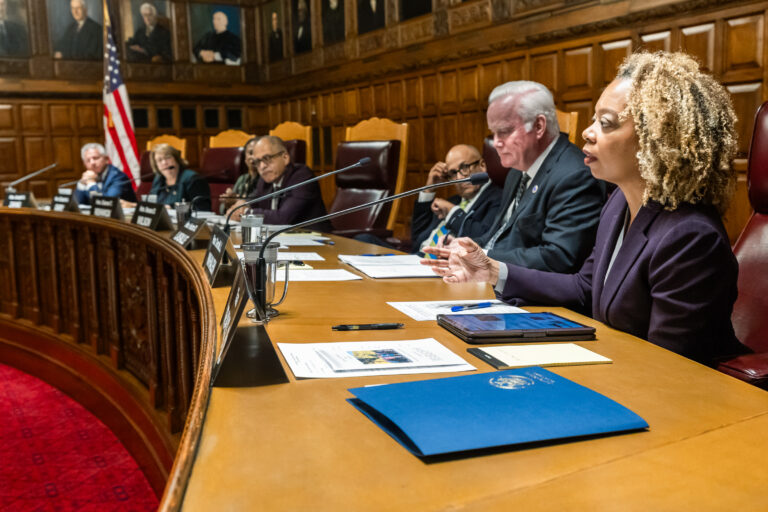
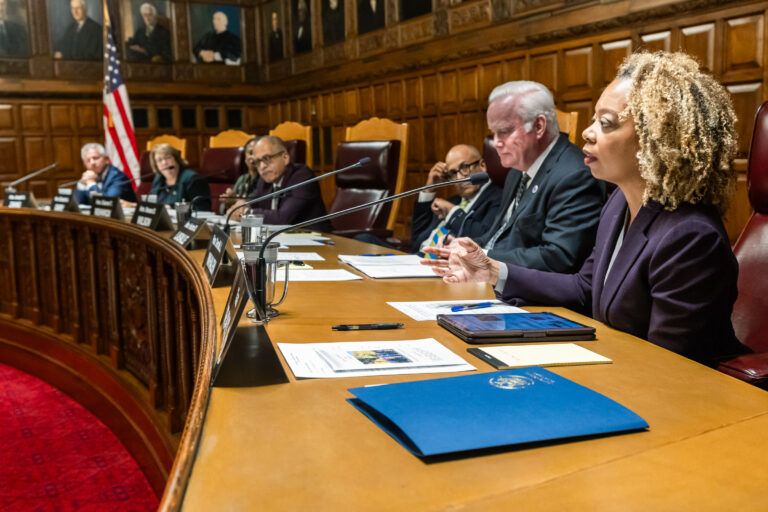 Taa Grays (far right), president of the New York State Bar Association, comments on testimony during the statewide public hearing to evaluate the continuing unmet civil legal service needs in New York. The event was held at the Court of Appeals in Albany on Thursday, September 24, 2026. Photograph by Lorenzo Ciniglio/OCA.
New York State Bar Association President Taa Grays joined Chief Judge Rowan Wilson, the presiding justices of the Appellate Divisions, and Chief Administrative Judge Joseph Zayas for the annual Civil Legal Services hearing in Albany on Thursday.
They heard testimony from more than a dozen civil legal service providers grappling with the challenges of ever-increasing caseloads, stretched budgets and limited staff.
In his opening remarks, the Chief Judge advocated for expanding the roles of legal advocates and non-lawyer assistance to meet civil legal services needs. He acknowledged that $180 million in funding for civil legal services is a significant increase from years past but still not enough to meet the statewide need.
“We are realists. We know that we are not going to get the $1 billion needed to provide legal representation to those at or below twice the federal poverty level anytime soon,” he said. “Not every dispute requires a lawyer to resolve it. For the time being, at least, the question is not whether nonlawyers could provide the same level of assistance as could a lawyer, but whether nonlawyers could provide meaningful assistance to the millions of civil litigants or potential civil litigants who have no assistance at all.”
The panel heard from more than a dozen organizations about the real-life challenges they are facing on issues ranging from a shortage of rural attorneys to contracting delays that affect non-profits.
Grays called attention to the issue of contracting delays during the testimony of Sal Curran, executive director of the Volunteer Lawyers Project of CNY. Curran detailed how there is no consistency in policy or practice among state agencies in how they pay non-profit grantors. Curran implored the panel to consider lobbying for reform of the contracting process.
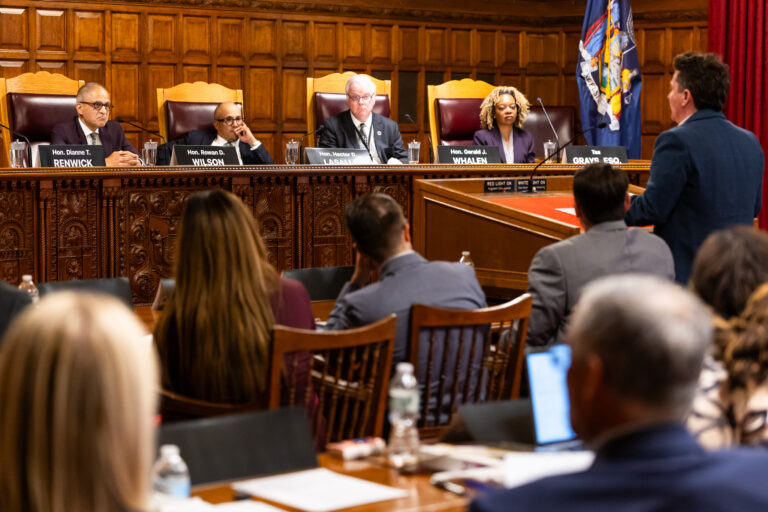 (L-R) Chief Judge Rowan D. Wilson; Presiding Justice Hector D. LaSalle, Second Department; Presiding Justice Gerald D. Whalen, Fourth Department; and Taa Grays, president of the New York State Bar Association, listen to testimony during the statewide public hearing. Photograph by Lorenzo Ciniglio/OCA.
“Different agencies have different practices and making payroll is increasingly difficult due to the funding flow of how cash is coming through,” he said.
The hearing also focused attention on the need for attorneys in rural New York as outlined in the New York State Bar Association’s 2020 Task Force on Rural Justice report. Judd Krasher, chief of staff to Presiding Justice Elizabeth Garry, outlined the success of the New York Pathways program, which places law school students in rural counties for eight-week summer internships.
Krasher said a recent survey of summer interns found that 74% said they are fairly or totally convinced to begin their legal career in rural New York because of the Pathways program. The success of the law student program encouraged the creation of a new program this year focused on relocating practicing attorneys.
“Our other pipeline initiative, Rural Ready, connects attorneys looking for work with job opportunities and a member of the local bar, an ambassador to help make key social and neighborly connections that make our upstate communities such good place to live and work,” he said.
The human side of civil legal services work was represented among the clients who testified before the panel sharing their painful experiences and positive outcomes. Tyra Robinson of Suffolk County shared her harrowing experience with a predatory landlord who evicted her family of five during the COVID pandemic after receiving payment from a rental relief fund. She explained the pain after learning the landlord had thrown out all the family’s belongings.
“In a single day my children not only lost their home, but every physical thing that told the story of their lives. We left dismayed and confused. We felt like we were erased,” she said, wiping her tears. “Because of Legal Services of Long Island, we had access to the law. They became our shield.”
Legal Services of Long Island Deputy Executive Director Rez Islam profiled Robinson’s case as an example of the many families who benefit from his organization, dispelling the stereotype that the island is only home to the wealthy. Robinson’s case was settled for triple the value of damages and paid in full by the landlord.
“This case does not end in silence or shame; it ends in accountability,” he said.
Following the hearing, Chief Judge Wilson will report his findings to the New York State Legislature and the Permanent Commission on Access to Justice. The full four-hour hearing was recorded and is available to view here .
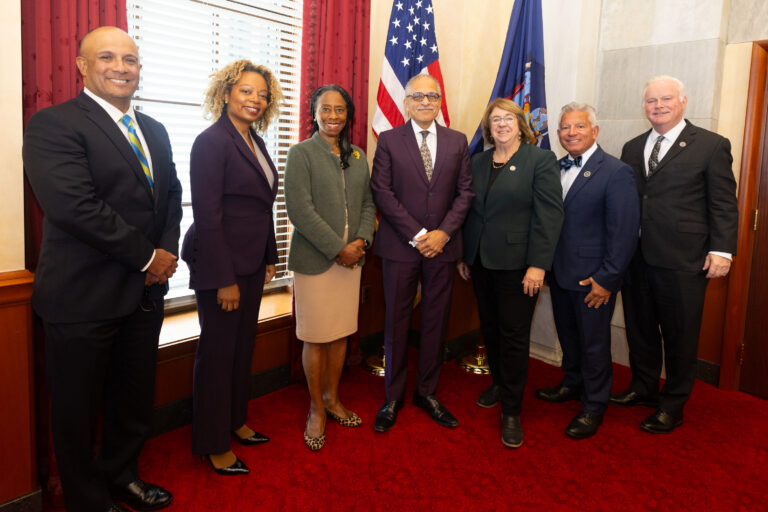 (L-R) Presiding Justice Hector D. LaSalle, Second Department; Taa Grays, president of the New York State Bar Association; Presiding Justice Dianne T. Renwick, First Department; Chief Judge Rowan D. Wilson; Presiding Justice Elizabeth A. Garry, Third Department; Chief Administrative Judge Joseph A. Zayas and Presiding Justice Gerald D. Whalen, Fourth Department. Photograph by Lorenzo Ciniglio/OCA.