
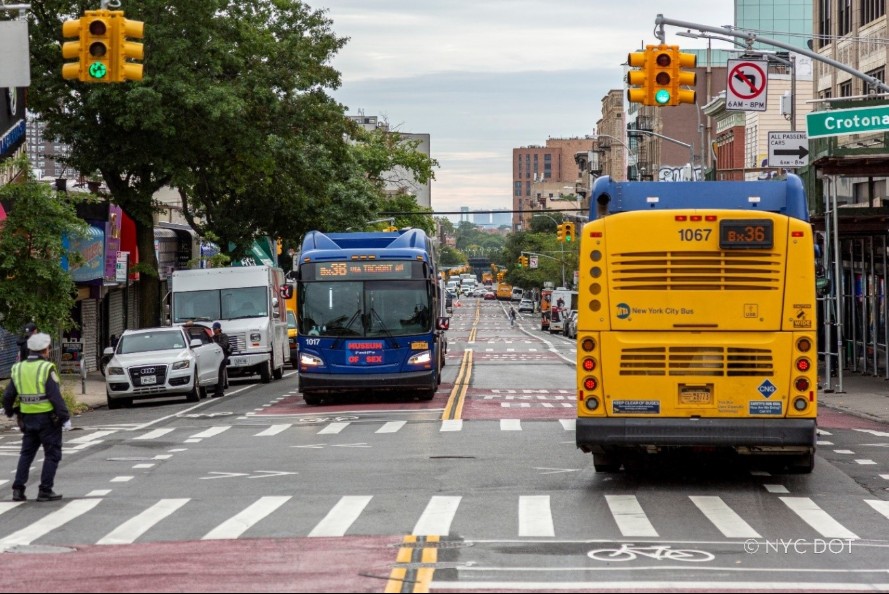
New York City has completed the Bronx’s first busway as part of a wider programme to improve bus speeds, reliability and street safety across the city.
The Tremont Avenue busway serves the Bx36 route, which carries around 39,000 passengers a day and has historically seen buses travel at less than 5mph during rush hours.
The corridor provides connections to eight subway routes, Metro-North Railroad and other local bus services. It also serves a particularly transit-dependent part of the Bronx, where 72 per cent of households do not own a private car.
New York City Department of Transportation (NYC DOT) said the project will also provide the foundation for future bus rapid transit along a broader Tremont Avenue corridor.
Prioritising buses on Tremont Avenue
The busway operates seven days a week between 6am and 8pm. Buses, larger trucks, emergency vehicles and Access-a-Ride vehicles can travel along the full corridor.
Construction began in August, with the project comprising one mile of new busway and a further 0.26 miles of bus lane. NYC DOT said the design is intended to reduce delays caused by general traffic while maintaining local access for pick-ups, drop-offs and deliveries.
The corridor is among those prioritised through Next Stop: Fast Buses, Better Service, a partnership between New York City, New York State and the Metropolitan Transportation Authority (MTA) targeting faster and more reliable services across 175 bus routes.
Mayor Zohran Mamdani said: “For 39,000 daily riders, that means less time stuck in traffic and more time getting where you need to go. This is what it looks like when we build a city that respects New Yorkers’ time and makes our streets safer for everyone.”
NYC DOT commissioner Mike Flynn said the authority would now look to build on the busway with further improvements to the wider corridor: “We look forward to building off the success of this busway to deliver true world-class, bus rapid transit upgrades in the future.”
NYC DOT plans to begin public engagement on potential upgrades including changes to streets and pavements, as well as station-style bus stops with improved shelters.
Improving street safety
As well as addressing bus journey times, the project includes safety interventions along a corridor designated as a Vision Zero priority.
Between 2020 and 2024, nearly 630 people were injured in crashes on Tremont Avenue, including 46 who suffered severe injuries, while four people were killed.
NYC DOT has introduced safety improvements at eight intersections along Tremont Avenue and surrounding streets.
These include painted pavement extensions designed to shorten pedestrian crossing distances and encourage vehicles to slow down when turning. The extensions are reinforced using flexible delineators, granite blocks and bicycle parking to discourage illegal parking.
The transport department previously said existing New York busways had increased bus speeds by up to 60 per cent and reduced pedestrian and cyclist injuries by as much as 45 per cent.
MTA chair and CEO Janno Lieber highlighted the speed at which the Tremont project itself was delivered, with construction beginning in August.
“The Tremont Avenue Busway has been completed just two months after it was announced, and it’s going to build on MTA’s local bus network redesign to improve speeds and reliability for almost 40,000 daily riders,” he said.