
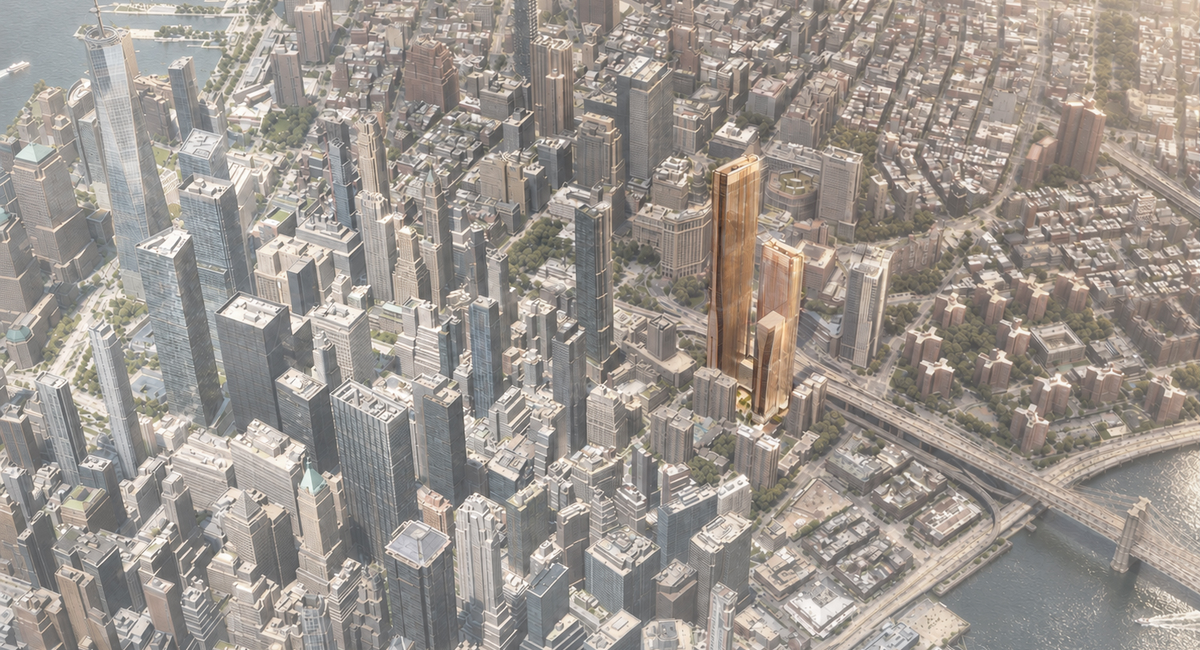
New Yorkers will soon get to weigh in on the mega-development planned for city-owned land at 100 Gold St. in the Financial District, where a virtual village is on the drawing board.
A public hearing kicking off a long review process has been scheduled for October on the 100 Gold Redevelopment Project, earmarked for property near the Brooklyn Bridge.
The Mamdani administration recently announced plans to squeeze an additional 300 residential units out of the project, upping the total to 4,000 new homes. A quarter of the units will be permanently affordable and rent-stabilized. A rendering released by City Hall shows three towers soaring above the iconic bridge.
The property is presently home to city agencies, including the Department of Housing Preservation and Development, which will relocate, and a center for older adults, which will be revamped. The development also includes a commercial fitness center and 40,000 feet of neighborhood amenities, including public-use open space, according to the city.
“New York’s housing crisis demands that we build more — and that we use every tool we have to do it,” Mayor Zohran Mamdani said in a statement. “That means looking at land the City already owns and asking how it can serve New Yorkers better.”
In this case, he added, that means turning an “aging government building” into thousands of homes.
Conceptual rendering of the proposed new publicly accessible open space at 100 Gold St. in Lower Manhattan.
Courtesy of CetraRuddy
The plans for 100 Gold St. have been churning slowly since it was first proposed in January 2025 by then-Mayor Eric Adams. In the initial announcement, Adams promised more than 1,000 mixed-income units, a quarter of which would be affordable. Adams increased the projection to 3,700 units later the same year.
Mamdani is now touting the project, which is four times its initial size, in his own housing plan, which includes building 200,000 new affordable units in the next decade.
The announcement comes after the city officially put an end to a long battle over the Elizabeth Street Garden, a green space in Lower Manhattan that, for years, was slated for development as a low-income senior housing project.
In exchange for the garden’s preservation, Councilmember Christopher Marte, who represents Lower Manhattan, agreed to support the Gold Street project as an alternative, according to a letter Marte sent City Hall last year.
GFP Real Estate won a competitive bid as the developer of choice for the project in December.
A spokesperson for the city’s Economic Development Council said that city-owned land will effectively be sold to the developer — the deal is structured to help fund the affordable housing and community benefits at no cost to the city.
The development will bring twice as many affordable units to Manhattan’s Community Board 1, which spans Lower Manhattan, than have been built in the last decade, according to the announcement from the mayor’s office.
“Amid a historic housing shortage, every site counts — even ours,” Housing Preservation and Development Commissioner Dina Levy said. “By repurposing HPD’s headquarters for mixed-income housing, we’re making our values concrete.”
Conceptual rendering of the proposed new older adult center, relocated above grade, at 100 Gold St. in Lower Manhattan.
Courtesy of CetraRuddy
The site is presently home to Hamilton-Madison House’s older adult center — one of the biggest and longest-standing such facilities in the city. But the building needs extensive repairs, according to the EDC. The existing structure faces demolition.
The new building will include a space that better meets the needs of older New Yorkers, according to the EDC’s announcement. During construction, the center will be moved to a nearby, temporary facility.
A new and improved facility at the same location “honors the past and prepares us to meet the evolving needs of older New Yorkers for decades to come,” said Isabel Ching, the Hamilton-Madison House executive director.
The city said 1,000 of the units would be permanently affordable and include Section 8 units. Actual proposed rents have not yet been disclosed
The affordable units are also eligible for Section 8 vouchers, according to the city’s housing department. The size of the units and the number of bedrooms in each has yet to be determined.
During the Adams administration, the project was criticized for not including more affordable units. A spokesperson for the EDC said that the addition of 300 homes in the development reflects the mayor’s commitment to building more affordable housing.