
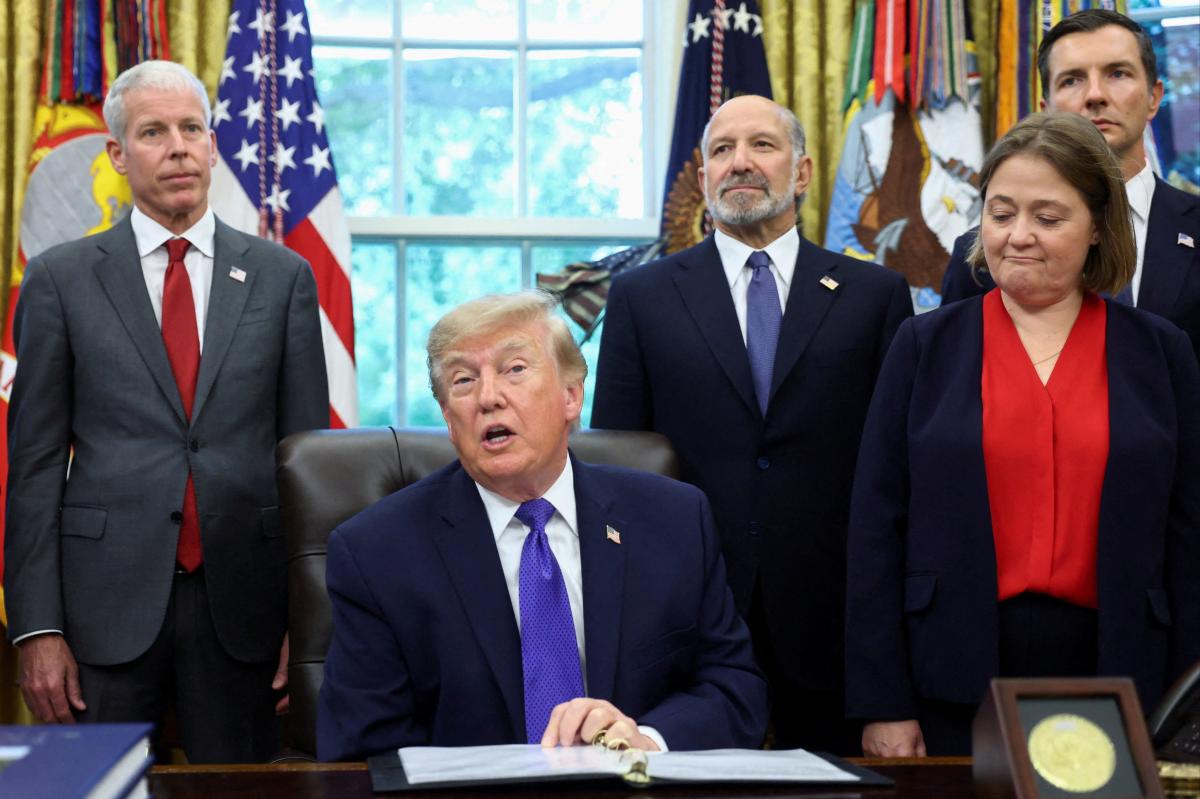
WASHINGTON — President Trump announced Monday afternoon that the largest steel plant in American history will be built in Iowa — and that he’ll be coming to the state soon to campaign for its embattled Republican congressional candidates.
The announcement is part of the administration’s focus on domestic manufacturing ahead of the Nov. 3 midterm elections and comes as the president’s 50% tariffs on steel have driven up construction prices. Trump argues the move was necessary to boost domestic steel production, calling it a national security issue.
“We’ve created nearly 60,000 new manufacturing jobs this year alone, many of them in the steel industry, and today we’re adding even more — the largest American steel plant of all time,” the president said in the Oval Office event.
President Trump revealed plans for the country’s largest steel plant to be built in Iowa during an Oval Office announcement with Energy Secretary Chris Wright, Secretary of Commerce Howard Lutnick and other officials on Sept. 28, 2026. REUTERS
Republicans are defending all four of Iowa’s House seats as well as the Senate seat being vacated by the retiring Joni Ernst. Trump won Iowa by more than 13 points just two years ago, but polls show Republican candidates are struggling.
All five races are competitive, while Democrat Rob Sand is favored to turn the Des Moines governor’s mansion blue for the first time in 20 years.
Vice President JD Vance has traveled to the state several times to get the administration’s message out in the heavily agricultural state where farmers are struggling with high prices on fertilizer and diesel fuel.
Republican Senate candidate Ashley Hinson, a congresswoman, was in the Oval for Monday’s announcement.
Trump told her he’d come to Iowa soon. “We’re going to do a great rally, and we’ll all be there together. We have to get you all elected.”
Rep. Ashley Hinson (R-Iowa) joined President Trump for the steel plant announcement on Monday. AP Photo/Alex Brandon
“We’ll save you a good Iowa pork chop,” Hinson said in response.
The steel plant, which will be built by Minnesota-based Mesabi Metallics, will create 1,750 new permanent jobs in Iowa in addition to 5,000 to 6,000 construction jobs, a White House official said, with construction expected to start this month and production scheduled to begin in 2030.
Start your day with all you need to know
Morning Report delivers the latest news, videos, photos and more.
Thanks for signing up!
“This is a transformational opportunity, not only for our country but for Iowa and really for American families,” said Iowa Gov. Kim Reynolds (R).
“It reduces our dependence on our foreign supply chain and strengthens our national security. And most importantly, as the governor for Iowa, these are tremendous, tremendous, high-paying jobs with incredible benefits, increased salaries, and opportunities for local businesses and community development.”
Iowa Gov. Kim Reynolds told the commander-in-chief the steel plant will be a “transformational opportunity” for the Hawkeye State. REUTERS
Mesabi recently invested $2.5 billion in an iron ore mine in its home state, the first new excavation in the US in five decades.
The new steel plant will be in eastern Iowa, with local residents telling the Des Moines Register that a commercial real estate agent has approached them over the last few weeks about selling their land.
Commerce Secretary Howard Lutnick credited the tariffs for the boost in the American steel industry.
Mesabi Metallics Chairman Rewant Ruia speaks as Essar Capital Director Prashant Ruia (right) and Mesabi Metallics CEO Joe Broking listen during the Oval Office announcement event. AP Photo/Alex Brandon
“These are the steel tariffs at work,” he said. “Without those tariffs, this mine doesn’t get built, and this steel plant does not get built.”
Trump agreed.
“Everyone’s building their plants here because they don’t want to pay tariffs,” the president said.
The Wall Street Journal first reported the announcement.
The initial annual production capacity of the steel plant is estimated to be 7.5 million tons and could rise as high as 10 million per year.
The first phase of the project is expected to generate $95 billion in total economic impact over construction and the first 10 years of operation, the White House predicted.