Gov. Mikie Sherrill (D) vetoed two bills today that sough to aid Jersey City’s fiscal woes: One that would’ve allowed the city to utilize their Arts and Culture Trust Fund for their municipal budget next year, and the other to create a parking tax.
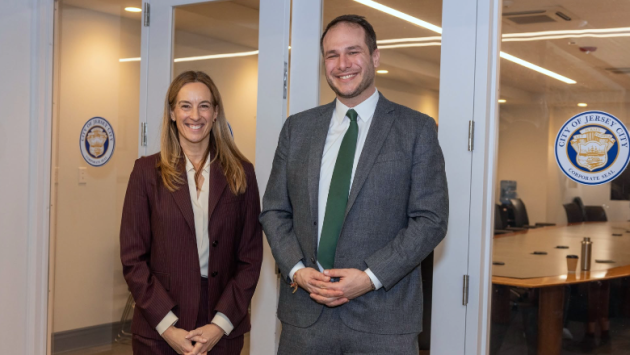 Facebook photo.
By John Heinis/Hudson County View
“According to the Department of Community Affairs, Jersey City is the only municipality that has both an annual levy for open space, recreation, and historic preservation and an arts and culture trust fund,” Sherrill said in a veto statement released this afternoon.
“In 2016, Jersey City voters approved a referendum to establish a Municipal Open Space, Recreation and Historic Preservation Trust Fund to be funded at a rate not to exceed $0.02 per $100 of assessed valuation of each annual tax levy. The referendum’s language stated that the funds raised from the levy would be used exclusively for the acquisition, development, and maintenance of lands for recreation, conservation, and historic purposes.”
While the City Council approved establishing an Arts and Culture Trust Fund in 2016, voters did not approve the referendum until November 2020.
Bill S-4513, sponsored by state Senators Angela McKnight (D-31) and Raj Mukherji (D-32), with the companion bill in the Assembly sponsored by Jerry Walker, Will Sampson, and Gabriel Rodriguez, was approved easily in both chambers on June 30th of this year.
That was the same time the state legislature approved a $120 million relief package for Jersey City: $105 million loan that requires increased state oversight and a $15 million grant.
The state legislation cleared the Senate by a tally of 25-14, with one senator not voting, and then the Assembly by a 49-21 vote, with 10 assembly members not voting.
“This bill authorizes that certain moneys reserved for a municipality’s ‘Municipal Open Space, Recreation, Floodplain Protection, and Farmland and Historic Preservation Trust Fund,’ may be deposited into the municipality’s current fund, for uses as determined necessary by the municipality,” the bill statement says.
“The authority established by the bill is to only apply if the municipality has established an arts and culture trust fund.”
Further, this legislation would have been limited to the tax level for fiscal year 2027.
According to the governor’s veto statement, this bill would go completely against the referendum Jersey City voters approved.
“The plain language of the ballot question that was submitted to Jersey City’s voters clearly dedicated to recreation, conservation, and historic purposes the revenues that this bill
now seeks to divert to the City’s general fund,” Sherrill wrote.
“The voters assented to an additional tax levy on the condition that the funds raised from the levy be used exclusively for the purposes set forth in the referendum. The will of the City’s voters should not be set aside in the manner proposed in the bill.”
Another bill seeking to aid Jersey City’s municipal woes, S-4514 – sponsored by McKnight, Mukherji, Sampson, and Walker – sought to “impose a mass transit access parking tax of three and one-half percent on fees for the parking, garaging, or storing of motor vehicles at public parking garages, lots, or facilities only.”
This legislation, which would’ve also implemented a five percent rental car tax, would’ve only applied to New Jersey municipalities with a population of 200,000 or greater, which would’ve only made Newark and Jersey City eligible.
Sherrill vetoed that as well, taking a swipe a former Mayor Steven Fulop, a political rival from last year’s Democratic primary for governor.
“The residents of Jersey City are currently suffering from a fiscal crisis caused largely by the irresponsible decisions made by the City’s prior administration. The prior administration’s over-reliance on short-term budget gimmicks and ‘one-shots’ have seriously undermined the City’s long-term stability,” she wrote in that veto statement.
“Going forward, sustainable revenue growth and structural reforms must be a priority. The proposed legislation is not appropriate at this time.”
Jersey City spokeswoman Megan Malloy said while City Hall is “disappointed,” they will continue to work with state lawmakers to find financial relief for their residents.
“We’re disappointed that these bills were vetoed since they would have provided relief for Jersey City at a time when we need every penny. We’re grateful to our state delegation for fighting to get these bills through both houses and for standing up for Jersey City every step of the way,” she said late Monday afternoon.
“We will continue working with the Governor and state legislature at the state level, and our office is committed to using every tool possible to make sure Jersey City is on the right fiscal pathway while providing relief for our citizens.”
Editor’s note: This story was updated with Jersey City spokeswoman Megan Malloy.