
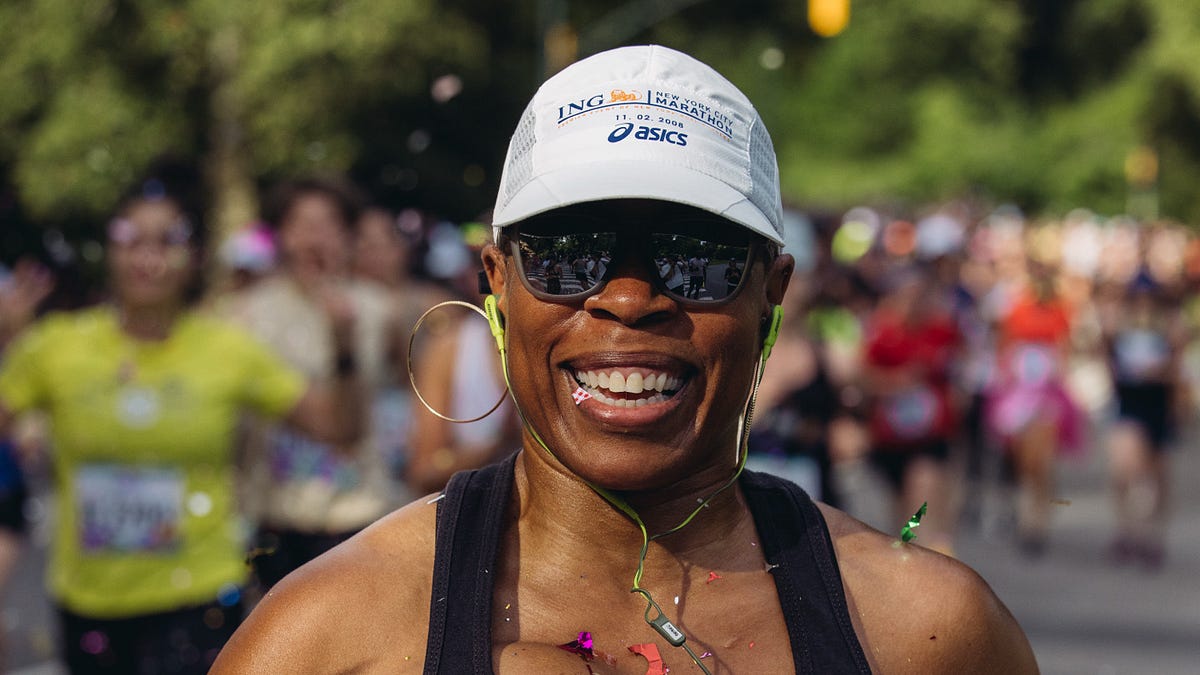
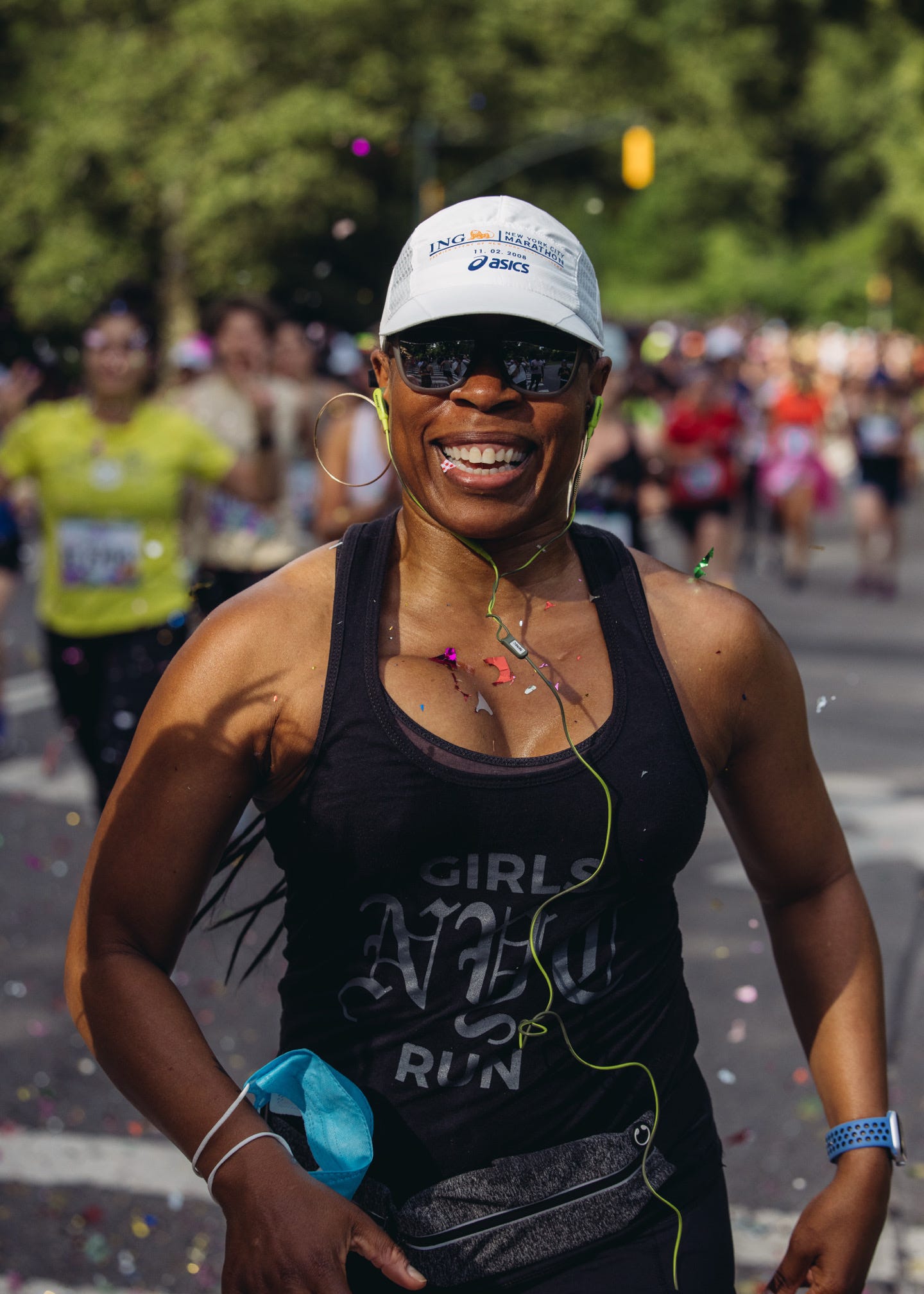
Rasheda Herndon had no specific goals when she first started showing up to BridgeRunners.
She says she doesn’t even remember why exactly she kept going every Wednesday night. But she did, and over time got to know the others that did as well—especially the other women in what was a ‘heavily male-dominated’ space. One of those women was Jessie Zapo, who eventually started Girls Run NYC and asked Rasheda to serve as one of the co-captains. The latter jumped on the opportunity and it’s been all about consistency ever since, with the group still going strong over a decade later.
Through the years Rasheda has dipped her toes in a variety of marathons and ultras, though her goals—or rather, lack thereof—have remained the same since the beginning. She says she rarely races for time and gets more enjoyment now from pacing others, including Jessie for the Javelina 100-Mile this October.
We spoke with Rasheda to discuss the early years of BridgeRunners, how Jessie ‘saved [her] life’ at the New York City Marathon, allyship within the running space and more.
This interview has been edited for length and clarity.
Can you start off with an intro of where you’re from, what brought you to New York City and your origins of how you got into running?
I’m born and raised in Washington, D.C. …. My mother’s family lived in New York, so I spent my summers in New York. But as an adult, I moved to New York 30 years ago for school. I left D.C., went to Connecticut, and then from Connecticut I came to New York, and I’ve been here ever since.
As far as my running journey, I don’t have one of those spectacular stories. I ran in junior high school…. I’ve always had a love-hate relationship with running, because I love to run, but I never felt good running. And as it turns out, I had asthma and a heart murmur, and so I stopped running for a little bit. Ran in high school, but not a lot, because again I didn’t like the effects of running. I didn’t like what I felt like afterward. And back then—I mean I come from the inner city, we really didn’t pay too much attention to health. So when I was diagnosed with asthma and a heart murmur, it was, ‘So, stop running.’ That was the remedy for all of that. And so I did. I stopped running, took up other sports—volleyball, softball, whatever.
Went to college, landed in New York, and just started getting active again, started running. There was a time in my life where I lived close to Central Park, and so I started running again, and it was awful. I literally felt ill every time. But then when you become an adult and you get the insurance, the big-people insurance, I started going to the doctor regularly. And I was on a treatment plan for the asthma, and running became much more feasible and doable for me.
I was just running, and I would be in Central Park when they would be running races and not sure what was going on, this is late ’90s. By early 2000s, I was introduced to New York Road Runners. And back then, a 5k was considered a marathon for me. That was my marathon. Did a couple of those, and from those you just meet people. It’s almost like a snowball effect, where you meet one person, and you show up to go run with them, and then other people are there as well, and you meet them, and they tell you about another group. So that’s how I really got into running.
I was running New York Road Runners races, and every year I would get this email about the marathon, but I never really had a desire to run a marathon. Running was never that serious for me. But I decided to sign up for the marathon one year, and I decided to take running a little bit serious and I signed up for an official marathon training group. And within that group, I became friends with a lady who introduced me to BridgeRunners. It was in the early stages of BridgeRunners, but it was a very unconventional group that would meet every Wednesday 7pm, down in the Lower East Side. Every Wednesday the group would grow, and you would meet somebody new. You weren’t there to meet friends, but it just happened. All of these strangers meeting up to run, you just kind of meet people, and it snowballed from there honestly.
In your experience, what about [BridgeRunners] made it so attractive that it drew people from all over the city, all the different boroughs, to that one space in that time period, and eventually inspired a lot of those people to start their own things?
I’m not sure if we even considered it attractive back then. I can honestly tell you, I’m not sure why I showed up every Wednesday. I do think it was the fellowship, coupled with the unpretentiousness of this group. I call them Raggedy Anns. It was literally people that—they didn’t have matching outfits on, the sneakers didn’t match the shirt. It was people who were showing up in just regular gear, ready to run and talk shit. There was no real organization to it. I don’t even think there was a real route. But we all had the same goal, to just run. There were fast people, but it wasn’t like, ‘Yeah, I’m going to go to BridgeRunners because they’re fast.’ I think for me personally, I was invisible, and I liked that. You came as you are.
“There was no real organization to it. I don’t even think there was a real route. But we all had the same goal, to just run”
I remember one time I came, I had my bag, I was coming from work, and I didn’t realize I didn’t have my running clothes in my bag. And we were in [Mike] Saes’s apartment, and I was like, ‘Oh fuck, can’t find my shorts or my shirt.’ And Saes went to a drawer and was just tossing stuff. He held up a pair of shorts, he was like, ‘Here, try that…. Keep it. That’s what we’re here for.’ You had no reason not to run.
And you met cool people. Every Wednesday I met somebody new—again, not intentionally…. But you would find yourself running with the same people every Wednesday, because you were all on the same pace or same level. You didn’t know their name, but if for some reason you got over that bridge before they did, you were waiting for them, because you knew, ‘Oh yeah, the girl with the red hair, she’s normally behind me. Let me wait for her.’ It was an unspoken family, so to speak. So yeah, I definitely came back every Wednesday.
Were there other clubs or groups that you knew of or were involved with at the time?
I did belong to an official marathon training group. It was a much smaller one, and you paid for it, and it was very regimented—set days, set workouts—and it was serious. I met nice people there too, but there was no social aspect to it. You showed up, this is what you were supposed to do, and that’s what you did.
Then there was the Nike Run Club, which was a much bigger run club that ran out of 57th Street, when the Nike store was on 57th between Fifth and Madison, and it was hundreds of people running out of there. You had pacers, you had run groups, there was a set mileage and all of that…. And you would definitely see the same people throughout each run club.
Did you have goals you were striving toward on the running front, or was it just going to these groups and meeting people?
No, didn’t have goals. And again, the goal wasn’t to meet people. I didn’t need any friends. I didn’t need friends at all. There were no goals. Nike was training you for a marathon, and that was cool, and it was a club where you didn’t really have to pay…. Bridge—it was just fun. It wasn’t like, ‘I’m going to see my friends,’ or whatever. It was fun. We would meet up some Saturdays or just other days to run, and then go drink. Summertime, it was, ‘Hey, we’re running to the Rockaways, meet here at 7am.’ And that was fun…. It wasn’t like, ‘Oh yeah, I’m training for the marathon, I need to get these miles in.’ Very few people in the running community, and especially BridgeRunners, were training for a marathon back then. We were just running because we could….
“Very few people in the running community, and especially BridgeRunners, were training for a marathon back then. We were just running because we could”
But to answer your original question, there wasn’t a goal. There wasn’t a mileage goal. I think my ultimate goal for Bridge, when I was running back in those days, was to not be the last person tonight, and not to get lost. They would tell you before you leave, ‘Get your MetroCard,’ because it would be an out, and we’d go so far out, ‘We’re not running back, let’s get on the subway’…. But as far as training goals, there really wasn’t a goal. That pressure and that culture wasn’t there back then. We ran races back then, but there was no competitive goal. We went to have fun.
Can you talk through the origins of meeting Jessie Zapo and how you got involved with Girls Run NYC?
Yes, Jessie, she’s had me tell this story a number of times. I refer to Jessie as my Buddha, and I tell people I will follow her to the end of the earth. Jessie saved my life during a marathon, and we both cannot figure out what year it was, somewhere between 2007 and 2009.
But that year, I had not met her. And I had a great training year—food-wise, mileage, all of that—for the New York City Marathon, and that morning everything went great. Heard the gun, everything was good. By Mile 11, there was a rumble in the jungle, and I was like, ‘What in the world?’ And it got so bad, I dipped off just before the Pulaski Bridge. It was in Greenpoint, I dipped off…. I jumped back on the course and I felt better, and I kept running.
Now, along the way, this lady was in front of me with this platinum blonde hair, and it was very long, and it would sweep her butt. And I would see her, but then I would get in front, and the next two miles I had to dip off again. And by Mile 18, I thought I was going to die. I had dipped off like six times. I had nothing left. It was just my stomach cramping. I started throwing up, but nothing was coming out, it was just the movement of it. At a certain point, I started crawling. I had nothing left in me. But every time I got back on the course, I would start running, and I would run up on the lady with the sweeping hair, and I would know, ‘Okay, I’m still in the race. I’m still alive, and I’m still in this thing.’
I finished the marathon, and when I crossed, I literally just fell to my knees…I heard someone say, ‘Get a medic.’ But then somebody put their hand on my shoulder and was like, ‘I’m so glad you made it.’ And I looked up, and that was it. I passed out. I was in medical, I was so dehydrated.
Fast forward maybe three weeks, I started running again. Showed up at Bridge, on the sidewalk, tying my shoe, and somebody put their hand on my shoulder and said, ‘How are you feeling? So good to see you.’ And I looked up and I was like, ‘That’s my angel, oh my god.’ And it was kismet after that…. You let her tell the story—this lady with this shirt kept jumping in and out of the race, and the shirt said ‘Sheda (the e is long).’ And that’s what she kept reading the whole race. She was like, ‘As long as I saw ‘Sheda,’ and in parentheses, ‘the e is long,’ I just knew I was still in there.’
And I told her, ‘I am forever in your debt. I will do whatever you want me to do for the rest of my life.’ And she makes me pay for it, which is how I started running ultras.
How did you get involved with Girls Run NYC?
So within Bridge, there were the same females running every Wednesday, and we kind of just clicked together…. And in the running community, there really wasn’t a space for women. Bridge was heavily male-dominated, very competitive, very testosterone-laden. We were tough, we held our own. But there was never a set space for women, and Zapo wanted to create that.
We started having Sunday runs. She would invite just women, and it was word of mouth…. Shortly after that, Jessie developed Girls Run NYC and asked me to co-lead, and I jumped at the chance. Of course, I owe her my life, so why not? But I really enjoyed the idea of it, because at that time I didn’t realize how we were seen as leaders in the community. There were no women to really show us what to do. It was hook or crook. We literally were building that plane in the air. So to have the chance to be what I wish I had back then, I was like, ‘Definitely, I would love to create this space for women to thrive. I’m all for it.’
On women-only running spaces and the importance of allyship:
I don’t think much has changed within the space, other than the increased volume of women-only running spaces, which is great to see. But the same thing happens in the coed running spaces, or all-male running spaces, where I don’t think guys really understand what it’s like to be a female running in the streets…. I would definitely encourage males to be more of an ally to female runners. Step up and lead, and step up and speak for female runners.
A lot of people don’t think it’s their business or their space. But I don’t think they understand, or even conceptualize, that when they want to get up at 6am to go for a run, the only thing that they’re thinking about is, ‘Where am I going to put my keys, and how far am I going today?’ But when a woman wants to get up and go for a run, she has to drop her location with someone. She has to carry her mace. She has to carry her stun gun. She has to make sure that what she’s wearing is not enticing someone. We have a plethora of other things to worry about just to go for a simple run.…
I’ve been running in the street, and cab drivers will reach out and touch me. And it’s like, what gives you the right? But there are guys standing there and won’t say anything. When we’re running in coed spaces, guys, construction workers will catcall, and male runners with us won’t say anything…. When I ran for Adidas—I was a pacer for Adidas—we used to do a lot of allyship programs, which I thought was great, and it gave guys another view of what we went through when we ran. A lot of dudes didn’t realize, ‘Oh wow, yeah, it’s up to me to say something.’
And it was within the space too. Guys can be very competitive. They can be very mindless in their world, and they’ll say certain things to a female runner. And it’s like, ‘Okay, you wouldn’t say that to a guy, but you’re going to say that to me?’ And it’s up to an ally, another male, to say, ‘Hey, buddy, that wasn’t cool that you said that.’ So that’s what I encourage. I encourage just more allyship amongst male runners. But I am happy to see the increase in all-women running spaces. It’s very nice to see.
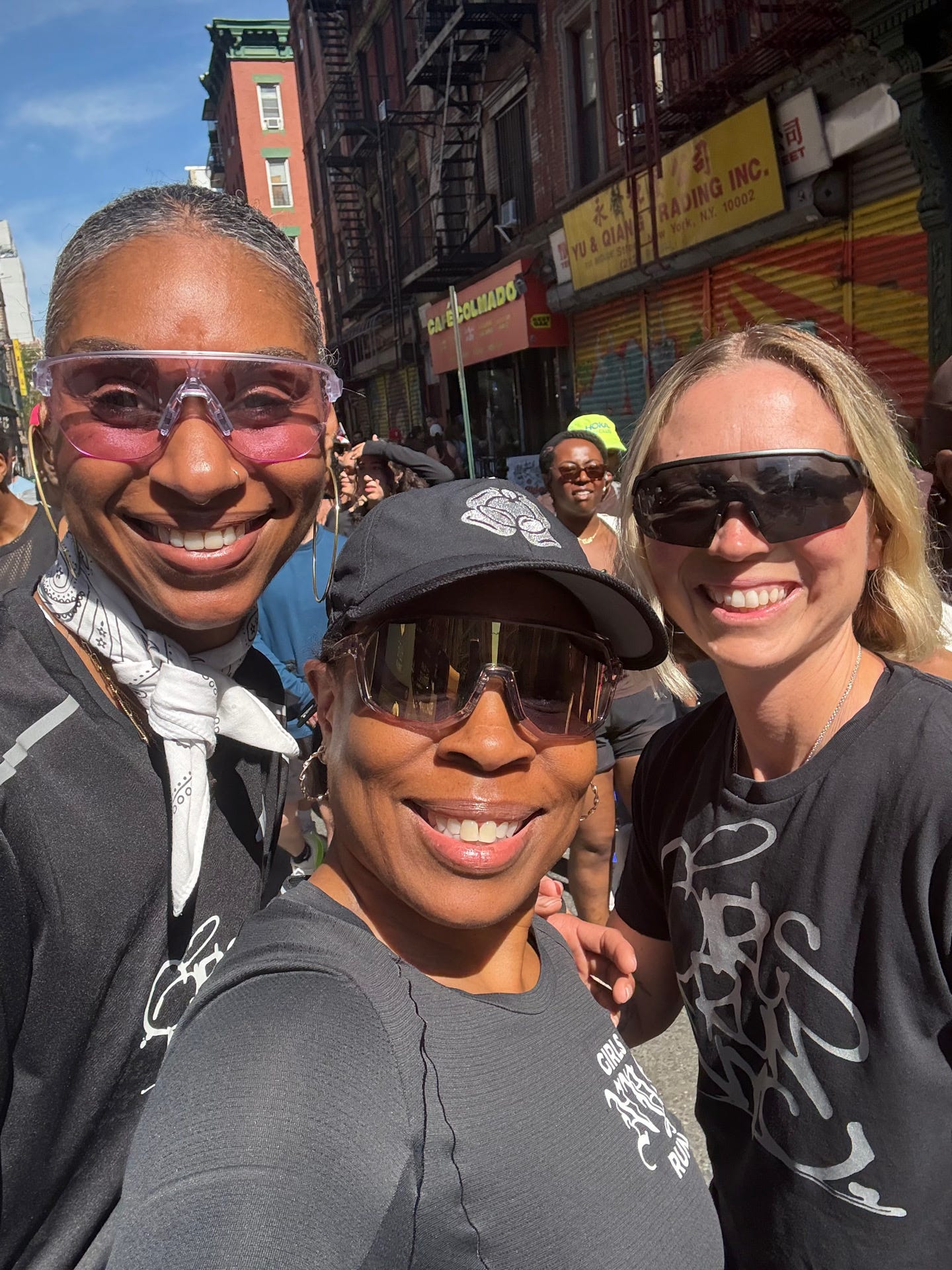 Rasheda (middle) with fellow Girls Run NYC captains Ameerah Omar (left) and Jessie Zapo (right)
Your transition to ultras—you said it was Jessie who initially got you doing that as well.
Jessie gets me into all types of trouble…. It started out one day, her and Ameerah were talking—I think the three of us were going out to dinner or something, but they got there first. And when I approached, Ameerah said, ‘Oh, ask SheShe.’ I said, ‘Ask me what?’ And Jessie said, ‘What are you doing next weekend?’ I said, ‘Whatever you want me to do.’ And she said, ‘Oh good, I’m running Philly. You’re going to run it with me’…. And that started off what we call the Suffer Fest, because every year for maybe four years, it was freezing rain or snow that marathon day, and I would curse her so much. We definitely reevaluated the nature of our relationship during the Philadelphia Marathon….
And then she was doing ultras, and I’m not sure what it was that made me say something to the effect of, ‘If you do that, I’ll do it next year.’ She was training for Black Canyon, which is in February. She completed it, which meant I had to do Black Canyon as well…. That race handed me my ass on a platter, it was horrible. And I vowed to never run Black Canyon again, and I haven’t. Now, I have paced at least four times, which is totally different from running Black Canyon.
On her individual racing goals and pacing others:
Rarely do I run for time…. I prefer to pace ultras, not run them myself. Some people call me the professional pacer. I just get more enjoyment and excitement out of pacing someone else and helping them fulfill their goal. It also takes the pressure off of me. It doesn’t take much for me to keep you encouraged and on target to complete this race. But if it was me having to run this race, that’s a whole different story.
“I just get more enjoyment and excitement out of pacing someone else and helping them fulfill their goal”
I’m pacing Jessie for the Javelina 100 in October…. I’ve paced her for Black Canyon twice. So yeah, it’s what I do. I think there have only been maybe four other ultras I’ve actually signed up for. We just did the Flagstaff 40-miler in May, we did it for her birthday. You know what we did for my birthday? We went to Paris for my birthday. The other person we were running with, it was her birthday as well, and everybody was like, ‘Oh my gosh, happy birthday, I can’t believe you’re running an ultra with them for their birthday. That is so cool.’ And I was like, ‘You want to know what we did for my birthday? We went to Paris for my birthday.’ I went to Paris for my birthday.
Any topics that I didn’t specifically ask about that you’d like to touch on, or any closing thoughts?
No real closing thoughts. Girls Run NYC is a passion of mine. I love it. I love the leadership. I love how we have evolved. We have been consistent for 14 years, and that says something in this community. And I don’t think Jessie, Ameerah or myself give ourselves enough credit for that.