
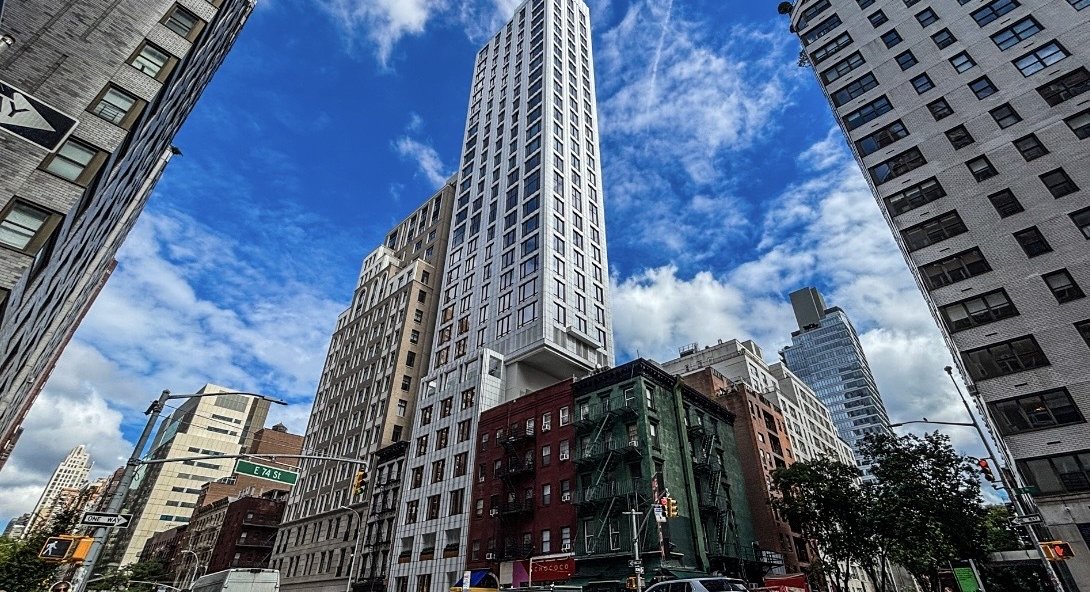
A new pair of luxury condo towers at Third Avenue and 75th Street are indicative of the kind of housing development that’s taken place on the Upper East Side over the last decade and a half — notable for a city in dire need of affordable housing.
Spacious units in one of the buildings start at $8.5 million. An available penthouse in the other is listed at just under $17.9 million.
Despite their soaring heights, the two new towers contain just 77 condos – roughly the same number of units as the much smaller buildings that were demolished to make way for the towers, according to an analysis of property records.
It’s typical for the neighborhood, one of the country’s wealthiest enclaves. An analysis of New York City Department of City Planning data reveals that property owners have demolished or combined 2,687 existing units and added 4,598, resulting in a net gain of just over 1,900 units over the past 15 years.
And even fewer of them are affordable. Less than 300 were priced for low- and middle-income tenants, according to an analysis by NYU’s Furman Center, a housing policy and research institute.
”My district is one of the densest council districts in the city of New York, and it’s something that has made it difficult to build more affordable housing,” Council Speaker Julie Menin, who represents the neighborhood, said in an interview.
But a new measure could soon pave the way for a different kind of construction boom on the Upper East Side – one that housing policy experts and city officials say will not only spur the creation of more apartments in the area, it will also lead to more affordable options. And the prospective changes are triggering outcry from community leaders who will undoubtedly lose influence over future planning decisions in the process, and who may have little power to stop developments they consider out of character with the surrounding blocks.
Last year, voters approved a ballot measure proposed under former Mayor Eric Adams that speeds up the review process for new housing developments and cuts the City Council out of rezoning decisions in 12 community districts that have produced the fewest new affordable units over the past five years.
The Upper East Side will likely be among the “Bottom 12” when the Department of City Planning releases its final list as soon as Oct. 1, according to independent analyses by the Furman Center and other groups.
“There’s no question they’ve been building something on the Upper East Side,” said Furman Center Executive Director Brad Greenburg. “It’s just not what the voters said they wanted, which is more affordable housing.”
The Department of City Planning declined to confirm whether the Upper East Side made the list ahead of its October announcement.
The new rules could cut costs for developers who will no longer have to sit on vacant or underutilized land for months, if not years, while waiting for building approvals from local lawmakers. The changes could make it cheaper and easier for developers to go bigger, and existing city law will require them to price a quarter of all new apartments for low- and middle-income tenants.
Mayor Zohran Mamdani could also use the fast-track process to pursue neighborhood-level rezonings that affect dozens of blocks and allow for larger buildings with affordable housing requirements. The city is pursuing a similar effort south of Prospect Park in Brooklyn.
City housing officials have already stuck a large housing target on the neighborhood.
The Department of Housing Preservation’s new “Fair Housing Framework” calls for more than 12,700 new units over the next five years in Manhattan Community District 8, which covers the Upper East Side and nearby Roosevelt Island. It’s the highest total in the city.
But a backlash is already brewing among local leaders, including members of the community board representing the Upper East Side and nearby Roosevelt Island. They worry developers will demolish more townhomes and walkups to erect colossal apartment buildings, potentially on streets that have so far been spared from new development, with little the community can do about it.
Missing plans
The Upper East Side is one of a handful of densely populated neighborhoods likely to appear in the Bottom 12 based on affordable housing construction rates, according to the Furman Center review. The Upper West Side and Midtown Manhattan will also likely make the cut.
The remaining nine districts are concentrated in suburban-style areas, such as southern Brooklyn, Staten Island, and eastern Queens.
In some sections of the city, including Bay Ridge and the North Shore of Staten Island, councilmembers have begun issuing their own plans to shape what gets built and where before their powers are curtailed.
But Menin has not unveiled a similar grand vision for her district.
She instead pointed to a plan that Manhattan Community Board 8 submitted to the Department of City Planning last year.
Board members proposed changing the zoning rules on some low-rise residential blocks and on various industrial sites concentrated east of Second Avenue. The list includes a block that is currently home to a hulking self-storage warehouse on East 90th Street between First and York avenues, and a residential stretch of East 73rd St. with two single-story garages between York Ave. and the East River.
Urban planner George Janes, who advises local Community Board 8 and has analyzed the number of units lost through demolition, said that without a plan like the community board’s, the neighborhood may face “ad hoc” applications, or one-off projects scattered around the Upper East Side.
At a land-use committee meeting last week, board members touted their plan and expressed disdain for large new projects that have eliminated existing homes and transformed the neighborhood.
“It’s stupid to build with one hand and tear it down with the other,” the board’s Zoning, Development, and Housing Committee Co-Chair Elizabeth Ashby said during the session. “One of the things that is lost in these proposals is protecting the scale and character and livability of neighborhoods.”
Elizabeth Rose, a co-chair of the board’s task force on residential rezoning, countered that outright rejecting new housing proposals would be a mistake that could lead to the dreaded Not In My Backyard or “NIMBY” label.
“It’s difficult to argue that the character and scale of our neighborhood should be protected as it is, but we want the character and scale in other neighborhoods to increase to be more like ours,” she said. “Other districts could simply respond, ‘Then you’re not respecting the character and scale of our neighborhoods.’”
Rose said the board should use its remaining advisory powers to “embrace additional opportunities for development,” such as those in its proposal.
The Department of City Planning has not acted on the board’s plan. City Planning spokesperson Joe Marvilli said only that the agency appreciates when community boards send them ideas and wants to learn more.
“We look forward to working with communities across the city as we implement these voter-approved reforms and keep working to create a fairer, more affordable city for New Yorkers of all incomes,” Marvilli said in a recent statement
‘Always rebuilding and reinventing’
What happens after the faster land-use review process hits the Upper East Side remains to be determined.
In an interview, former City Planning Chair Dan Garodnick said change won’t occur “overnight.”
“Someone needs to propose to develop something for anything to happen in that expedited procedure,” Garodnick said. “It’s a well-developed area; there’s not a lot of vacant land around.”
Community Board 8 Chair Valerie Mason said she said she doesn’t expect much to change. She said developers can already construct apartments – they have just decided not to.
“Developers are not jumping all over each other to develop affordable housing here,” Mason said. “They are jumping all over themselves to build luxury housing.”
Proponents of the new fast-track measure say that’s true – but only because condos are more profitable for developers under current rules that restrict size but lead to faster returns after developers sell pricey units.
A neighborhood rezoning, in contrast, could subject all new development to the affordable housing requirements.
Ben Carlos Thypin, a commercial real estate broker at the firm Quantierra who represents developers, said he has clients eager to build apartment complexes with “four times” as many units as they currently could in the neighborhood.
“Right now, the incredible housing demand on the Upper East Side is translating almost exclusively to luxury condo development,” said Thypin, who helped found the pro-housing group Open New York. “If the Upper East Side lands in the ‘Bottom 12,’ that demand could be channeled into high-density, mixed-income rental housing development.”
A huge swath of the Upper East Side, between Third and Fifth avenues and East 59th and 78th streets is landmarked, making new development all but impossible on those blocks. The neighborhood has few vacant lots or open spaces prime for new buildings.
But Nate Bliss, a former executive director for economic development under Mayor Eric Adams, said there are still plenty of opportunities to build new housing in the neighborhood.
“ New York City is always rebuilding and reinventing itself, and even in dense neighborhoods, there are often properties that are not delivering to their full potential,” said Bliss, who now runs the real estate consultancy Latent Urban Ventures. “That two-story retail structure could be a 20-story residential building or that row of townhomes could be an apartment building.”