
During Hispanic Heritage Month, I feel compelled to share my story—one shaped by resilience, identity, and the belief that our beginnings need not define our limits.
I grew up in Villalba, a quiet mountain town in Puerto Rico, where slow days and storied hills shaped the rhythm of life. In the late 70s, my parents gathered up our few belongings, along with dreams too large to fit into any suitcase, and we boarded a plane to New York City.
Our new home became the East Village, a gritty, loud, artistic, and stubbornly alive neighborhood. For my parents, it represented opportunity. For me, still a child, it was a place I had to learn how to traverse before it swallowed me whole.
School on the nearby Lower East Side introduced me not just to English and arithmetic, but to an American ritual I never understood: the quick sorting of children into categories. “Smart” or “not smart,” “gifted” or “remedial,” “college-bound” or “struggling.” These labels clung to students in ways that had little to do with intelligence and everything to do with race, class, or the thickness of an accent.
My accent, still warm with the cadence of Puerto Rico, became a target. The mocking stung. It reminded me daily that I was an outsider, someone who didn’t quite belong.
But at home, belonging was never measured by pronunciation. My parents — people of few words and endless resilience — showed me what discipline, sacrifice, and hope look like in practice. Their example, along with the guidance of teachers who saw potential beneath the surface, shaped the habits that would carry me forward. Discipline did not come naturally; I built it deliberately, piece by piece, until it became the foundation beneath me.
That foundation carried me beyond what others expected of me. It brought me from Seward Park High School to LaGuardia Community College, then to Lehman College, and eventually to New York University School of Law.
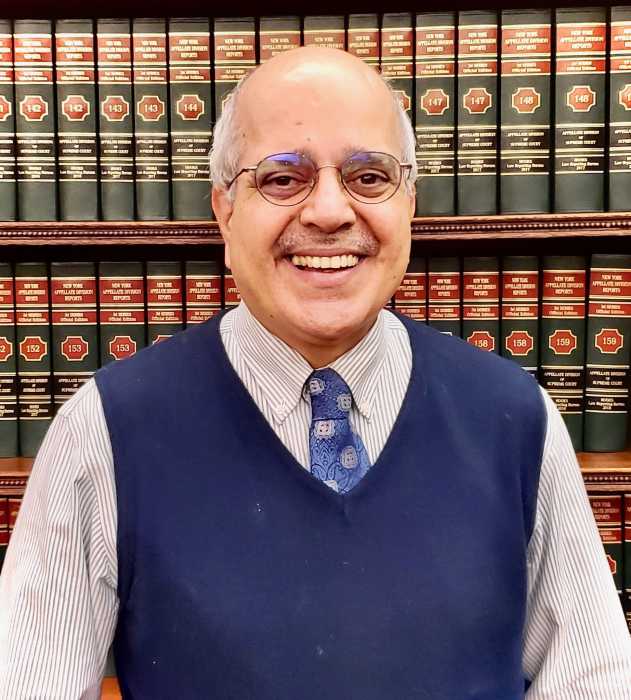 William Ramos is a court attorney for the Appellate Division, First Department.
When I arrived at NYU, I didn’t come as someone told he was destined for greatness. I arrived as someone who refused to let anyone else’s assumptions chart the boundaries of his dreams. I graduated with good grades and passed the Bar Exam on the first try. These achievements felt less like victories over other people’s doubts and more like affirmations that my parents’ sacrifices had not been made in vain.
Law school also gave me one of the greatest gifts of my life: my wife, Sylvia Avila. We met as fellow students, two aspiring lawyers confronting the same demanding environment. Thirty-seven years later, she remains my partner in every sense — my closest confidante, my source of strength, and the love of my life. Meeting Sylvia grounded me in a way law school alone never could.
With my degree in hand, I was eager to put my training to use in a place where the values that guided me — fairness, service, and empathy — truly mattered.
My professional journey began at the Legal Aid Society’s Criminal Appeals Bureau, where I represented indigent defendants who appealed their convictions and needed not just legal advocates, but human ones. I argued before the First and Second Departments, and even before the New York Court of Appeals. Each brief, each oral argument, and each client reminded me why I had pursued law in the first place: to make justice more than an abstract concept reserved for the fortunate.
Eventually, I found my long-term home within the court system itself. Twenty-seven years as a court attorney and more than fifteen as Principal Law Clerk — to an Appellate Division, First Department Justice — have taught me the quiet, steadfast impact of public service. Along the way, I published articles in the New York Law Journal, the New York State Bar Journal, and the Albany Law Review—achievements that would have seemed impossible to the boy who arrived in New York City unsure of his place.
Through it all, one label has endured—a nickname given to me by former Appellate Division, First Department Presiding Justice Rolando Acosta: “Jíbaro.” What once might have been used to diminish became, for me, a badge of pride.
It speaks of the distance I’ve traveled from Villalba to Manhattan, to the resilience I drew upon when confronted with doubt, and to the identity I’ve grown to embrace fully. Being a “Jíbaro” is not something I have ever outgrown; it is the root from which every accomplishment has grown.
I am still that kid from Villalba—the child who learned that labels should never define a future, that discipline can transform doubt into opportunity, and that the most meaningful successes are carved from the very identity others once tried to use against you. My story is an immigrant story, a Puerto Rican story, an American story, and above all, a testament to the belief that we each have the right to write our own.
And as my recently born granddaughter begins her own journey, I hope she carries the same truth I learned on my journey to New York: that no matter where you begin, you have the power to shape where you’re going.
William Ramos is a court attorney for the Appellate Division, First Department.