
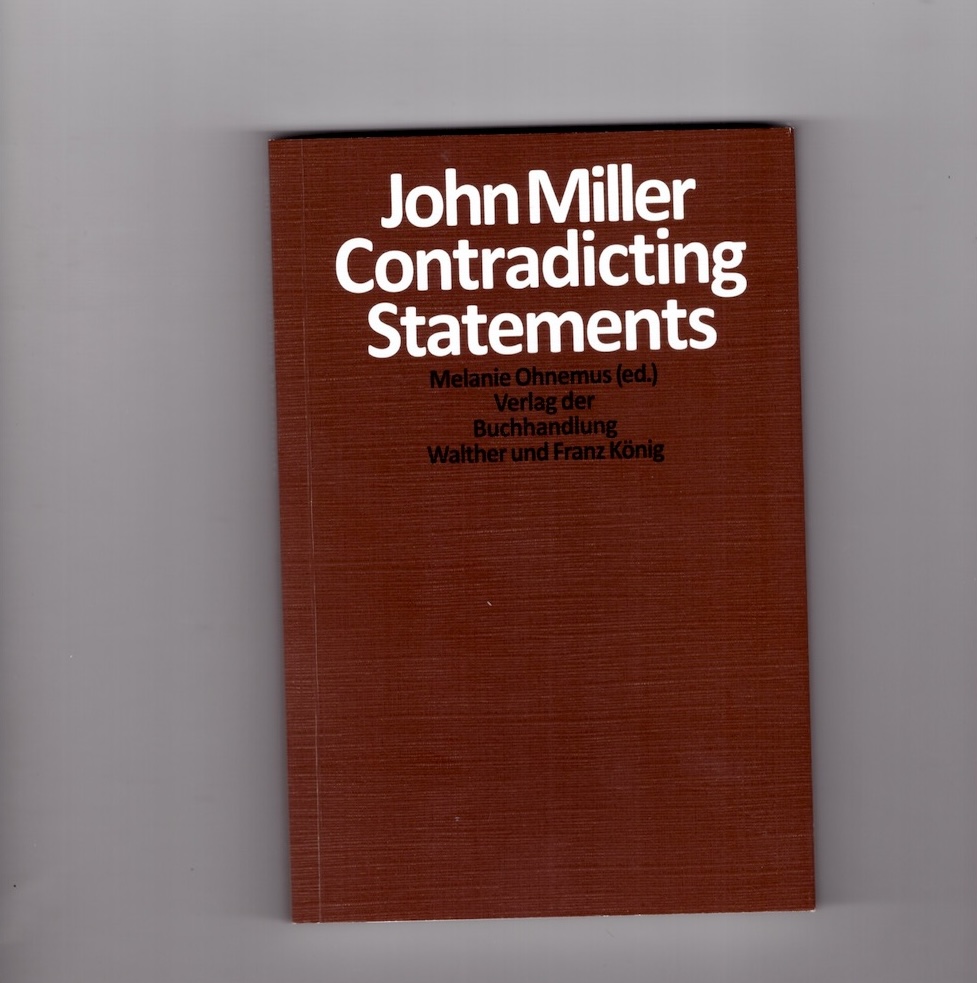
John Miller: Contradicting Statements
Edited by Melanie Ohnemus
Kunsthaus Glarus and Verlag der Buchhandlung Walther König, 2026
In the video Contradicting Statements (1977), John Miller records six of his undergraduate classmates at Rhode Island School of Design speaking one at a time directly to the camera. The video begins with a prompt to the participants in the artist’s game: “In this piece, each person will contradict the person who came before him.” A classmate takes over the frame: “That’s not the real description.” As the back-and-forth dialogue continues, another student chimes in: “She’s no authority on it. She doesn’t know what a description is.” Through subsequent polemic and humorous declarations, the authority of the artist and film’s participants comes into question as they analyze their relationship to one another.
The softcover publication of the same name, edited by curator and writer Melanie Ohnemus, sequences grainy black-and-white film stills in a flipbook format, offering the illusion of a moving image by thumbing its pages. John Miller: Contradicting Statements focuses on a selection of frames from the film, appearing at the top of each page, while faithfully transcribing each line of dialogue below. The book lays out the stills, capturing the students both frozen mid-speech and in blurry motion, entering and exiting the frame with ghostly movements.
The front and back covers of the book unfold to reveal two essays: “Making Contradicting Statements” by Miller and “Contradiction” by Ohnemus. Miller’s career, which spans decades of criticism and artistic production and mediums from painting and sculpture to photography and video, is not the focus of these pages. Miller recalls transferring from RISD to CalArts for a year and beginning to experiment with film; afterwards, back at RISD, he produced Contradicting Statements (9 minutes, 15 seconds). In returning to a video made almost fifty years prior, the publication examines the prescience and resonance of the work today.
In the video, the camera remains fixed as performers stand in front of two lockers. Miller reveals in the introduction that he pointed his lens into a mirror, offering the non-actors immediate self-perception to adjust and re-center themselves in the frame. The frozen moments in this publication’s stills highlight participants looking off camera presumably at each other for recognition, or making faces in the mirror, balancing coyness and animation. This highlight reel of the students play acting condenses the film’s awkward pauses.